
How to Teach Beginning Sounds: Turn Your Table Into a Sound Shop
Put a sock, a spoon, and a mug on the table.
Tell your child, “Welcome to my shop. Today, you can only buy something that starts with /s/.”
Then reach for the mug. Wait.
Your child might laugh, stop your hand, or announce that you’ve picked the wrong thing. Ask them to help you check:
“Mug. I hear /m/ at the beginning. You’re right—this doesn’t belong in my /s/ shop. What should I choose?”
That small exchange gives you a place to begin. Your child has something to do, a reason to listen, and permission to correct the adult. If they don’t notice the mistake yet, you can teach the sound together. No scorekeeping needed.
This guide shows you how to teach beginning sounds using a few household objects, short conversations, and a gradual move into letters and worksheets. It’s written for parents and teachers working with Grade 1 children who need practice hearing the first sound in a word.
First, know what you’re listening for
A beginning sound is the first speech sound in a word. Sock starts with /s/. Mug starts with /m/. Fish starts with /f/.
When you see /s/ in this guide, say the sound you hear at the beginning of sun. Don’t say the letter name “ess.” A child who answers “ess” knows something useful about the letter, but you still need to find out whether they can hear /s/ in a spoken word.
“The letter’s name is ess. The sound we’re listening for is /s/. Listen: sssock.”
Hearing and identifying individual speech sounds is part of phonemic awareness. Matching those sounds to written letters adds phonics. Modeling a sound, practicing together, and giving the child an independent turn follows established phoneme-isolation teaching routines from the Florida Center for Reading Research.
Set up your sound shop
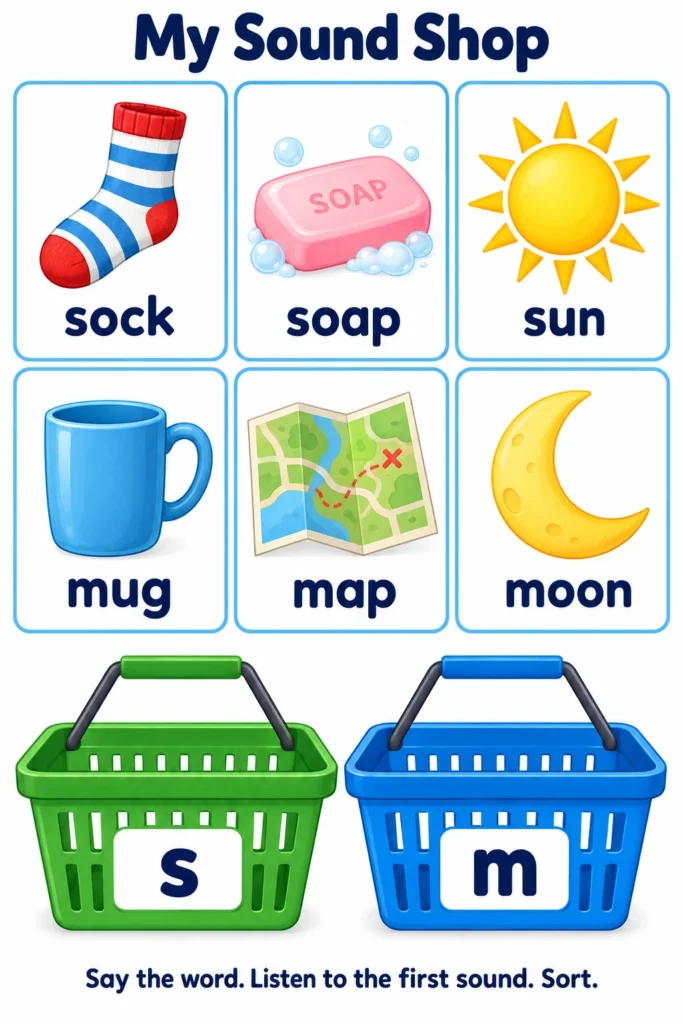
You need six objects or clear pictures: sock, soap, sun, mug, map, and moon. Use real objects where convenient and drawings for the others. Make two paper signs: lowercase s and m.
Open the six picture cards and baskets for printing, or play the interactive game below. Name each picture together before sorting.
Your turn: fill the sound baskets
Say the picture name. Tap a picture, then tap its beginning-sound basket. On a computer, you can also drag the picture into a basket. Start with sss as in sun and mmm as in moon—not the letter names.
Hear word uses your device’s English voice and requests US English; the voice may vary. No microphone or sign-in is needed. For the recorded US English word list, use the player below. Keyboard: Tab to a picture, press Enter, then choose a basket with Enter.
You can also play without the interactive panel: open the printable sheet linked above, point to each picture, and choose the s or m basket together.
These are example sounds for the lesson. If your child’s school is teaching a different set, use familiar words beginning with those sounds instead.
Before opening the shop, name every item together. You might call an object a mug, while your child calls it a cup. They would then be listening for different beginning sounds—and neither of you would be wrong about the object.
“You call it a cup. That works. For this game, let’s call it a mug.”
Keep the table uncluttered. Introduce two items first and bring out the rest as the child becomes comfortable.
Listen to the six picture names
Play the US English word audio together. Each picture name is followed by a three-second pause for your child to repeat it. The recording uses a synthesized US English voice and models whole words; use the spoken teaching prompts below to model isolated sounds.
Read the word-listening transcript
Welcome to the sound shop. Listen to each word. Then say it during the quiet pause. Sock. [3-second pause] Soap. [3-second pause] Sun. [3-second pause] Mug. [3-second pause] Map. [3-second pause] Moon. [3-second pause] Play this again whenever you want to practice.
Round one: Help me hear it
Hold up the sock.
“This is a sock. Say sock with me.”
Say it naturally once, then emphasize the beginning briefly: “Sssock. I hear /s/ first.” Invite the child to repeat the sound. Then put the sock beside the s sign: “This letter represents /s/ in sock.”
Now show the soap.
“Soap. Listen to the beginning: sssoap. Does it start like sock?”
If the child is unsure, say both words again. Supply the answer while pointing out what to notice: “Yes. Sock and soap both start with /s/.” The first few turns are teaching turns. Give your child enough examples to understand what “first sound” means before expecting them to answer alone.
A small pronunciation detail makes a difference
Some sounds, including /s/, /m/, and /f/, can be held briefly. That makes them convenient for showing where a word begins. Other sounds, such as /p/, /t/, and /b/, need a short release. Avoid turning /b/ into “buh” or /t/ into “tuh.” That adds a vowel the child is not supposed to hear.
For /m/, close your lips gently and hum. For /f/, touch your upper teeth lightly to your lower lip and let air pass. Let your child watch your mouth, then return to the word. You don’t need to stretch every word. A clear model followed by natural speech is enough.
Round two: Fill my shopping basket
Put the sock and mug in front of your child.
“I’d like something that starts with /s/. What can I buy?”
Let them choose. Then ask them to say the object’s name. If they choose the sock: “Sock—/s/. That matches my sound.”
If they choose the mug, avoid immediately asking the same question again. Show them what to listen for: “Let’s check. Mug starts with /m/. Listen to this one: sssock. Sock starts with /s/. Put the sock in my basket.”
Later, try another pair: soap and map. Changing the objects shows you whether the child is listening for the sound or remembering which object earned a “yes.” Move the matching object to a different position, too. A child who always chooses the item on the left may need the choices rearranged before you can understand their response.
Round three: Catch the shopkeeper’s mistake
Once your child has had some successful turns, become a slightly unreliable shopkeeper. Pick up the moon picture and say:
“One moon for my /s/ basket!”
Pause and let your child investigate. “Did I get that right? Say moon and listen to the beginning.” If they catch it, ask where the moon should go. If they don’t, think aloud: “Mmmmoon. That starts with /m/. I put it in the wrong place.”
Use occasional mistakes between correct examples. Your child should be able to trust the sound models you give during instruction.
Now invite them to rearrange your shop. Put the map with the sock and the soap with the mug. Can they move each item and explain their choice? “The map goes here because it starts with /m/” tells you more than a silent correct placement.
Round four: Your child runs the shop
Switch roles. Ask your child, “What sound can I shop for today?” They can say a practiced sound or point to its letter sign. You make a purchase, and they check it.
Being the shopkeeper changes the task. The child now has to hold the target sound in mind, listen to your word, and decide whether it belongs. If choosing a sound independently is too difficult, offer two options: “Will this be the /s/ shop or the /m/ shop?”
For a small classroom group, one child can make a purchase while another checks it. Rotate roles so each learner gets a chance to respond; a confident speaker should not have to answer for everyone.
Make the next round fit the child
You don’t need a harder game just because one round went well. Watch how much support the child still needs.
| What you notice | What to try next |
|---|---|
| They struggle to name the objects. | Teach the picture names and use fewer items. |
| They choose correctly but cannot say the first sound. | Model the sound again and invite them to repeat it. |
| They hear the sound but choose the wrong letter. | Keep the listening game and practice the sound-letter match directly. |
| They sort the familiar cards easily. | Introduce one new word with a practiced sound. |
| They identify sounds independently across new words. | Move into a short worksheet or the next step in their phonics program. |
A child who can sort two groups does not necessarily need five groups immediately. Make the task more revealing simply by changing sock to sun.
Take the game away from the table
Later, try a short listening question without showing any objects: “Which word starts like moon: mouse or fish?” Say each word clearly and give your child time to think.
The answer is mouse. If they choose fish, compare the beginnings together: /m/ in moon, /m/ in mouse, and /f/ in fish. This is a useful change because the child works with spoken words without reaching for a familiar card.
Try the listen-and-answer game
This recording leaves five seconds after each question. Pause it for longer whenever your child needs more thinking time.
Read the listening-game transcript and answers
Listen for the first sound. Answer during the pause.
Which word begins like sun? Sock, or mug? [5-second pause] Sock. Sun and sock begin with the same sound.
Which word begins like moon? Soap, or map? [5-second pause] Map. Moon and map begin with the same sound.
Do mug and moon begin with the same sound? [5-second pause] Yes. Mug and moon begin with the same sound.
Now ask a grown-up to give you a new word.
You can also try a sound hunt while putting things away: “We found a sock that starts with /s/. Can you see anything else that starts that way?” Accept a reasonable word even if it is not the one you expected. Ask the child to say it so you can listen together.
If finding a word from scratch is too demanding, give a choice. “Soap or towel?” is easier than “Name something beginning with /s/.”
When an answer sounds wrong, check the reason
A worksheet mark cannot always tell you why a child struggled. A short conversation often can.
“It’s a bunny.” If your worksheet expects /r/ for rabbit, the child’s /b/ answer makes sense for their chosen name. Agree on the picture name before checking the sound.
“Em!” The child supplied the letter name. Say, “Yes, that’s m. Now tell me its sound in moon: /m/.” Keep both pieces of knowledge, but clarify which one you asked for.
“Mug!” They repeated the whole word. Model the smaller part: “The word is mug. The first sound is /m/.” Then practice together.
They point correctly but cannot pronounce the sound clearly. Let pointing count as evidence that they can identify it. Recognizing a sound and producing it clearly are different demands.
They begin guessing after several good answers. Reduce the choices or end the activity. Try another brief session later before deciding that the child has forgotten the skill.
Bring out the worksheet at the right moment
After the game, a worksheet gives the child a new place to use what they have practiced. Start with one row. Name its pictures together, read the directions, and let the child try the first item.
- If writing is getting in the way, use matching or circling.
- If the sound-letter connections are familiar, try missing beginning letters.
- If separate formats are going well, try a mixed page.
The Beginning Sounds Mixed Practice Worksheet for Grade 1 on BloomKidsLearn combines several task types. It is useful after children have practiced those types separately.
Ask about a new word after the worksheet: “You found the first sound in these pictures. What sound starts mouse?” That extra question helps you see whether the learning travels beyond the page.
Finish with three fresh words
Choose familiar words your child has not used in that session. If you have already used sun, mouse, and sand, choose different examples such as sit, mat, and seed.
Ask for each first sound, then offer the s and m cards for the child to match. Keep the check brief. Record the help needed, if any:
“Heard /s/ in sit independently. Needed a model for mat. Matched /m/ to m after hearing the sound.”
Next time, you know where to begin. Try another small check on a different day. One successful session is encouraging, but repeated use with new examples gives a clearer picture.
Questions parents ask about beginning sounds
Do we need to work through the alphabet from A to Z?
Follow the sequence used at school when possible. For extra practice, choose a few sounds the child is learning and use familiar words. Alphabetical order is not necessary for this game.
What if my child already knows beginning sounds?
Use a few fresh words to check. If they can identify the first sounds and connect them to letters independently, continue with their phonics program rather than repeating the same task. That may include blending, segmenting, and attending to sounds elsewhere in a word.
BloomKidsLearn’s Short Vowel Worksheets for Grade 1 provide practice with the middle vowel sounds when those fit the child’s current learning. Our short vowels guide with examples explains those sounds for parents and teachers.
Is sh one beginning sound or two?
In ship, sh represents one sound, /sh/. Two written letters can work together to represent a single sound. Introduce these spellings in line with the child’s phonics instruction.
How long should we practice?
The shop can be a short activity: a few modeled examples, several shopping turns, and one new word. There is no need to complete every round at once. Stop while your child can still participate comfortably.
Leave the s and m signs beside the basket when you finish. Tomorrow, add one unfamiliar item to the shop and ask your child where it belongs.