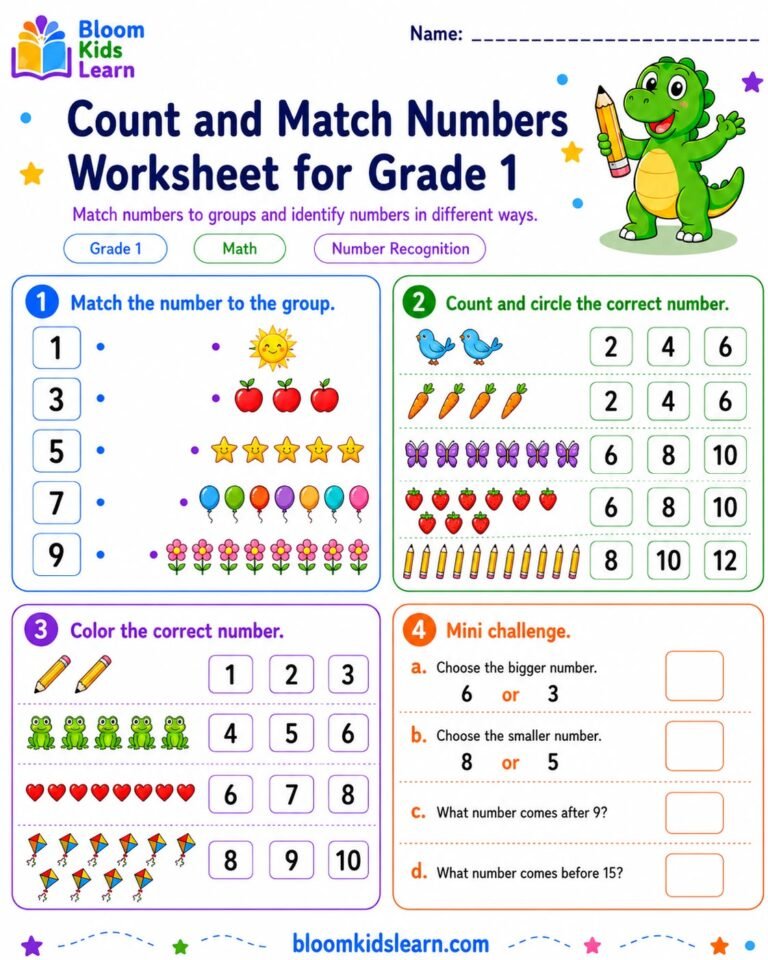
Before, After, and Between Numbers Worksheet for Grade 1
Free Grade 1 before, after, and between numbers worksheet for counting pictures, matching number words, and completing number sequences.
- Skill: Use before, after, and between language with numbers 1 to 20
- Learning goal: Complete number sequences and connect quantities, numerals, and number words.
- Format: Printable PDF worksheet
 Download Worksheet PDF
Before, after, and between numbers worksheet for Grade 1 helps learners organize numbers in order while they practice quantity recognition. This free printable begins with picture counting, moves to matching number words, and then asks children to complete missing middle numbers and answer quick review questions. The mixed format keeps practice purposeful: students read a numeral, connect it to a quantity, and use the counting sequence to explain what comes next.
Skills and learning objective
Children work on one-to-one counting, numeral identification, number-word matching, and the positional language before, after, and between. By the end of the page, a learner should be able to count a group, choose its numeral, match number words from one through ten, supply a missing neighbor, and identify the largest or smallest number in a short set. These are useful foundations for later addition, subtraction, and place-value work.
How to introduce the page
Start with a short oral sequence. Say aloud 5, 6, 7 and ask which number is between 5 and 7. Then place three counters in a row and have the child count them from left to right. Explain that before means the number immediately earlier in the counting order, while after means the next number. Read the worksheet directions aloud and let the student point to each picture while counting. Encourage a pause after every answer so the child can check the written symbol.
Worked examples
If a row shows five apples, the correct choice is 5 because the final number said tells how many objects are present. When matching words, connect “three” with the numeral 3, not with the third position on the page. For a sequence such as 10, blank, 12, the missing number is 11. For “What comes after 13?” say 12, 13, 14 and record 14. If asked for the largest number in 4, 9, 2, and 7, compare them on a number line and choose 9.
Common errors and helpful prompts
- Counting pictures twice or skipping a picture.
- Matching a word by its length instead of its meaning.
- Writing the number before when the direction asks for after.
- Choosing a familiar number without checking the sequence.
Use a finger tracker or move a counter to each object. Ask, “What number did you say last?” for a counting error. For a before-and-after mix-up, have the child walk one step backward or forward on a floor number line. Keep the prompt brief and let the learner make the correction.
Differentiation and extension
For support, cover the lower review section and complete the picture and word tasks first. Provide numeral cards from 1 to 20 and let the child build each three-number sequence before writing. For extension, ask a confident learner to create a new between problem, then explain why only one number fits. They can also compare two groups and tell how many more objects one group has without using a formal subtraction sign.
Answer guidance
Check picture counts one row at a time and confirm that every matching line connects the intended word and numeral. In the missing-number section, read the complete sequence aloud after the child writes. For the quick review, ask the learner to justify the largest or smallest choice using greater than or less than. If the answer is incorrect, return to a concrete group or number line rather than simply supplying the correction.
Use this printable in a lesson
The worksheet works for a ten-minute intervention, a math-center rotation, homeschool practice, or a quiet homework review. Print on US Letter paper and offer a pencil, colored pencil, or a dry-erase marker in a sleeve. A second copy can be used as an exit ticket after a short lesson on number order.
Related practice and FAQs
Visit the Number Recognition topic hub for more numeral activities. Children who need extra sequence practice can use the Counting by 1s worksheets, while Number Words Basic Practice reinforces word-to-symbol connections.
What grade is this for?
It is designed for Grade 1 and can also support advanced kindergarten learners or older students who need a gentle review.
Should children answer orally?
Yes. Saying the sequence before writing helps connect mathematical language to the symbol.
Can it be reused?
Place the page in a sheet protector and use a washable marker for repeated practice.
This worksheet reinforces Grade 1 number-order and counting-sequence skills connected with CCSS.Math.Content.1.NBT.A.1.

 Preview