Counting by 1s Missing Numbers Worksheet for Grade 1
Free Grade 1 missing-number practice for counting by 1 to 120. A clear printable PDF for independent work, math centers, or homework.
- Skill: Finding missing numbers while counting by 1
- Learning goal: Identify and write missing numbers in sequences within 120.
- Format: Printable PDF worksheet
 Download Worksheet PDF
This free Counting by 1s Missing Numbers worksheet helps first graders use number order to determine which value belongs in a blank. Instead of copying a complete sequence, children must look at the numbers before and after each space, apply the one-more rule, and check that the finished row makes sense. The printable extends through 120 and includes several starting points.
What students learn
A missing-number problem asks for more reasoning than a simple counting chant. Children need to locate the known numbers, decide whether the sequence moves forward, and identify the value that connects both sides. This practice strengthens counting fluency, mental addition of one, attention to order, and confidence with larger two- and three-digit numbers.
- Find a missing value in a consecutive sequence
- Count forward by 1 from an unfamiliar number
- Identify the number immediately before or after another
- Check a completed pattern for skipped or repeated numbers
What is on the worksheet?
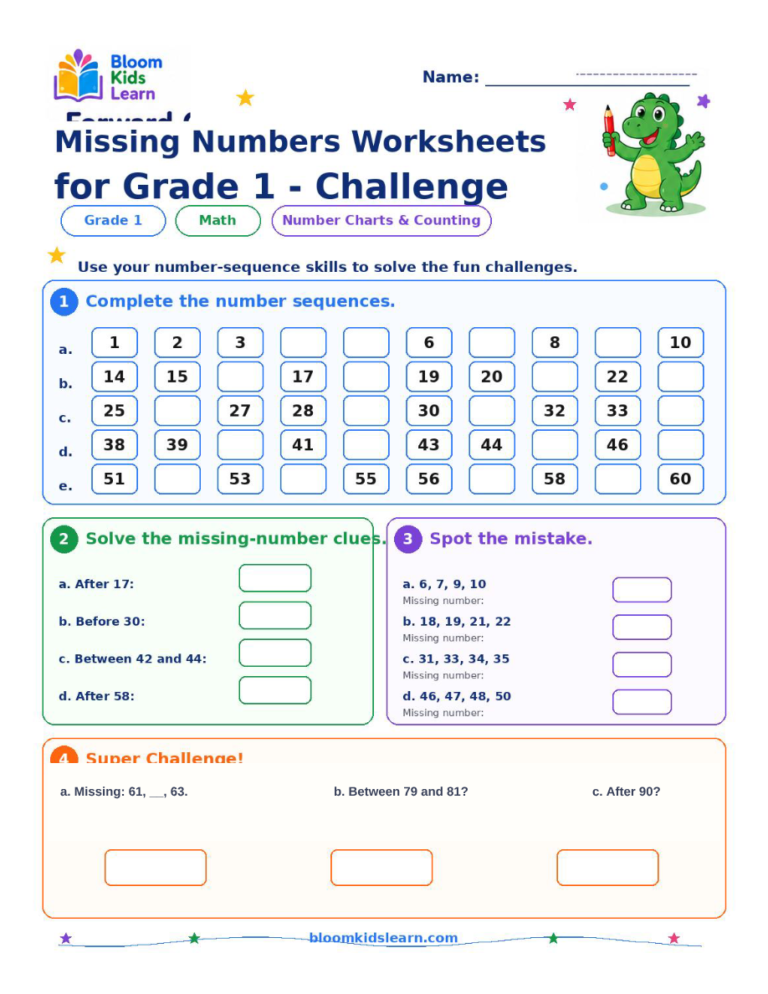
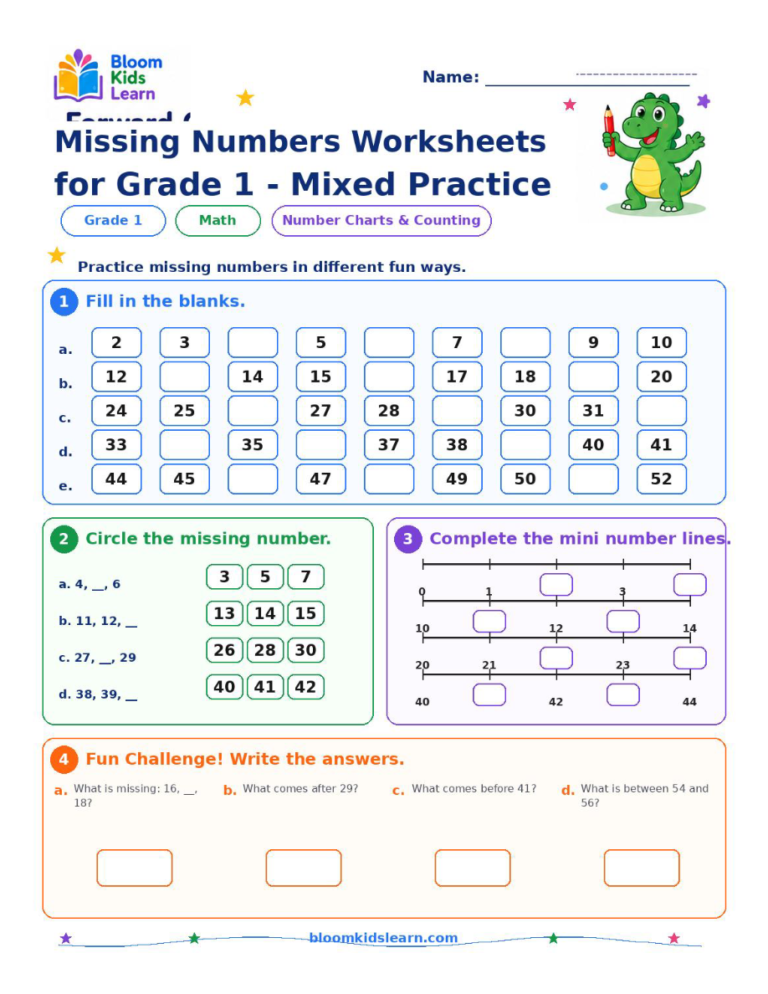
The first section contains five rows with carefully placed blanks. Printed numbers appear on both sides of many spaces so learners can use more than one clue. The rows include values in the thirties, forties, sixties, eighties, and above 100. The second section gives short three-number starts and asks for the next value, providing a quick check of the same skill in a simpler format.
Prepare with a hands-on activity
Write five consecutive numbers on separate cards and place them in order. Ask the child to close their eyes while one card is removed. When they look again, invite them to name the missing number and explain how they know. Repeat with a new range. Then remove two cards that are not beside each other. This game makes the worksheet task familiar before pencil-and-paper work begins.
Directions for using the printable
Read each row from left to right. Touch every printed number and say it aloud. When you reach a blank, say the number that is one more than the value before it, write that answer, and continue. After finishing the row, reread the entire sequence. In section two, write only the single number that comes next after the three printed values.
Worked examples
In the sequence 31, blank, 33, the missing number is 32. It is one more than 31 and one less than 33, so both clues agree. In 45, 46, blank, 48, the missing number is 47. For a row above 100, 103, blank, 105 requires 104. The rule does not change when a number has three digits.
Useful questions to ask
Instead of saying an answer, ask, “What is one more than the number before the blank?” or “What number is one less than the number after it?” If two blanks appear in a row, ask the child to begin at the nearest known value. Encourage an explanation such as “104 belongs here because it comes after 103 and before 105.”
Common mistakes and corrections
Some learners copy the number before a blank, creating a repeated value. Others jump over a number or reverse digits when moving into a new decade. When a mistake appears, locate the first place where the row stops increasing by one. Use a number line or hundred chart to repair that step, then let the child finish without further help.
Crossing 99 to 100 can be especially challenging. Build the transition with cards labeled 97, 98, 99, 100, 101, and 102. Point out that the quantity still increases by only one even though the written number changes from two digits to three.
Differentiation and extension
For support, cover the rest of the row and reveal one blank at a time. Provide a hundred chart and let the child trace the sequence with a finger. For on-level work, remove the chart and ask for a verbal reason after each row. For an extension, hide additional printed numbers with small paper squares, create a new sequence above 110, or ask the learner to solve a similar row backward.
Classroom and home uses
Use the page for morning work, a math center, intervention, homework, tutoring, or a quick formative assessment. Families can cut the rows apart and practice one each day. A reusable sleeve allows repeated work with a dry-erase marker. Short sessions protect accuracy and make it easier to notice which number transitions require more teaching.
Answer-checking strategy
Every neighboring pair should differ by exactly one. Read the completed row aloud while pointing to each number. If the rhythm breaks, compare that answer with the values on both sides. Section two can be checked by adding one to the final printed number. Let children circle a repaired answer so self-correction becomes visible and positive.
Related practice
Begin with the Counting by 1s Basic Practice worksheet when a learner needs more clues. Browse the full Counting by 1s collection, then continue with the Hundred Chart worksheet. These activities support the Grade 1 counting expectation.
Frequently asked questions
Should children use a number chart?
Yes, as temporary support. Gradually remove it after the learner can explain the one-more relationship.
What if handwriting slows the work?
Let the child say the missing numbers first, then write them. This separates number knowledge from numeral formation.
How can I tell whether the child understands?
Ask them to solve a new sequence with a different starting number and explain one answer. Flexible reasoning is stronger evidence than memorizing a completed page.

 Preview