
Missing Numbers Number Paths Worksheet for Grade 1
- Skill: Number-path reading, missing numerals, and counting by ones
- Learning goal: Use number paths to find missing numbers and explain sequence order.
- Format: Printable PDF worksheet
 Download Worksheet PDF
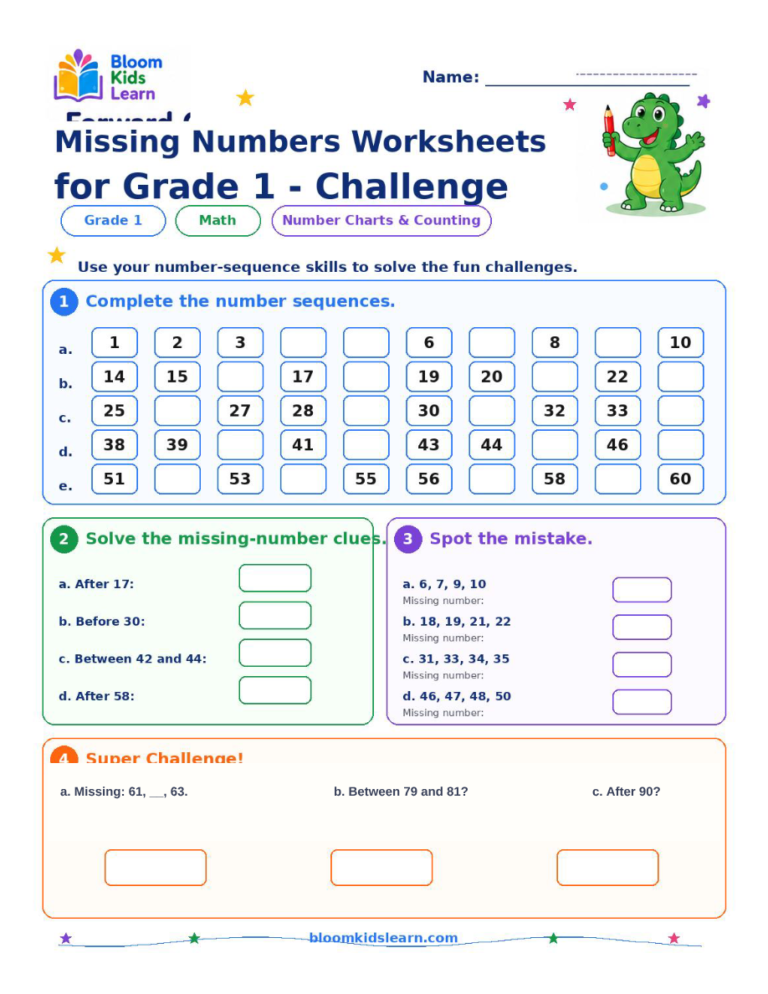
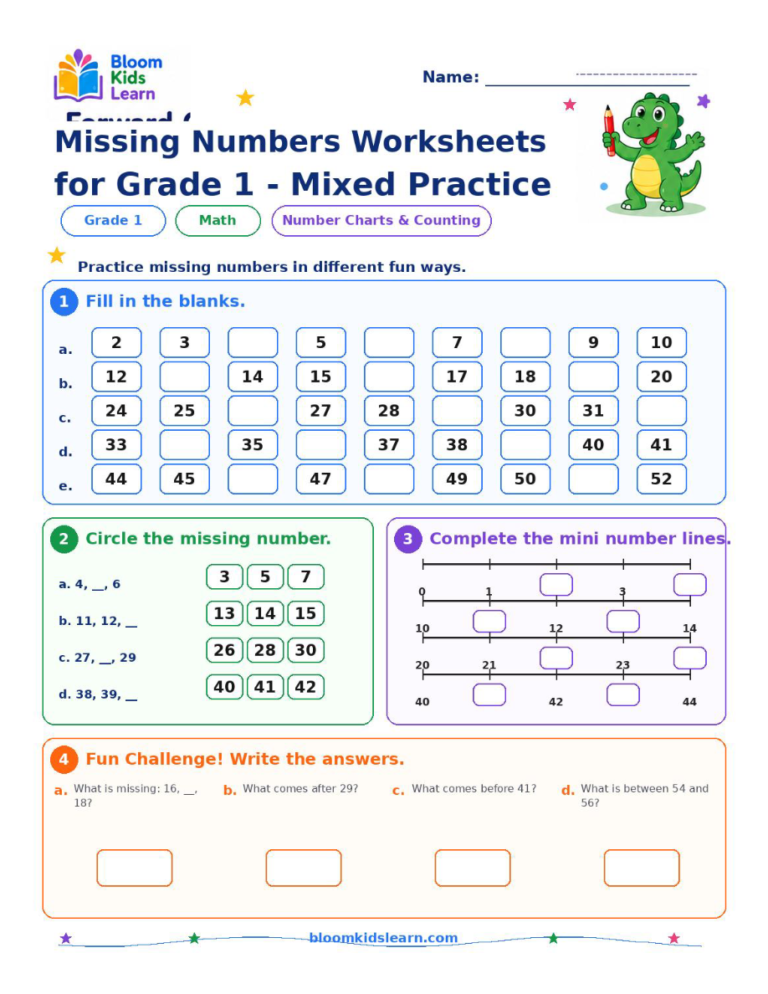
This free missing numbers number paths worksheet for Grade 1 gives children several ways to follow counting order. Students complete a path with blanks, choose the row that shows a correct sequence, write what comes next, and finish two short winding paths. The changing layouts ask learners to use number sense instead of copying one familiar row.
Missing Numbers Worksheet Skills
Number paths make sequence practice active. Children look at neighboring values, notice the one-step pattern, and use that pattern to fill a blank or reject an incorrect path.
- Count forward by ones in rows and paths.
- Find a missing numeral between known numbers.
- Compare several paths and identify the correct sequence.
- Predict the next number from a short pattern.
- Explain why a path is in or out of order.
Grade 1 Learning Objective
After completing this worksheet, a learner should be able to follow a counting path, supply missing numbers, and justify an answer using the numbers before and after the blank. The page is most useful when children say each sequence aloud while they work.
How to Use the Number Paths Page
Warm up with a floor or desk number line. Start at 1, 11, or 21 and count forward together. In section 1, model the blank between 1 and 3, then ask the child to read the entire row. In section 2, have the learner compare each candidate path from left to right; one skipped or repeated number makes a path incorrect. Section 3 is a quick prediction task. Save the winding paths for a final independent challenge.
Worked Examples
In the path “1, __, 3, __, 5,” the missing numbers are 2 and 4. A correct path from 4 to 7 is 4, 5, 6, 7; a row containing 4, 6, 7, 8 skips 5. In “6, 7, 8, __,” the next number is 9. The winding path that begins 36, __, 38, __, 40 continues with 37 and 39.
Common Mistakes and Helpful Prompts
Children may choose a row because its first number looks familiar, then stop checking. Ask them to touch each box and read every value. Another common mistake is treating a path as a skip-counting pattern when it actually moves by one. Point to two neighboring numbers and ask, “How much did it change?”
Differentiation and Extension
For support, cover all but four boxes and let the learner use a 1–50 number chart. Begin with the shortest path before returning to the longer rows. For extension, ask a child to create one correct path and one path with a single error, then trade with a partner. A confident learner can start at 60 and continue for six steps without a chart.
Answer Guidance
Check each path by reading from the first box to the last. Section 1 completes consecutive sequences beginning at 1, 11, and 21. In section 2, the correct rows show 4–7 and 25–28 without skips. Section 3 answers are 9, 21, 32, 45, and 58. The winding paths continue 7, 8, 9, 10, 11, 12 and 36, 37, 38, 39, 40, 41.
Related Missing Numbers Practice
Use the Missing Numbers Basic Practice worksheet for longer number rows, then try the Missing Numbers Number Lines worksheet to connect sequences with visual positions. The counting by 1s collection adds more forward-counting practice. For standards context, review the official Grade 1 Common Core counting language.
FAQs
What grade is this worksheet for?
It is designed for Grade 1 and can support kindergarten enrichment or Grade 2 review.
Can children use a chart?
Yes. Use a chart for the first path, then remove it as the learner gains confidence.
Is the PDF print-ready?
Yes. Print the corrected PDF on US Letter paper from the worksheet details panel.
How to Read Each Number Path
Start by finding the direction of the path. Some rows move forward one number at a time, while others use a larger jump. Have the learner place a finger on the first printed number, say it aloud, and trace each arrow to the next box. When a blank appears, pause and ask what must happen between the two numbers that are already shown. This simple routine keeps the child focused on the pattern instead of filling boxes at random.
Teaching Strategy for Missing Numbers
Model one path with a pencil and a small number line. If the path shows 24, 25, __, 27, explain that the missing value is 26 because the sequence increases by one. If the path jumps from 40 to 50, count the equal steps and look for the ten-more relationship. Encourage the learner to check an answer from both sides whenever two neighboring clues are visible.
Support, Extension, and Review
For extra support, cover later rows and solve one path at a time. A 1–100 chart or counters may be used as a temporary scaffold. For an extension, ask the child to draw a new path with three blanks and trade it with a partner. Save the page and revisit one path the next day; explaining a previously missed number is a useful sign that the pattern is becoming secure.

 Preview