
Number Handwriting Practice Worksheet for Grade 1
Free Grade 1 number handwriting practice worksheet with formation tips and number-word matching.
- Skill: Form and space numerals 1-10
- Learning goal: Use correct start points, spacing, and line placement for numerals 1-10.
- Format: Printable PDF worksheet
 Download Worksheet PDF
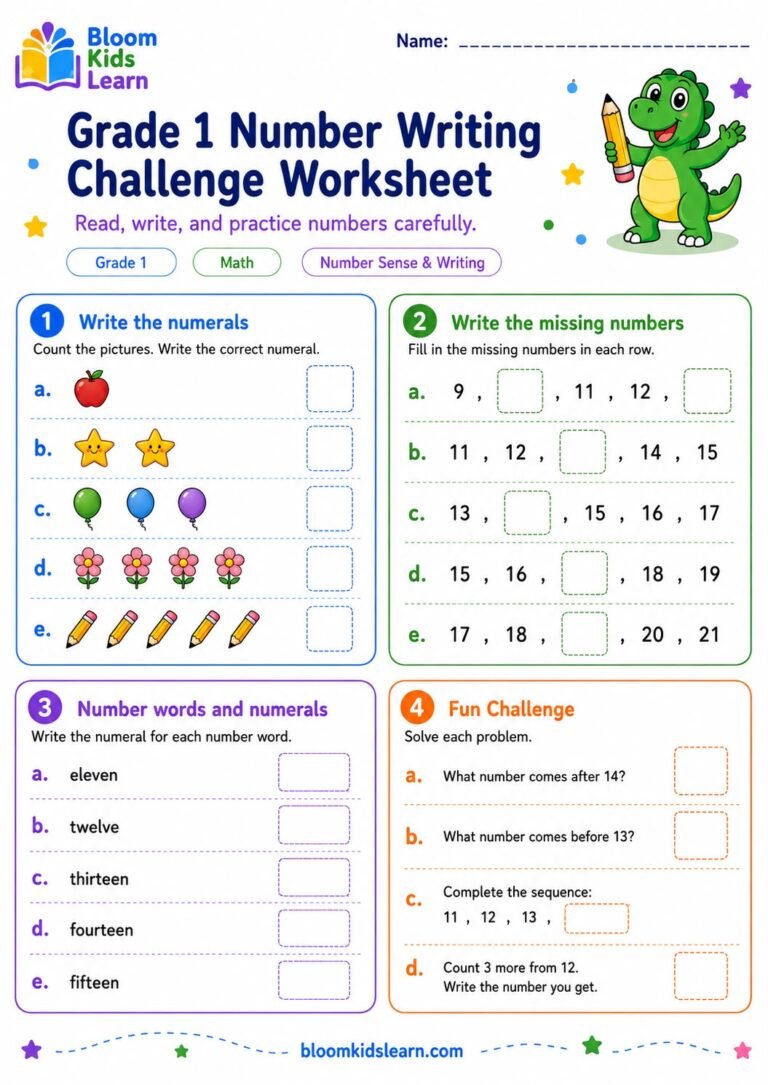
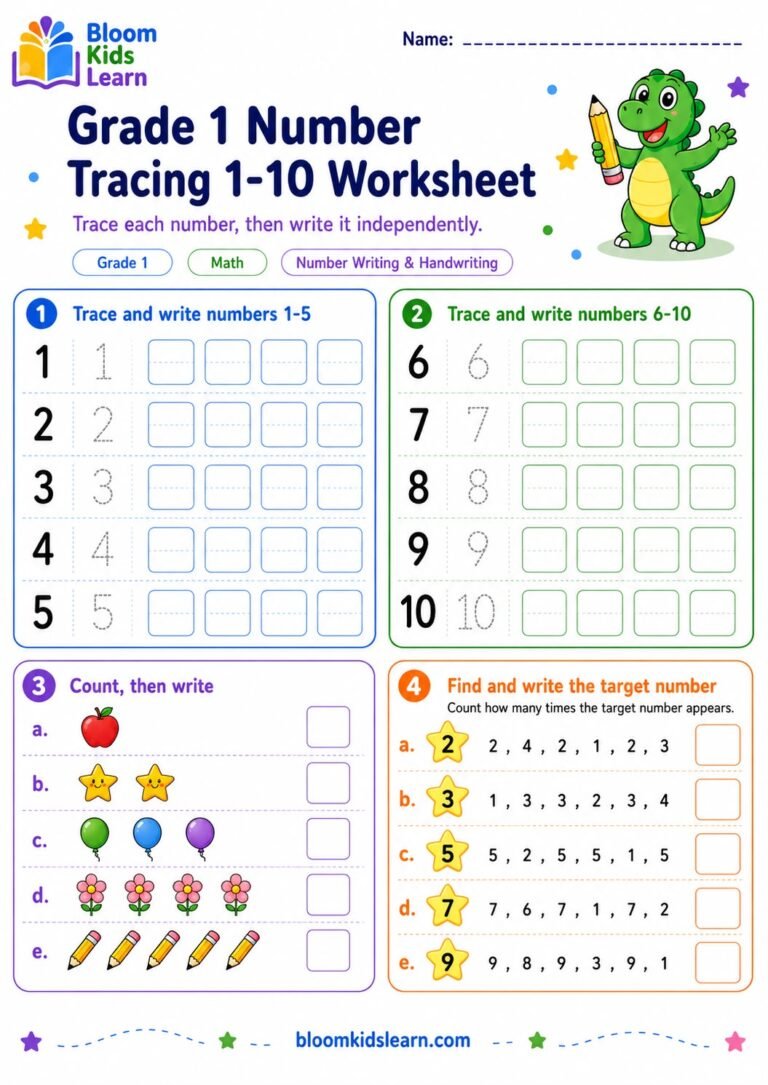
Tracing teaches the route a pencil should take. Handwriting practice asks a different question: can a child write a recognizable numeral without dotted guidance? This Number Handwriting Practice Worksheet for Grade 1 is designed for that independent stage. It gives learners room to form numerals, count small groups, and connect written numbers with number words.
What good number handwriting looks like
A well-written numeral does not need to look printed by a machine. It should be recognizable, reasonably consistent in size, placed on the line, and separated from the next numeral. The child should be able to start and finish the shape without a dotted model. Look for a clear top and bottom, a steady baseline, and enough space for the reader to tell one digit from the next.
Which numerals deserve a closer look?
Ask the child to write 2, 5, 6, 8, and 9 without copying. These shapes use curves and are often confused or reversed. Compare 2 and 5 by noticing their different starting points. Check that 6 has a closed lower loop and that 9 has its loop above the descending stroke. For 8, look for two balanced loops rather than one large circle. If the child writes a digit beautifully when copying but changes it from memory, the next step is short independent practice, not more tracing.
What the worksheet asks learners to do
The upper rows give a numeral and space for repeated writing. The page then asks children to count pictured objects and record the matching numeral. A final matching activity connects number words such as three, seven, one, five, and nine with their symbols. This combination checks shape, quantity, and recall. A child may form 7 neatly but still need help remembering that seven objects are represented by 7.
Count, write, and check
In the picture rows, touch each object once and say the count. Write the total in the answer box, then recount to verify it. If a group has four flowers but the child writes 5, first check the counting action. If the count is correct and the written symbol is wrong, use a numeral card and ask the learner to copy it once, cover it, and try again. This separates quantity understanding from numeral formation.
Mistakes to watch for
- A numeral that changes size from one box to the next.
- Digits that float above or drop below the writing line.
- Reversed 2, 5, 6, 8, or 9.
- Writing a correct count but recording the wrong numeral.
- Joining two digits so closely that they look like one number.
Choose one improvement for the next attempt. “Make the lower loop smaller” is more useful than “write it neatly.”
A short lesson routine
Print on US Letter paper. Let the learner write three numerals freely before beginning, then complete one row at a time. Use a pencil with a relaxed grip and offer a brief hand break after the first section. Do not erase every imperfect mark; circle a sample that is readable and a sample to improve. The child should see progress, not a page of corrections.
Next step in the progression
If independent formation is still difficult, step back to the Number Tracing 1–10 Worksheet or the Number Tracing 1–20 Worksheet. When numerals are recognizable, use the Number Writing Practice Worksheet for sequences and count-and-write work, then try Grade 1 Number Writing & Counting as a mixed check.
The page supports Grade 1 number writing and counting development described in the Common Core State Standards.
Independent writing check
Use this page after a learner has seen numeral models and is ready to write without dotted guidance. Ask for a short row of 2, 5, 6, 8, and 9 from memory. Look for a recognizable shape first, then check whether the numerals sit on the same baseline, use a similar height, and leave enough space for the next mark. A child does not need perfect calligraphy; the goal is writing that another reader can identify quickly.
Compare pairs that are often confused. A 2 may lose its diagonal turn, a 5 may look like an unfinished 6, and an 8 may become two separate circles. For 6 and 9, ask the child to name the starting point before writing. If a numeral is clear but too large, draw a light top and bottom boundary. If the size is fine but the shape is unclear, model one slow stroke and have the child describe the movement aloud.
One useful teacher note
Record the pattern you see, not just the score: “writes 2 and 5 independently; reverses 6 and 9 when rushed.” That note tells you what to practise next and keeps handwriting support separate from counting or number-recognition practice.

 Preview