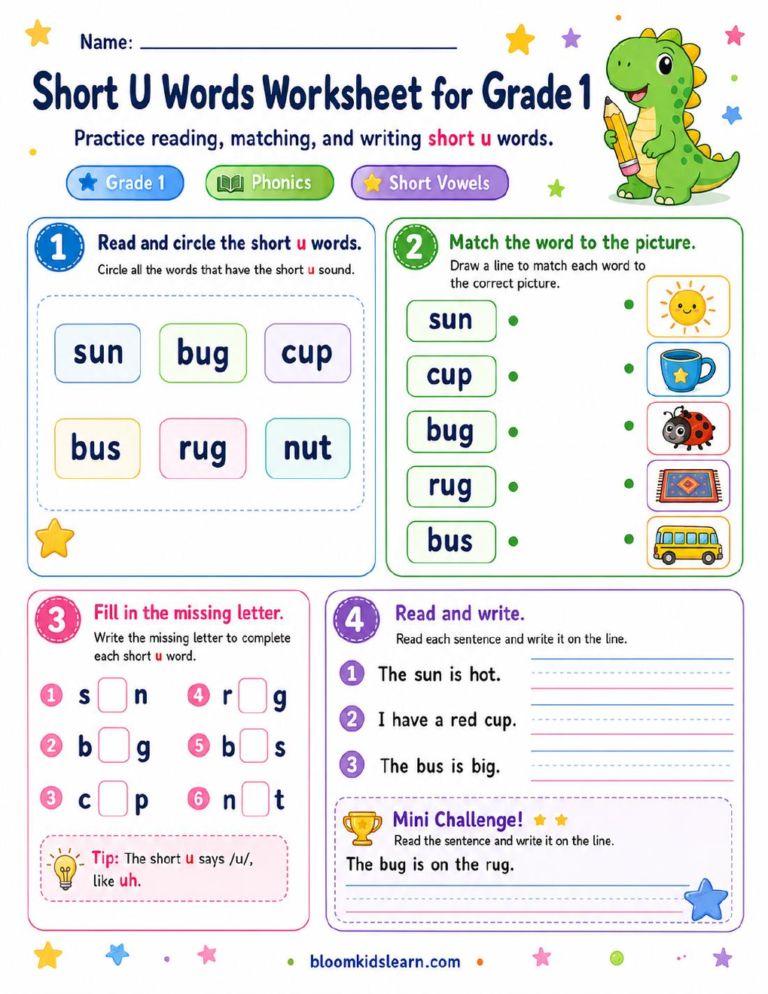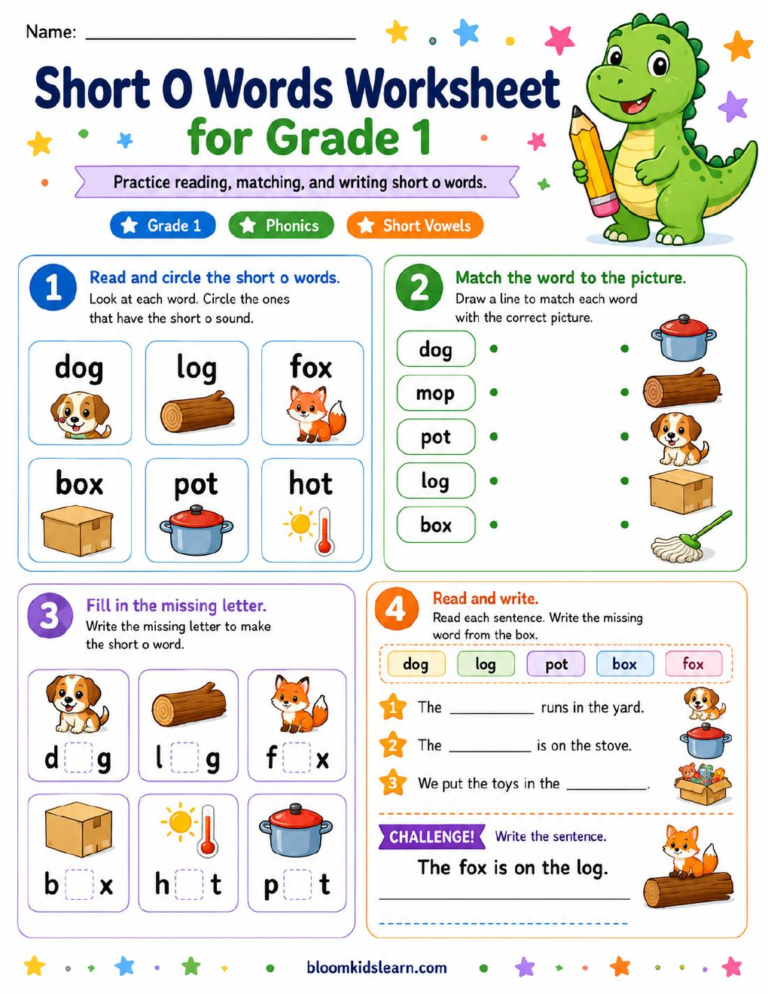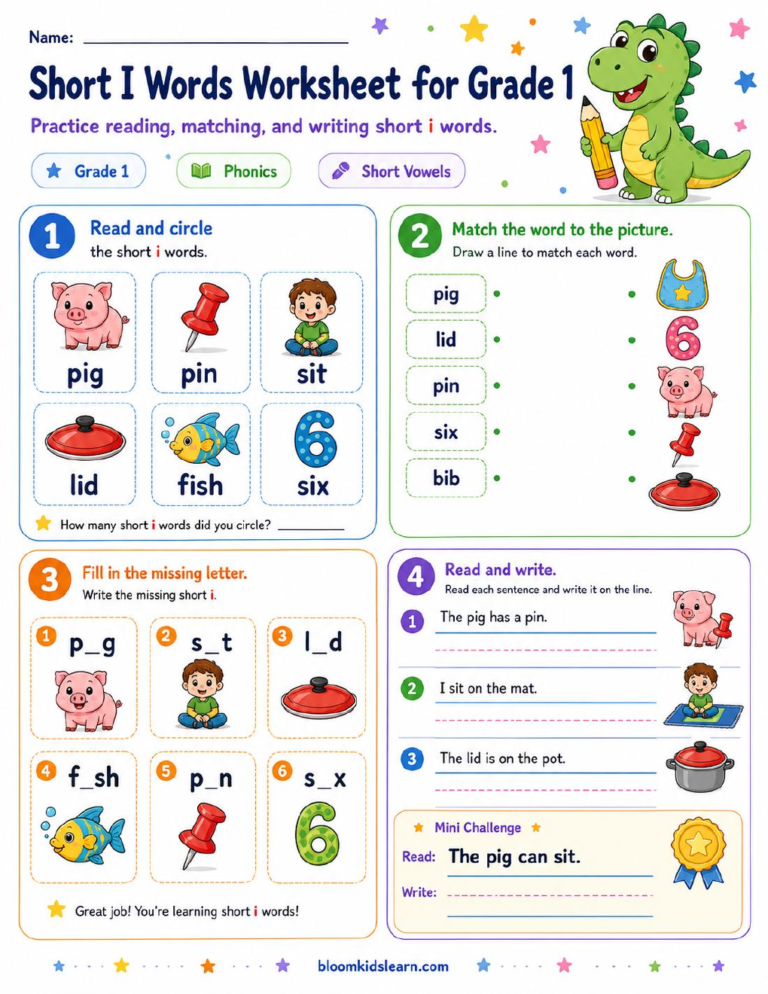

Short Vowel Sounds Mixed Practice Worksheet for Grade 1
Mix all five short vowels through missing-letter words, sound sorting, picture decisions, and a final phonics challenge.
- Skill: Identify short vowels in mixed words
- Learning goal: Select and sort short vowels without being told which sound to expect.
- Format: Printable PDF worksheet
- Answer key: Separate PDF available
 Download Worksheet PDF
 View Answer Key
A mixed short-vowel worksheet is a little different from practicing just one vowel at a time. Children do not already know that every answer will be a, e, i, o, or u. They have to listen to the word, notice the middle sound, and decide which vowel fits.
This Grade 1 printable reviews all five short vowels through missing-letter words, word sorting, picture choices, short-word contrasts, sentence reading, and an open response. It is designed as a review after separate practice—not as the first introduction to short vowels.
Mixed short-vowel worksheet PDF
Download the mixed-practice PDF. A corrected short-vowel answer key is available for teachers and parents.
What Will Children Practice in the Worksheet?
Children will practice:
- choosing the missing vowel in words such as cat, bed, pig, hot, and sun;
- sorting words by their middle vowel sound;
- matching picture names with the correct short vowel;
- telling the difference between words such as cap/cape, fin/fine, hop/hope, and tub/tube;
- finding short-vowel words in a sentence; and
- thinking of and writing their own short-vowel word.
What’s inside the mixed review worksheet?
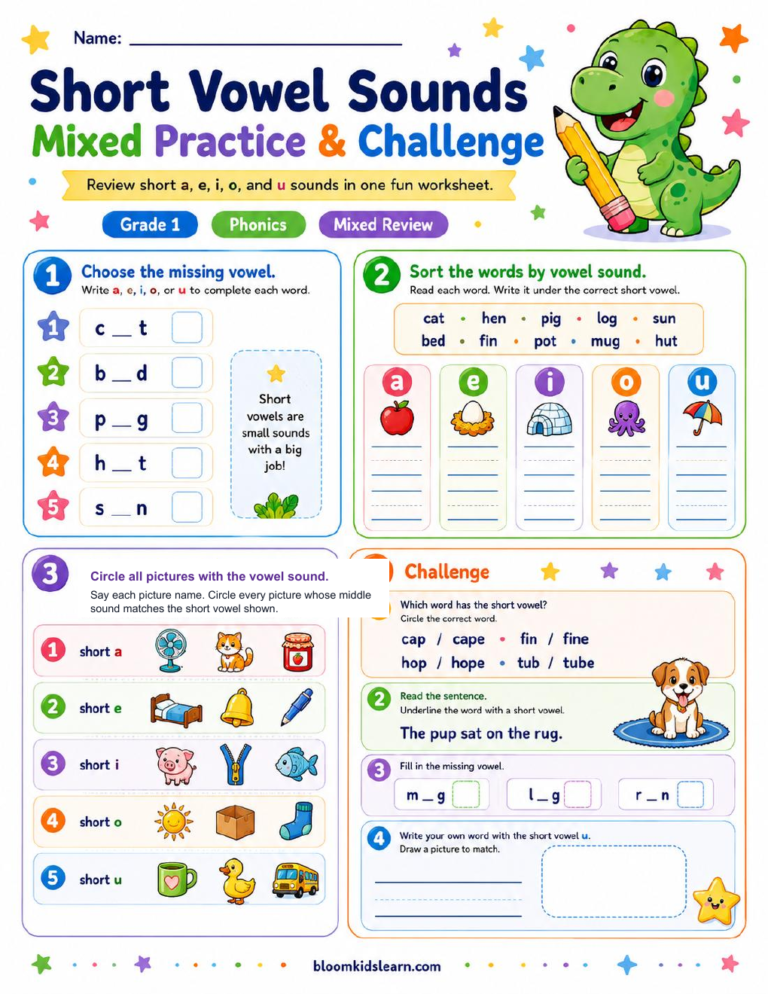
The first box presents five unfinished words—c_t, b_d, p_g, h_t, and s_n. Each requires a different vowel. In the sorting activity, children place words such as cat, hen, pig, log, sun, bed, fin, pot, mug, and hut under the correct vowel heading.
A picture section asks learners to circle every illustration whose name contains the vowel shown. The challenge then contrasts cap/cape, fin/fine, hop/hope, and tub/tube; asks the child to find short-vowel words in “The pup sat on the rug”; supplies three more missing-vowel words; and finishes with an original short-u word and drawing.
When to use this short vowel sounds worksheet?
Use it after the learner can read several words with each target vowel separately. Readiness does not require perfect spelling, but the child should be able to hear the middle sound in words such as cat, bed, pig, dog, and sun without being told the answer category.
If a learner still needs a model for one vowel, return to that focused page first. Mixed practice is most useful when it requires retrieval and comparison; it is frustrating when several sounds have never been taught.
How to teach short vowel sounds with the help of this worksheet?
For each unfinished word, say the complete word, tap three sound positions, and ask which sound belongs in the middle. In the sorting panel, have the child read the word before writing it in a column. A picture can confirm meaning, but it should not replace reading.
For the long/short pairs, read both choices aloud and notice what the final e changes. The aim is simply to select the short-vowel word; a full long-vowel lesson is not required.
What different errors can tell you about your child?
If the child repeatedly swapping only e and i points to a specific sound contrast that deserves targeted listening practice. Correct answers beside pictures but errors in the word-sort may show overreliance on visual clues. Accurate sound identification with incorrect spelling suggests the child hears the vowel but has not yet connected it securely to the letter.
If the learner can identify each sound on a focused page but struggles when the vowels are mixed, retrieval—not basic introduction—is the likely next teaching need. Use fewer choices, then gradually restore all five.
Do you need More Support?
Let the child work with one vowel group at a time if the full page feels difficult.
You can also place the letters a, e, i, o, u in front of the child and ask them to point to the vowel they hear before writing it.
Always have the child say and blend the word before filling in the answer.
Ready for a Challenge?
Cover the vowel headings and ask the child to sort words from memory.
They can also think of one new word for each short vowel and write two of those words in a sentence.
Answer Guidance
For the first activity, the answers are:
cat, bed, pig, hot, sun
For the sorting activity:
- short A: cat
- short E: hen, bed
- short I: pig, fin
- short O: log, pot
- short U: sun, mug, hut
For the short/long word pairs, the short-vowel answers are:
cap, fin, hop, tub
Open-ended answers and drawings may be different.
More Short Vowel Practice
If a child keeps making mistakes with one vowel, return to the matching practice page:
Short A | Short E | Short I | Short O | Short U
The main Short Vowel Worksheets collection can also help you choose what to practice next.
Mixed Short Vowel FAQ
Why is mixed short-vowel practice harder?
Because the child has to decide which vowel sound they hear instead of already knowing which vowel the worksheet is practicing.
Should children say the picture names aloud?
Yes. Saying the word aloud makes it easier to listen for the middle sound before choosing an answer.
What if my child only confuses E and I?
Practice a small group of words such as pen/pin and bed/bid before returning to the full mixed-vowel worksheet.
If my child spells the word correctly, does that mean they know the vowel sound?
Not always. Ask them to read the word aloud without looking at the picture. This helps you see whether they can actually blend the sounds.
 Preview