
Counting by 1s Hundred Chart Worksheet for Grade 1
Free Grade 1 hundred chart with carefully placed missing numbers from 1 to 100. Use the printable PDF for number-order practice.
- Skill: Using a hundred chart to count by 1
- Learning goal: Complete missing values on a 1-100 number chart.
- Format: Printable PDF worksheet
 Download Worksheet PDF
This free Grade 1 hundred chart worksheet helps children practice counting by 1 while learning how numbers are organized from 1 to 100. Instead of treating every missing number as a separate problem, students can use the chart’s structure to reason: numbers increase by one as they move across a row, and each new row continues the same sequence. That combination of counting, pattern recognition, and self-checking makes a hundred chart especially useful for first graders who are building number sense.
What students practice on this worksheet
The printable focuses on an essential first-grade skill: reading, saying, and writing numbers in order. Children fill in selected blanks on a 1–100 chart and use the printed numbers around each space as clues. The activity supports several connected skills:
- counting forward by 1 within 100;
- finding the number that comes just before or just after another number;
- recognizing that each row contains ten consecutive numbers;
- using number patterns instead of guessing; and
- checking written numerals for reversals or skipped digits.
The chart is visual, but the thinking is active. A child may start by counting from 1, then gradually learn to begin near a blank and use a neighboring number. That shift is an important sign of growing confidence.
How to introduce the hundred chart
Before handing over a pencil, look at the completed parts of the chart together. Ask the child to point to 1, then trace across the first row while counting aloud. Pause at the end of the row and notice that the sequence continues on the next line. Repeat with another row so the child sees that the layout changes, but the counting order does not.
Next, choose one blank as a worked example. Have the student name the number immediately before the blank and say, “one more is…” If the blank comes at the beginning of a row, look back to the last number in the row above. This is where many young learners need a calm reminder that 29 is followed by 30, even though the pencil must move down and back to the left.
Step-by-step directions for students
- Start at the first blank you notice.
- Look at the number directly before it in the counting sequence.
- Say that number and count one more.
- Write the missing number neatly in the empty square.
- Check the next printed number to make sure the sequence sounds right.
- Continue until every blank is complete, then read each affected row aloud.
Students do not have to complete the blanks in numerical order. However, working from the top of the chart to the bottom can make the task feel more organized. Encourage careful numeral formation rather than speed.
Helpful questions adults can ask
Good prompts keep the mathematical thinking with the child. Instead of giving an answer, try questions such as:
- “What number comes right before this space?”
- “If you count one more, what will you say?”
- “Does your answer fit between both neighboring numbers?”
- “What changes when we move from the end of one row to the start of the next?”
- “Can you find another row with a similar pattern?”
If a child is stuck, cover most of the chart with a sheet of paper and reveal only the row being completed. This reduces visual distraction without changing the learning goal.
Common mistakes and simple corrections
A common error is skipping a number at a row break. Have the student point to the final number in one row, move a finger to the first square in the next row, and continue counting aloud. Another common difficulty is reversing numerals such as 12 and 21. Ask the child to say the number, identify the tens digit first, and then write the ones digit.
Some children count correctly but copy a nearby printed number into the blank. A quick before-and-after check usually catches this: read the three-number section that contains the answer. The numbers should increase by exactly one.
Ways to adjust the activity
For extra support, complete one row at a time and allow the child to use a separate number line. You can also lightly mark the starting square for each blank. For independent practice, ask the student to complete the page without help and circle the three blanks that required the most thinking.
For an extension, invite the learner to choose a completed number and name one less and one more. Students ready for a deeper pattern can compare numbers in the same column and describe what they notice. Keep that observation informal; the main purpose of this worksheet remains fluent counting by 1.
Classroom and homeschool ideas
This page works well as a math-center task, morning warm-up, small-group review, or quick home-practice activity. Teachers can place a copy in a dry-erase sleeve for repeated use. Families can complete half the chart one day and the rest the next day if writing stamina is still developing.
After the worksheet is finished, turn it into a short speaking game. Point to five completed squares in random order and ask the child to name each number. Then point to two adjacent squares and ask which number is greater. These quick follow-ups reuse the same page without adding a long assignment.
How to check the finished worksheet
Read every row that contains a student answer from left to right. Each number should be exactly one more than the number before it. Then check the written digits for clear formation. When an answer is incorrect, return to the nearest printed number and recount; simply erasing and supplying the correct answer misses the chance to practice the strategy.
The Grade 1 Common Core standard 1.NBT.A.1 includes counting to 120, starting at any number below 120. This hundred chart provides focused practice within 100 and prepares children to continue beyond the chart. You can read the official wording on the Common Core State Standards Initiative website.
Continue the counting-by-1 sequence
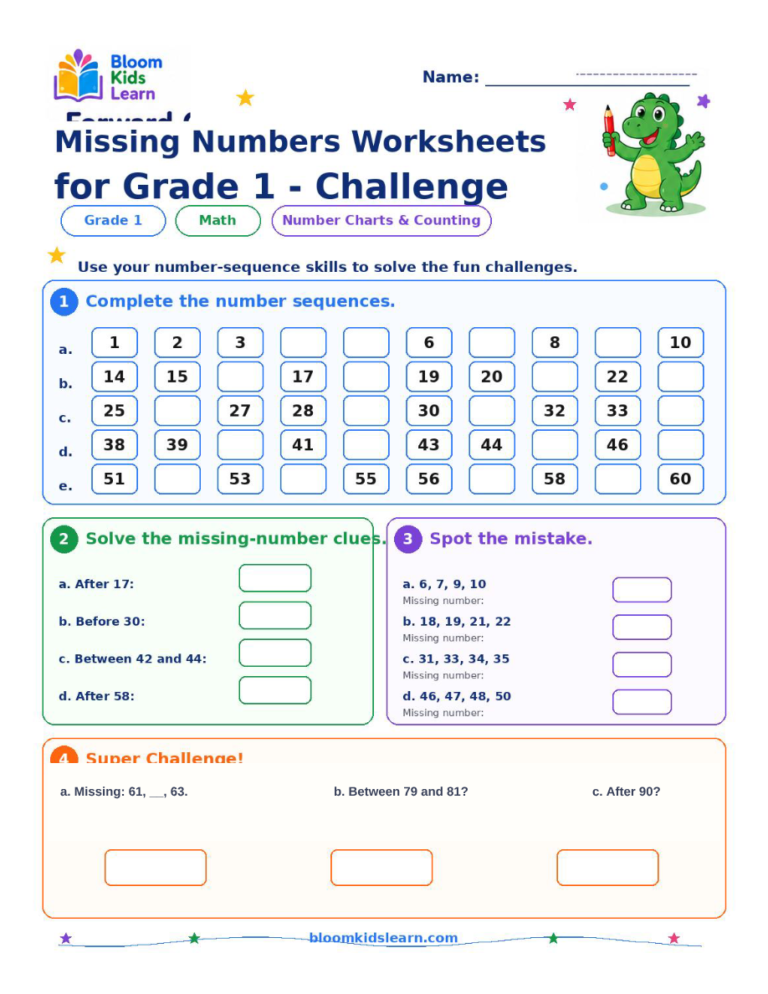
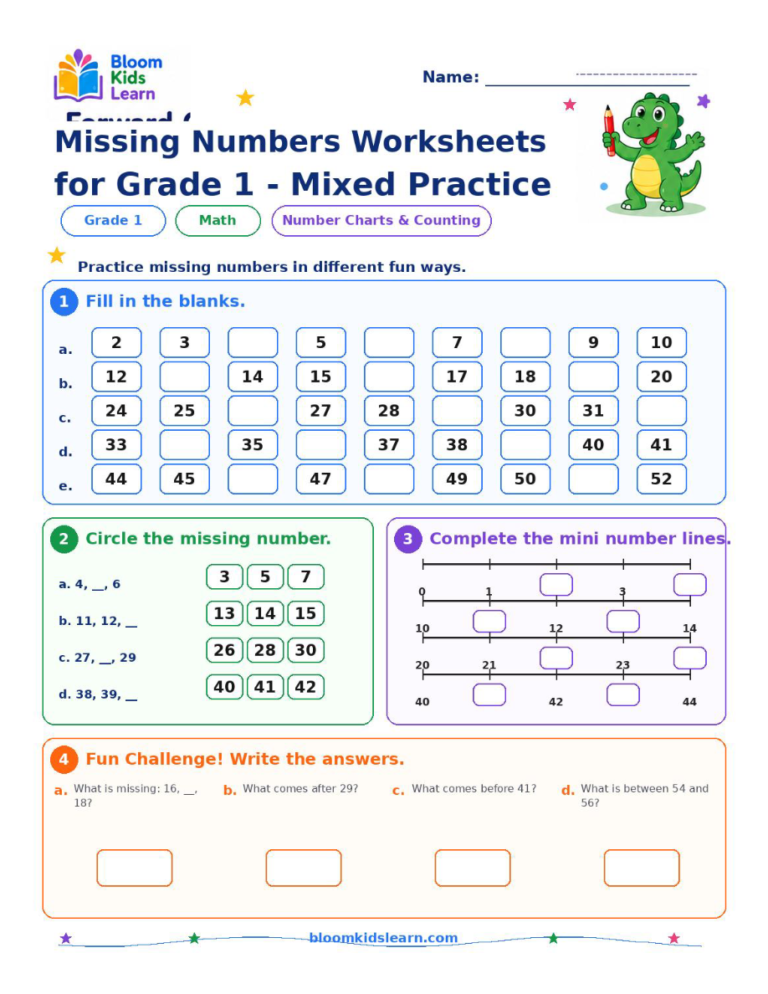
If your learner needs a shorter sequence first, use the Grade 1 Missing Numbers worksheet. After this chart feels comfortable, move to the Number Paths worksheet, where the same counting skill appears in a different visual format. You can also browse the complete Counting by 1s worksheet collection to choose practice by difficulty.
Frequently asked questions
Should a first grader memorize the whole hundred chart?
No. The goal is to understand number order and use patterns efficiently. Repeated meaningful practice usually builds fluency more effectively than asking a child to memorize the page as a picture.
Can students use a number line while completing it?
Yes. A number line is a helpful support, especially when the learner is still becoming confident at row transitions. Remove the support gradually as independent counting improves.
How long should the worksheet take?
There is no required time. A focused session of about ten to fifteen minutes is reasonable for many first graders, but accuracy and explanation matter more than finishing quickly.

 Preview