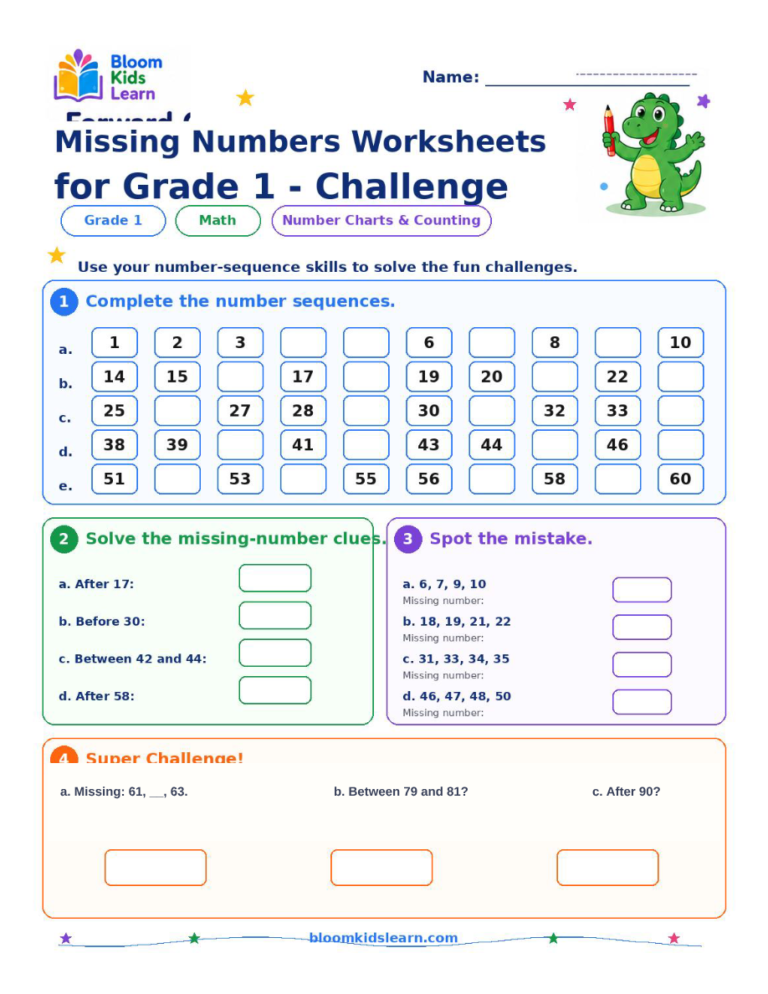
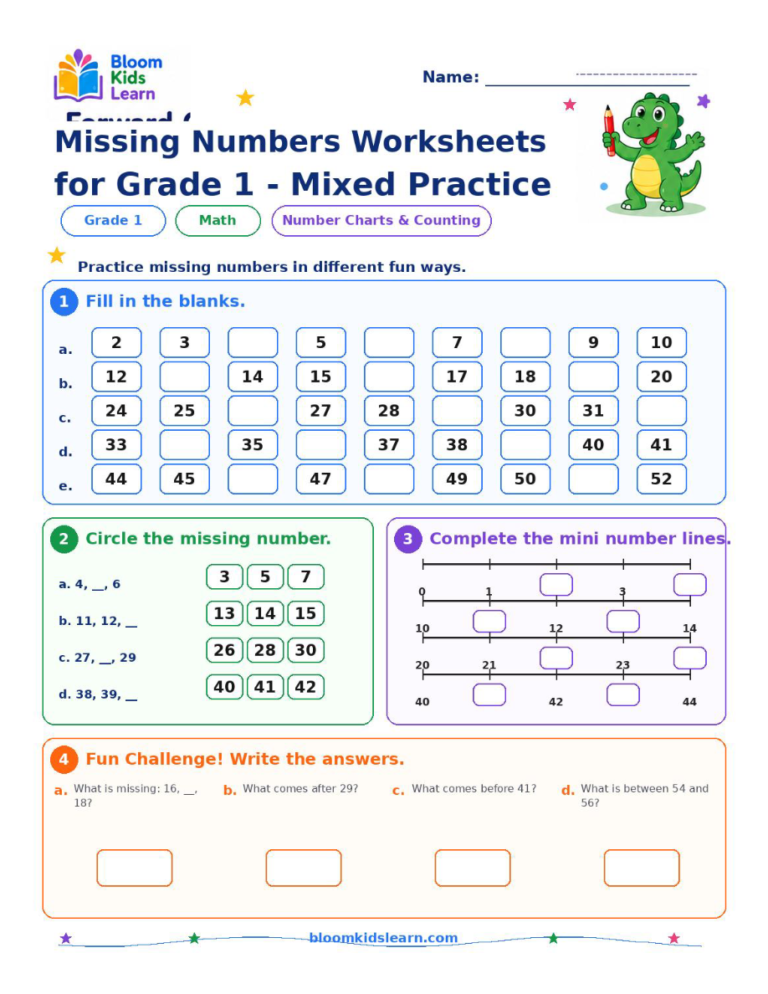
Counting by 1s Number Paths Worksheet for Grade 1
Free Grade 1 number-path practice for counting forward by 1 through 120. The visual printable helps children see each one-more step.
- Skill: Following number paths that increase by 1
- Learning goal: Complete connected number paths by counting forward by 1.
- Format: Printable PDF worksheet
 Download Worksheet PDF
This free Grade 1 counting by 1s number paths worksheet turns number order into a visual route. Students follow each path from one circle to the next and write the missing numbers. Every move forward represents one more, so children practice a simple but powerful idea: no matter where a sequence begins, the next whole number is always one greater.
Unlike a full hundred chart, a number path shows a shorter sequence with a clear direction. That narrower focus can help a first grader pay attention to the numbers immediately before and after a blank. The worksheet also includes sequences that begin at different values, giving students practice starting from numbers other than 1.
Skills developed by number-path practice
This printable is designed to strengthen number sense, not just handwriting. As children trace and complete the paths, they practice:
- counting forward by 1 from a given number;
- finding the next number in a sequence;
- reading two-digit and three-digit numerals in order;
- crossing important transitions such as 99 to 100;
- using neighboring values to check an answer; and
- writing numerals clearly inside a defined space.
Counting from a number other than 1 matters because it shows whether the child understands the sequence itself. A student who can begin at 47 and continue 48, 49, 50 is using number relationships rather than reciting a memorized list from the beginning.
How to introduce the worksheet
Begin by asking the student to find the starting circle on the first path. Point out the direction of travel and read the first few printed numbers together. Explain that each new circle is one step forward, so the value increases by exactly one.
Complete one blank as a model. Say the number before the blank, count one more, and write the answer. Then read the short section again, including the number after the blank when one is shown. For example, if a space falls between 63 and 65, the completed sequence should sound like “63, 64, 65.” This before-and-after check gives children a reliable way to catch mistakes on their own.
Step-by-step student directions
- Locate the beginning of a number path.
- Follow the route in the direction shown.
- Say each printed number aloud.
- When you reach a blank circle, count one more than the previous number.
- Write the missing numeral neatly.
- Continue to the end, then read the entire path aloud to check it.
Encourage the child to move a finger or pencil tip along the route while counting. This keeps attention on the correct circle and connects the spoken number with its place in the sequence.
Teaching “one more” instead of guessing
If a learner pauses at a blank, avoid immediately telling the answer. Ask, “What number did you just say?” and then, “What is one more?” This language links counting by 1 with the addition idea of increasing a quantity by one.
Physical objects can make the relationship clearer. Place a small group of counters beside the page, name the amount, add one counter, and count again. Then return to the number path and explain that moving to the next circle works the same way. Use the objects briefly; the goal is to help the child return to the written sequence with a better strategy.
Handling the transition from 99 to 100
The change from a two-digit number to a three-digit number can feel large even though the count still increases by only one. Have the student count 97, 98, 99, 100 slowly. Emphasize that the rule has not changed. The next number after 99 is 100, and the sequence continues 101, 102, and so on.
If writing 100 is difficult, say the number by place value: one hundred, zero tens, and zero ones. Make sure the child leaves enough space for all three digits. A backward glance is also useful: 100 must come after 99, not after 90 or 98.
Common mistakes and how to respond
Some students skip a circle when the path changes direction. Ask them to return to the last correct number and trace the route one step at a time. Others repeat a number, especially when they look away to write. Reading the completed path aloud usually reveals the repetition.
Digit reversals may also appear. If a child writes 36 instead of 63, ask them to say the intended number and identify how many tens it has. Correct the numeral calmly, then continue the count. The worksheet is number-order practice, so clear correction is more helpful than marking the entire path wrong.
Adjusting the activity for different learners
For extra support, cover the lower part of the page and complete one path at a time. Let the student use a number line or the Grade 1 Hundred Chart worksheet as a reference. You can also write the first missing number together before asking the child to continue independently.
For a challenge, ask the learner to write the next five numbers after a path ends. Another useful extension is to choose a completed circle and name one less and one more. Children who finish confidently can explain how they knew an answer without counting all the way from 1.
Ideas for class and home use
Number paths work well as a warm-up, math center, small-group activity, or short homework page. A teacher can ask partners to take turns reading and filling circles, while the second student checks that each move increases by one. At home, an adult can complete the first path with the child and save the remaining paths for independent practice.
Checking the completed number paths
Start at the beginning of each path and read every number in order. Each circle should contain a value exactly one greater than the previous circle. If the sequence includes 99 and 100, check that all three digits of 100 are present. Also look for skipped circles, repeated numbers, and digits written in the wrong order.
When an answer needs correction, begin again at the nearest printed number rather than recounting from 1. This reinforces the key skill of starting a count from any number.
What to practice next
If the visual route feels difficult, return to the Hundred Chart worksheet and practice finding one more across each row. When the paths are comfortable, try the Counting by 1s Mixed Practice worksheet, which combines number-order tasks in several formats. The full Counting by 1s collection keeps all six printable activities together.
Frequently asked questions
Should a child count aloud?
Yes, especially during early practice. Speaking each number helps the learner notice a skipped or repeated value. Quiet counting can come later as fluency improves.
Can a number chart be used for help?
Yes. A chart is a useful temporary support. Encourage the child to look only when needed and then complete the next path with less assistance.
What if the student always starts counting at 1?
Point to the path’s first printed number and say it together. Then ask for the next three numbers. Short, repeated practice beginning at different values will build flexibility over time.

 Preview