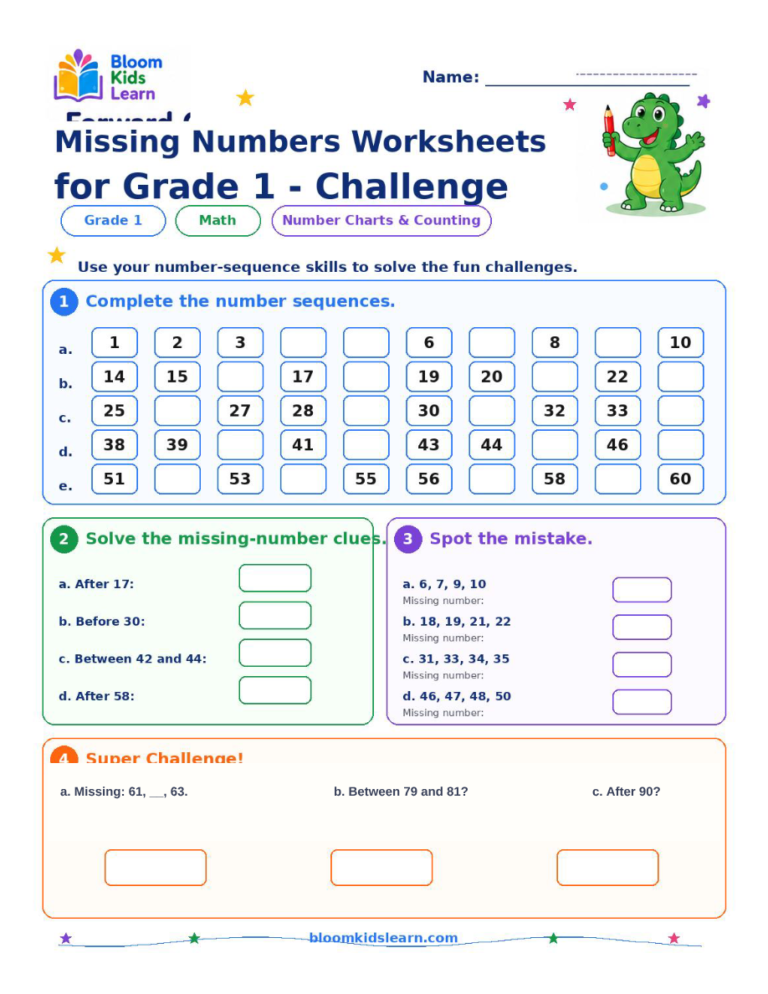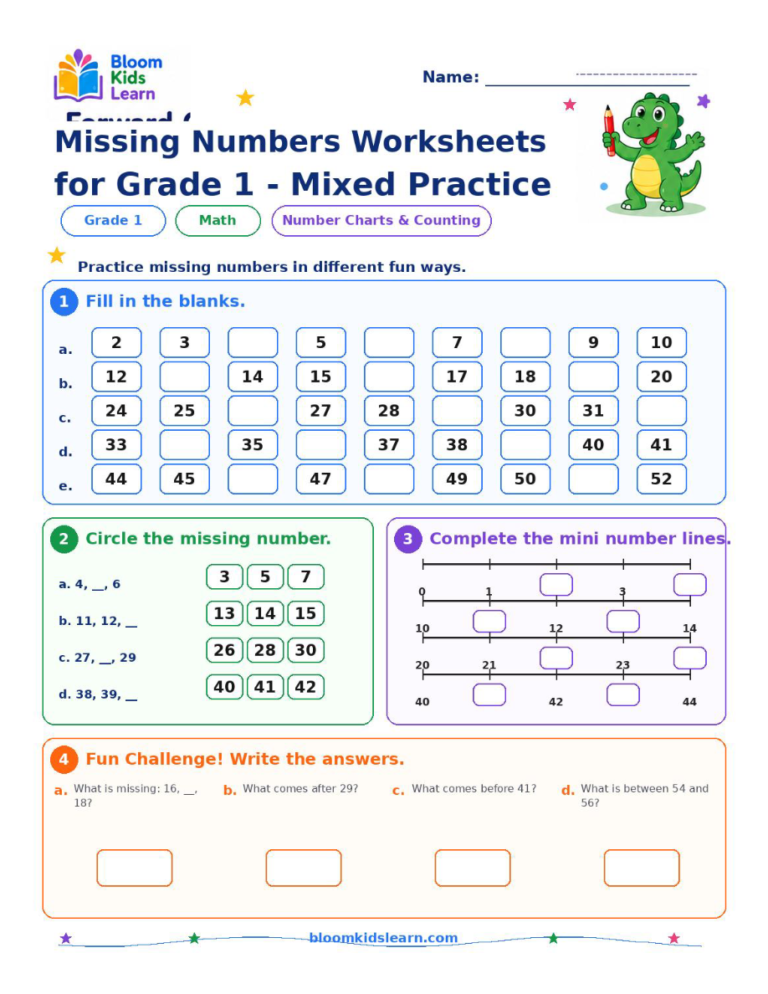

Counting by 1s Mixed Practice Worksheet for Grade 1
Free Grade 1 mixed practice for counting by 1 through 120, including sequences and before-and-after clues in one printable PDF.
- Skill: Applying counting-by-1 skills in several formats
- Learning goal: Use sequences and before-and-after clues to show number order within 120.
- Format: Printable PDF worksheet
 Download Worksheet PDF
This free Grade 1 counting by 1s mixed practice worksheet brings several number-order skills together on one printable page. Students complete forward sequences, identify the number immediately before or after a given value, and compare nearby numbers within 120. Changing between question types helps children show that they understand number order, rather than relying on one familiar worksheet pattern.
Skills included in this printable
The worksheet reviews connected first-grade number skills:
- counting forward by 1 from numbers other than 1;
- filling one or more missing values in a sequence;
- finding the number that comes directly before a given number;
- finding the number that comes directly after a given number;
- comparing close values within 120; and
- writing two-digit and three-digit numerals accurately.
Students must also notice what each direction asks them to do. That small reading-and-thinking step makes mixed practice more demanding than completing the same type of problem repeatedly.
Before starting the worksheet
Warm up with a short oral count. Choose a number below 120 and ask the child to say the next five numbers. Repeat from a different starting value. Then give one verbal before-and-after question, such as, “What number comes before 52? What number comes after 52?”
Review the meaning of “before” and “after” on a number sequence. Before means one less and appears immediately to the left when numbers are written in a forward row. After means one more and appears immediately to the right. If the worksheet asks students to compare numbers, remind them that the number farther along in a forward count is greater.
Step-by-step directions for students
- Read the directions for the current section.
- Look at all printed numbers before writing.
- Decide whether you need to count forward, find one before, find one after, or compare.
- Say the short number sequence aloud.
- Write the answer neatly in the correct space.
- Check the completed problem, then move to the next section.
Encourage students to slow down when the question format changes. A child may know the numbers but still make an error by continuing the rule from the previous section.
Strategies for missing-number sequences
Begin with the printed number nearest the blank. If the blank is in the middle, read the number before it and count one more. Then check that the following printed value is one greater than the answer. For several consecutive blanks, write one number at a time and reread the complete sequence.
When a sequence crosses 99 to 100, emphasize that the counting rule remains the same. The numeral becomes longer, but 100 is still exactly one more than 99.
Strategies for before-and-after questions
For the number before, count back one step. For the number after, count forward one step. A small three-box sketch can help: write the given number in the middle, place one less on the left, and one more on the right.
Students sometimes reverse the two answers because they focus on the order in which the questions are printed. Ask them to read the completed trio from left to right. It should count forward smoothly with no skips or repeats.
Strategies for comparing nearby numbers
Have the child say both numbers and locate where each belongs in the counting sequence. The number that comes later is greater; the number that comes earlier is less. For close values, looking first at the tens digit and then the ones digit can make the comparison quicker.
If the numbers have different numbers of digits, connect them to known benchmarks. For example, 100 comes after every two-digit whole number. Avoid teaching a symbol as a decorative trick. The child should be able to explain the comparison in words before selecting or writing a symbol.
Common errors and helpful responses
A learner may add one when the direction asks for the number before. Point back to the word “before” and ask the student to show one step backward with a finger. Another common error is skipping a value in a sequence. Start from the closest correct printed number and recount only the relevant section.
Digit reversals can change the value completely, such as writing 26 for 62. Ask the child to say the intended number, identify the tens, and rewrite it carefully. When comparing numbers, have the learner explain, “___ is greater because it comes after ___ when I count.” An explanation often reveals whether the answer was reasoned or guessed.
Use the page as a quick skills check
Let the student complete the worksheet independently if the goal is assessment. Avoid correcting answers during the first attempt. When finished, sort errors by type: sequence, before, after, comparison, or numeral writing. One pattern of errors is more useful than a single overall score because it shows exactly what to teach next.
If nearly all mistakes occur in one section, return to a focused worksheet for that skill. If errors are scattered, complete a few problems together and ask the child to name the strategy before writing each answer.
Support and extension ideas
For support, provide a number line or hundred chart, cover all but one section, and allow oral answers before written ones. You can also highlight direction words so the child pauses and identifies the task.
For an extension, ask the learner to create a new missing-number sequence for an adult to solve. Another option is to choose a number from the page and write two numbers before it and two numbers after it. Confident students can explain how comparison, one less, and one more are connected.
How to check the finished page
Read each completed sequence aloud and confirm that every step increases by one. For before-and-after items, check that the three values form a consecutive sequence. For comparisons, ask the child to justify at least one answer in words. Finally, inspect three-digit entries to make sure no digit is missing.
Corrections should include a reason. Have the student return to the nearest known number, use the appropriate strategy, and write the corrected value. This makes checking part of the learning process.
Continue the Counting by 1s series
For a visual warm-up, use the Grade 1 Number Paths worksheet. When the mixed page is accurate and comfortable, move to the Counting by 1s Challenge worksheet. You can also visit the complete Counting by 1s worksheet collection to choose a focused activity for any skill that needs review.
Frequently asked questions
When should students use mixed practice?
Use it after focused practice, when the child can already count forward and identify nearby numbers with some confidence.
Should children finish the page without help?
Independent work is useful for a skills check. For regular practice, brief prompts and visual tools are appropriate as long as the student does the mathematical thinking.

 Preview