
Missing Numbers Number Lines Worksheet for Grade 1
- Skill: Number-line reading, missing numerals, and counting by ones
- Learning goal: Use number lines to find missing numbers and explain before, after, and between.
- Format: Printable PDF worksheet
 Download Worksheet PDF
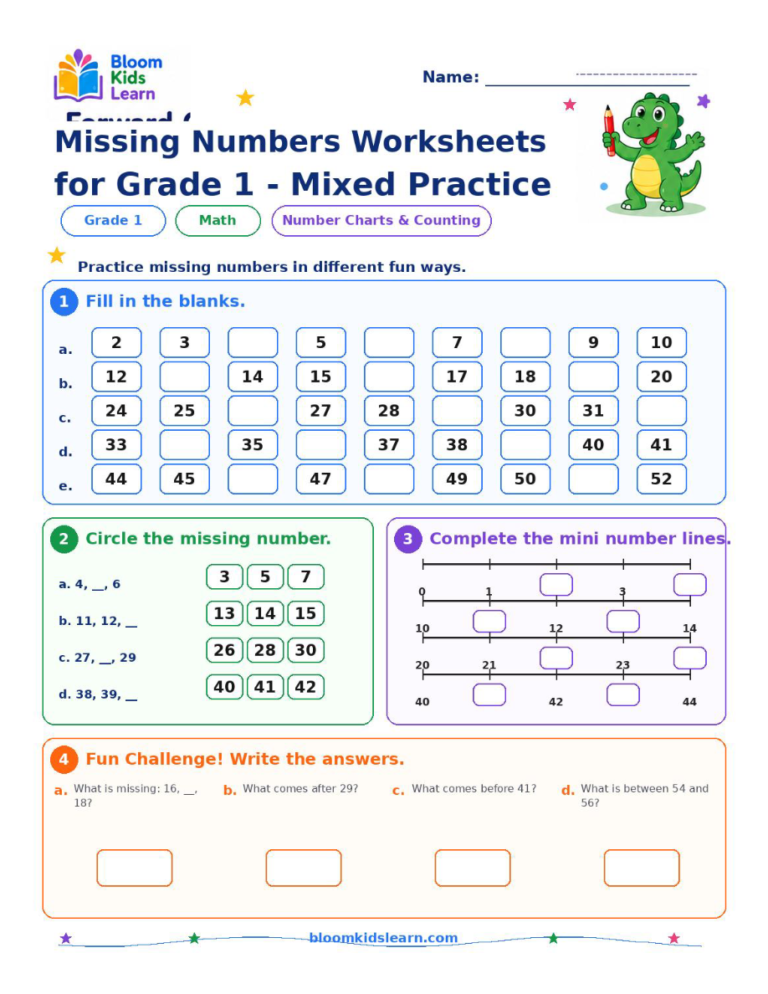
This free missing numbers number lines worksheet for Grade 1 helps children connect counting sequences to position. Instead of memorizing a list, learners look at evenly spaced marks, read the numbers around each blank, and decide which numeral belongs on the line. The page moves from 0–10 to larger ranges through 50, then finishes with clues that require a little more reasoning.
Missing Numbers Worksheet Skills on Number Lines
Number lines give children a visual way to see that numbers have an order and a place. This printable supports early number sense, counting by ones, and the language of before, after, and between.
- Read a number line from left to right.
- Fill a missing numeral between two known values.
- Use equal spaces to count forward by one.
- Find the number before, after, or between given numbers.
- Explain an answer using the neighboring marks.
Grade 1 Learning Objective
After completing this Grade 1 worksheet, a learner should be able to use a number line to find an unknown number and describe where it belongs in a sequence. The goal is to make the visual model support thinking, not to turn the activity into a guessing game.
How to Teach With This Printable
Start by drawing a short line with marks for 0, 1, 2, and 3. Ask the child what changes as the marks move to the right. Work through the first line together and point out that every tick represents one step. For each blank, have the learner read the full line aloud before writing. Section 2 uses short verbal clues, while section 3 asks children to complete mini lines with fewer labels. Keep section 4 for a quick independent check.
Worked Examples
On the first line, the blank between 2 and 4 is 3. On the 10–20 line, a blank between 13 and 15 is 14. If a clue asks for the number before 9, move one step left to find 8. For the mini line that begins at 15 and ends at 19, the unlabeled marks represent 16 and 18.
Common Mistakes and Helpful Prompts
A child may count the labels but forget to count the blank mark itself. Ask, “What number would you say at this tick?” rather than pointing to the answer. Some learners also read a line from right to left and reverse before and after. Have them place a finger on the smaller number, move one tick, and say the next number out loud.
Differentiation and Extension
For support, cover the larger lines and begin with the 0–10 example. Let the child use a small counter as a marker while counting each step. For extension, draw a line from 30 to 40 with three missing labels and ask the learner to write all three. A confident child can explain why equal spacing matters and create a clue for a partner.
Answer Guidance
Check each answer by counting the tick marks, not by estimating the distance. Section 1 completes consecutive ranges from 0 to 50. Section 2 answers are 8, 15, 23, and 39. Section 3 supplies the missing values within the short lines, and the final clues ask for 19, 30, 49, and 64. If a response is incorrect, return to the nearest labeled number and count one step at a time.
Related Missing Numbers Practice
Use the Missing Numbers Basic Practice worksheet for number rows without a visual line. The counting by 1s collection gives extra sequence practice, and the Number Words Mixed Practice worksheet connects numerals with written names. For standards context, review the official Grade 1 Common Core counting language.
FAQs
What grade is this worksheet for?
It is designed for Grade 1 and can support kindergarten enrichment or Grade 2 review.
Can children use a chart?
Yes. A chart or counter can help at first; gradually remove the support as the number line becomes familiar.
Is the PDF print-ready?
Yes. Print the corrected file on US Letter paper from the worksheet details panel.
Teach the Path Before the Pencil
Begin with a large floor or desk number line and let the learner walk or point from left to right. Say each printed number as you move. When you reach a blank, stop and ask what number would keep the spaces equal. This physical step helps children understand that a blank is a place in an ordered sequence, not a random box.
Worked Checking Strategy
For a blank between 18 and 20, count one step forward from 18 or one step backward from 20 to find 19. For a longer line, use the nearest labeled marks and count the equal intervals. Ask the child to check the answer in both directions whenever possible. If the line is crowded, cover the extra rows and solve only one section at a time.
Support and Extension
Provide a 1–100 chart or small counters for learners who need a visual anchor. Trace the arrows together and circle the two clues that surround each blank. For an extension, have the learner draw a short number line with three missing values for a partner to solve. Revisit one challenging line the next day and ask for an explanation, not just a corrected numeral.

 Preview