
Number Words Mixed Practice Worksheet for Grade 1
- Skill: Mixed number-word matching, sequences, spelling, and clue solving
- Learning goal: Use number words in pairs, choices, sequences, and short Grade 1 clues.
- Format: Printable PDF worksheet
 Download Worksheet PDF
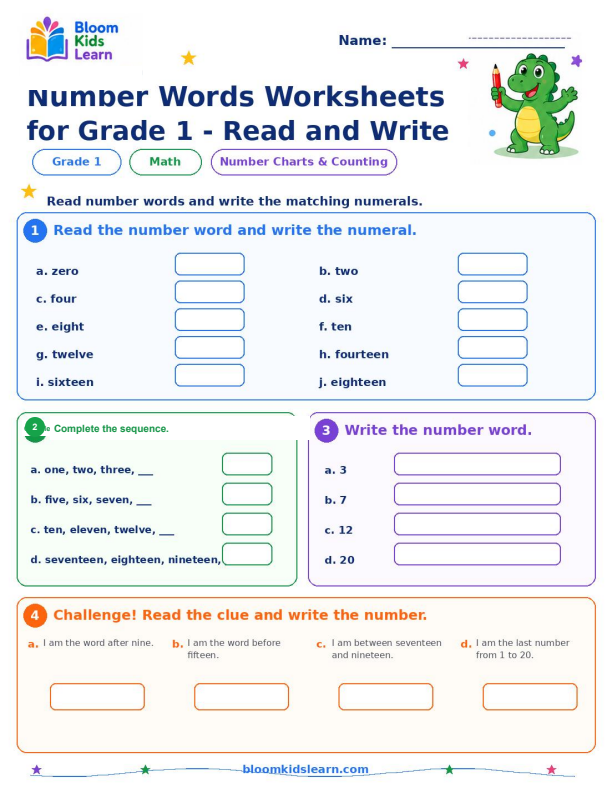
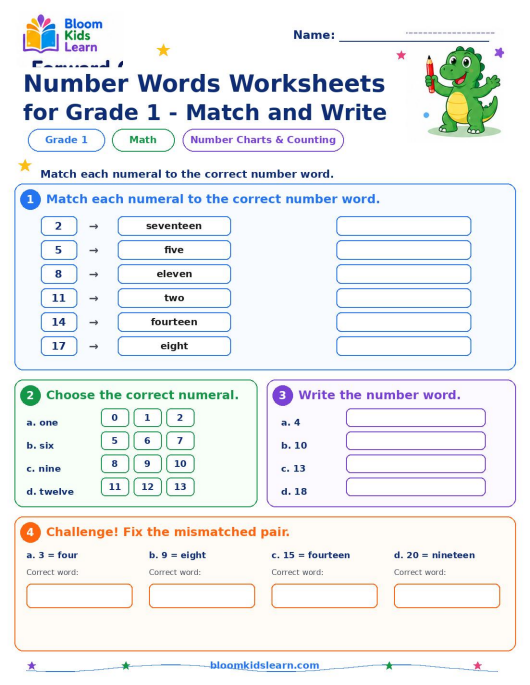
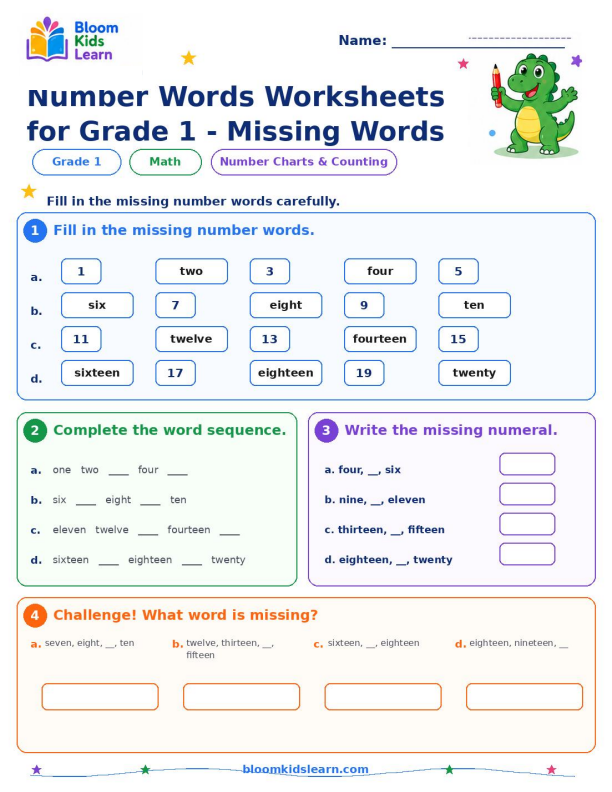
This free number words mixed practice worksheet grade 1 gives children several ways to read, write, and check number names. Learners complete numeral-and-word pairs, choose the correct spelling, fill missing words in sequences, and answer short clues. The variety helps children use number-word knowledge flexibly instead of memorizing one list.
Number Words Mixed Practice Worksheet Grade 1 Skills
The first section asks students to complete pairs for 1, 4, 7, 10, 12, 15, 18, and 20. The second section gives three word choices for 5, 9, 13, and 17. The third section uses word sequences such as two, three, __, five. In the challenge, children answer questions like “What number word is 6?” and “What comes before eleven?”
- Match numerals with number words from 1 to 20.
- Choose correctly spelled number names.
- Complete missing-word sequences.
- Read clues and write the matching word or numeral.
- Check answers by counting in order.
Grade 1 Learning Objective
After completing this printable, a learner should be able to move between a numeral and its written number name, recognize missing words in a sequence, and explain a choice using counting order. The activity supports math vocabulary, spelling, and early place-value language.
How to Use the Page
Warm up by counting from one to twenty while pointing to a chart. Ask the child to say each number before writing it. In the pair section, model one example and remind the learner that a numeral and word describe the same quantity. For multiple-choice questions, read every option aloud. In the missing-word section, say the complete sequence first, then write the word that belongs in the blank. Finish with the challenge clues as a short independent check.
Worked Examples
The numeral 4 matches four, and 10 matches ten. In “two, three, __, five,” the missing word is four. If the choices for 9 are eight, nine, and ten, circle nine. For the clue “What comes before eleven?” the answer is ten.
Common Mistakes
Children may choose a word because it starts with the same letter as another word. Point out that four and five both begin with f, so the numeral and counting order provide the clue. Other common errors include confusing thirteen and fourteen or writing twenty as “twente.” Ask the learner to reread the word, listen for each syllable, and compare it with a reference strip.
Differentiation and Extension
For support, complete only the first four pairs and let the child use letter tiles. Cover extra choices so the learner sees two options at a time. For extension, ask a confident learner to create a four-word sequence with one missing word, then swap it with a partner. You can also ask the child to sort words into single digits, teen numbers, and twenty, explaining what changes in each group.
Answer Guidance
The first section pairs are 1-one, 4-four, 7-seven, 10-ten, 12-twelve, 15-fifteen, 18-eighteen, and 20-twenty. The choices are five, nine, thirteen, and seventeen. The missing words are four, seven, thirteen, and twenty. The challenge answers are six, sixteen, twelve, and ten.
Related Number-Word Practice
Review the Number Words Read and Write worksheet for numeral conversion, then use the Number Words Match and Write worksheet for matching. The counting by 1s collection reinforces the quantity behind each word.
FAQs
What grade is this for?
This worksheet is designed for Grade 1, with use as kindergarten enrichment or Grade 2 review.
Can children use a reference chart?
Yes. Keep it nearby for support, then remove it during the challenge section.
Is the PDF print-ready?
Yes. Open the worksheet details panel and print it on US Letter paper.
Quick Review Games
After the written page, try a two-minute oral game. Say a numeral and ask the learner to give its number word, then reverse the task by saying a word and asking for the numeral. Use only the numbers that caused hesitation on the worksheet. A small stack of cards can make the practice feel less like another assignment: the child draws a card, reads it, and places it in counting order.
Family and Classroom Notes
This mixed practice page works well in a math center because every section can be checked without a long explanation. A teacher can listen for accurate number language while a child works independently. At home, stop after one or two sections if attention is fading and return to the remaining items the next day. Short, successful sessions usually build better fluency than rushing through every blank.
Self-Check Routine
Before handing in the page, have the learner point to each answer and ask three questions: Does the numeral match the word? Is the spelling complete? Does the answer fit the counting order? This routine helps children notice a missing letter or an out-of-order number and correct it themselves.
Keep a pencil nearby for self-correction, and celebrate careful thinking rather than a perfect first attempt. If the learner is still unsure, return to the number chart, say the sequence together, and try the item again after a short break.

 Preview