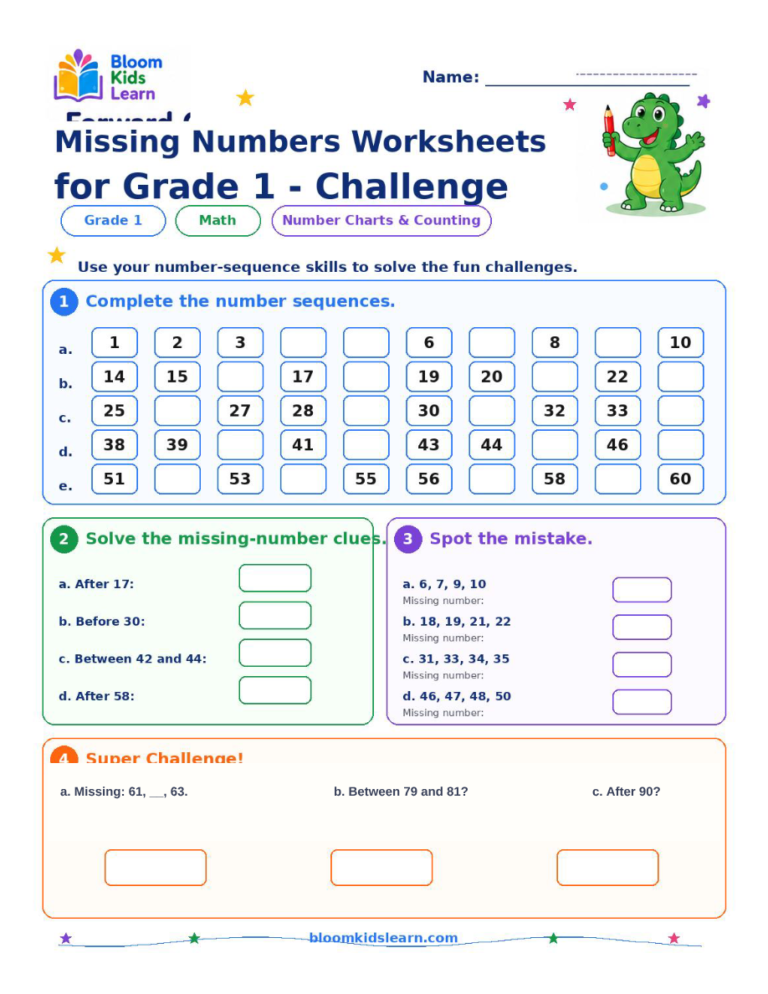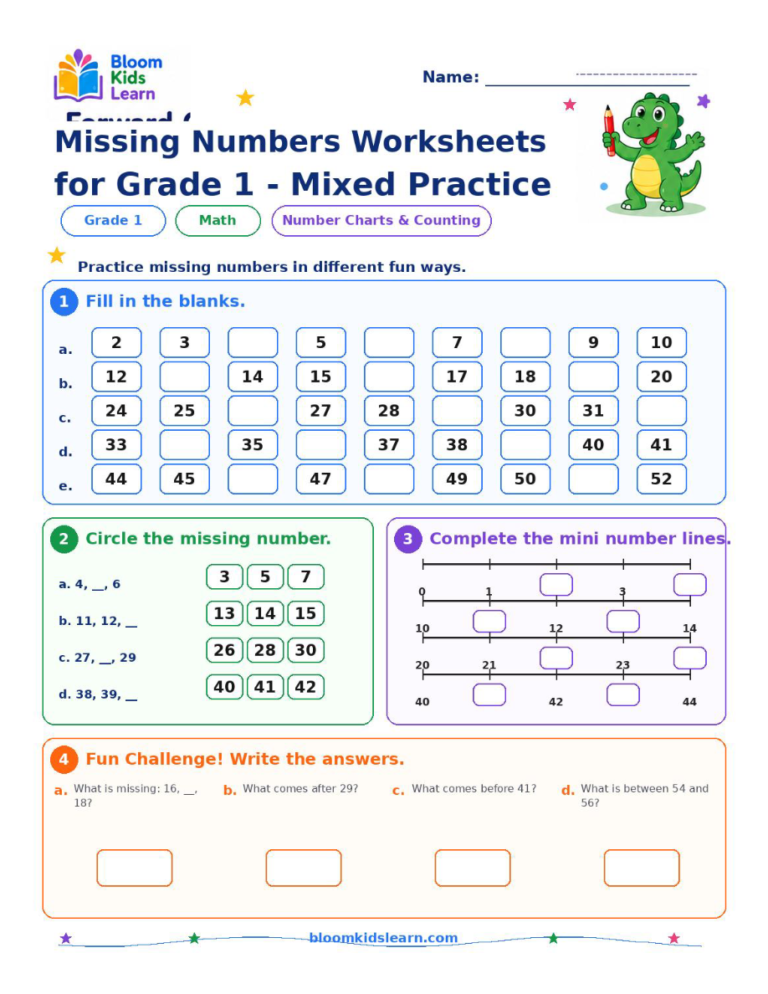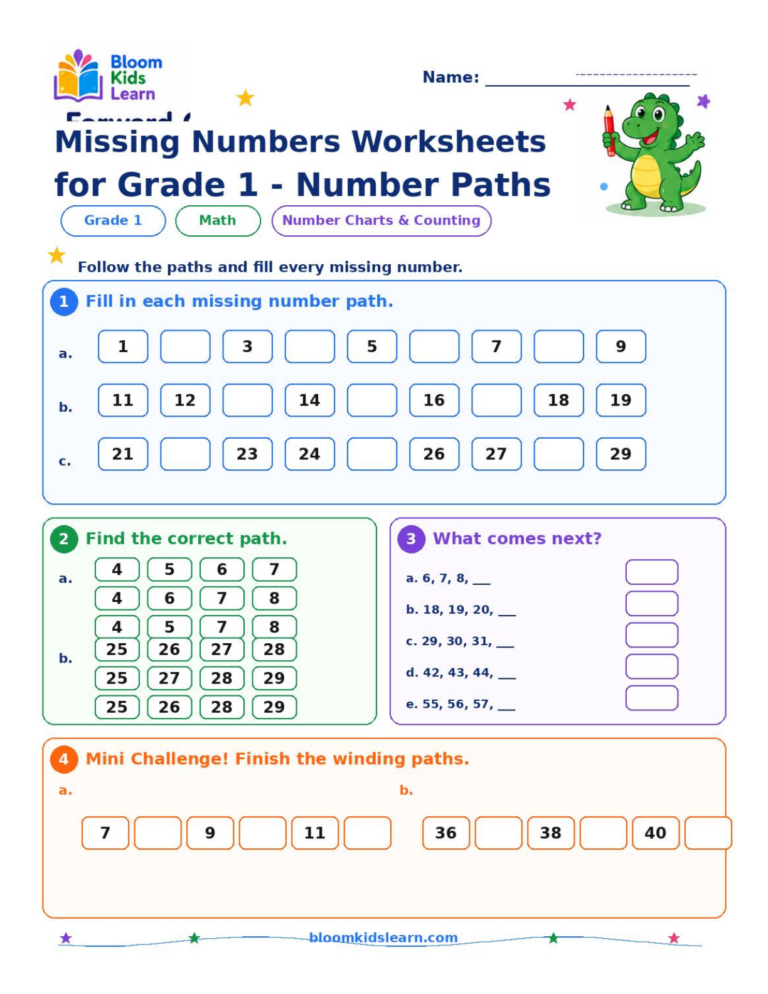

Missing Numbers Before and After Worksheet for Grade 1
- Skill: Before-and-after numbers, one more, one less, and missing numerals
- Learning goal: Identify the number before, after, and between given numbers through 50.
- Format: Printable PDF worksheet
 Download Worksheet PDF
This missing numbers before and after worksheet for Grade 1 helps children see how numbers fit together in an ordered sequence. Instead of memorizing isolated facts, learners look at a number, say the number that comes just before it, and then identify the number that comes just after it. The page also includes “between” questions, multiple-choice checks, and a short number-sandwich challenge so students use the same idea in several formats.
Missing Numbers Worksheet Skills
Before-and-after work is an important bridge between counting aloud and understanding number order. As children complete the rows, encourage them to point, speak, and write. Those three actions make the sequence visible and give an adult a quick way to notice whether a mistake comes from counting, numeral formation, or reading the prompt.
- Find the number immediately before a given number.
- Find the number immediately after a given number.
- Write the missing number between two neighbors.
- Compare choices and reject a number that skips the pattern.
- Explain an answer using “one less” and “one more.”
Grade 1 Learning Objective
After this practice, a Grade 1 learner should be able to identify one less, one more, and the number between two consecutive values through 50. A strong response is more than a correct numeral: the child can read the complete mini-sequence aloud and explain how the numbers change by one.
How to Use This Before and After Page
Begin with a short oral warm-up. Say a number such as 12 and invite the learner to respond, “11 comes before, 13 comes after.” Use fingers, a 1–50 chart, or a row of counters if a visual cue helps. In section 1, model one row from left to right. Ask the child to check the written number before moving to the next line. In section 2, have the learner read both endpoints, then write the number that belongs between them. Section 3 works well as a quick confidence check because the choices make the language of before, after, and between explicit. Save the number sandwiches for independent practice or a partner activity.
Worked Examples
For the prompt “before 15,” count back one step: 14. For “after 23,” count forward one step: 24. If the page shows 29, blank, 31, the missing value is 30 because 30 sits between 29 and 31. A number sandwich with 11 in the middle needs 10 on the left and 12 on the right. Invite the learner to read each completed row as a sentence: “Ten, eleven, twelve.”
Common Mistakes and Helpful Prompts
Some children reverse before and after when they read quickly. Place a small arrow on a number line and ask, “Which way would you move to go before?” Others write a number two steps away because they start counting from the wrong place. Have them touch the given number, take exactly one hop, and check the result. If a child chooses 25 for the number after 23, ask, “What number did we skip?” Keep the correction conversational so the learner can revise the idea rather than simply copy an answer.
Differentiation and Extension
For support, begin with numbers below 20 and let the child use a number strip. Cover the answer choices in section 3 and reveal them one at a time only if needed. For an extension, ask the learner to create three new prompts: one before question, one after question, and one between question. A partner can solve them and explain the strategy. Children who are ready for a challenge can start from 50, count backward to 44, and then describe what changed at each step.
Answer Guidance
Check each response by reading the entire sequence from left to right. Section 1 asks for one less and one more around 5, 12, 19, 27, 34, and 46. Section 2 completes 8, 9, 10; 16, 17, 18; 29, 30, 31; and 47, 48, 49. In section 3, the correct choices are 14 for before 15, 24 for after 23, 37 for between 36 and 38, and 50 for after 49. The number sandwiches are 10–11–12, 19–20–21, 32–33–34, and 47–48–49.
Related Missing Numbers Practice
After this page, use the Missing Numbers Basic Practice worksheet for longer rows. The Missing Numbers Number Lines worksheet connects the same idea to positions on a line, while the Number Paths worksheet adds movement and sequence reasoning. For extra counting-by-ones review, visit the Counting by 1s collection. The official Common Core Grade 1 standards provide useful context for counting and number relationships.
FAQs
What grade is this worksheet for?
It is written for Grade 1 math practice and can also support kindergarten enrichment or Grade 2 review.
Should children use a number chart?
Yes. A chart is a helpful scaffold at first; gradually remove it as the learner can explain one less and one more independently.
Is this a printable PDF?
Yes. The corrected file is prepared for US Letter printing and works for home practice, tutoring, math centers, or homework.

 Preview