
Missing Numbers Mixed Practice Worksheet for Grade 1
- Skill: Missing numerals, number lines, and before-and-after reasoning
- Learning goal: Find missing numbers in sequences and number lines through 52.
- Format: Printable PDF worksheet
 Download Worksheet PDF
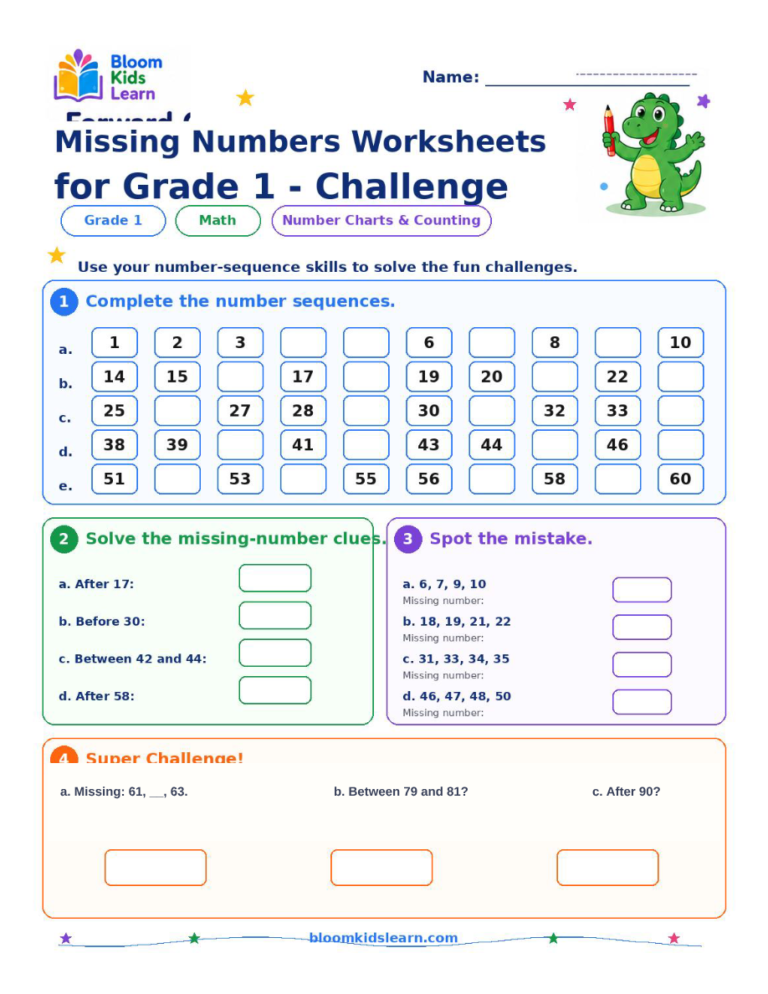
This free missing numbers mixed practice worksheet for Grade 1 gives learners several ways to use number order. Children fill gaps in long rows, choose a missing value, complete mini number lines, and answer short before-and-after questions. The changing formats are deliberate: a student may recite a sequence perfectly but still need practice finding a missing numeral when the starting point changes or a visual line is provided.
Missing Numbers Worksheet Skills
Mixed practice helps children connect counting language with written numerals. Encourage learners to say each row quietly, touch the known values, and check the step from one number to the next. This routine builds accuracy without turning the worksheet into a guessing game.
- Complete consecutive counting sequences through 52.
- Use nearby numbers to find a missing value.
- Choose the only answer that keeps a sequence in order.
- Read tick marks on short number lines.
- Answer before, after, and between questions.
Grade 1 Learning Objective
By the end of this activity, a Grade 1 learner should be able to find missing numbers in rows and number lines through 52 and explain the answer by describing what comes one step before, after, or between two values. Accuracy matters, but explaining the counting step matters too.
How to Use This Mixed Practice Page
Start with a one-minute warm-up. Pick a number between 1 and 20 and ask the child to count forward five steps. In section 1, model the first row and show how to look on both sides of a blank. Ask the learner to read the finished row from start to finish before moving down. Section 2 works well as a quick check: read the prompt, cover the choices, predict an answer, and then circle the matching choice. In section 3, point out that the tick marks are equally spaced; the missing value is found by counting from a labeled mark. Save section 4 for independent work or a short review at the end of a lesson.
Worked Examples
In the row “2, 3, __, 5,” the missing number is 4 because the sequence increases by one. For “4, __, 6,” choose 5, not 3 or 7. On a line labeled 10, 11, __, 13, the blank is 12. If the question asks, “What comes after 29?” count one step forward to 30. If it asks, “What comes before 41?” count one step back to 40.
Common Mistakes and Helpful Prompts
A common error is counting the given number as the first new step. Place a finger on the known value and say, “That is where we start; now take one hop.” Some learners read the number line backwards because the blank is below a tick mark. Ask them to trace from the labeled number toward the blank and name each stop. When a child circles more than one option, cover two choices and ask which value makes the whole sequence sound right. Keep prompts short and let the learner correct the row.
Differentiation and Extension
For support, begin with section 2 and use a 1–50 number chart. Let the child point to a number, then move one square left or right before writing. You can also complete only two rows at a time and offer a movement break. For extension, ask a learner to write a new row with three missing values and trade it with a partner. A confident child can create a number line that starts at 55, count backward, and explain how the direction changes the answer.
Answer Guidance
Check section 1 by reading each completed row aloud. The missing values are 4, 6, 8, 9, and 46, 48, 51 as appropriate to the printed rows. Section 2 answers are 5, 14, 28, and 40. On section 3, fill each tick by counting one step at a time from the labeled values: 2 and 4 on the 0–4 line, 11 and 13 on the 10–14 line, 22 and 24 on the 20–24 line, and 41 and 43 on the 40–44 line. Section 4 answers are 17, 30, 40, and 55.
Related Missing Numbers Practice
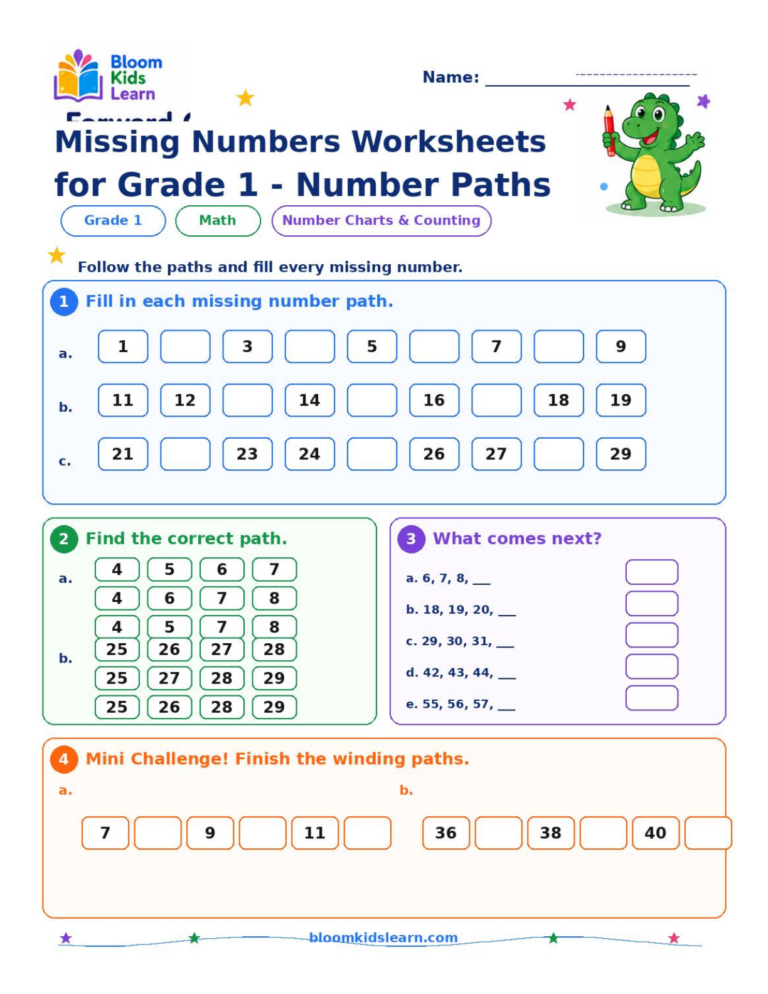
Use the Missing Numbers Basic Practice worksheet for direct sequence rows. The Before and After worksheet focuses on one less and one more, while the Number Lines worksheet adds visual position clues. Try the Number Paths worksheet when a learner is ready to move through a sequence. The Counting by 1s collection provides more forward-counting practice, and the official Grade 1 Common Core standards offer standards context.
FAQs
Who is this worksheet for?
It is designed for Grade 1 math and also works for kindergarten enrichment or Grade 2 review.
Can children use a chart?
Yes. A chart is a useful scaffold; reduce it as the child begins explaining the counting step independently.
Is the file ready to print?
Yes. The corrected PDF is prepared for US Letter paper and can be used at home, in tutoring, or in a classroom math center.

 Preview