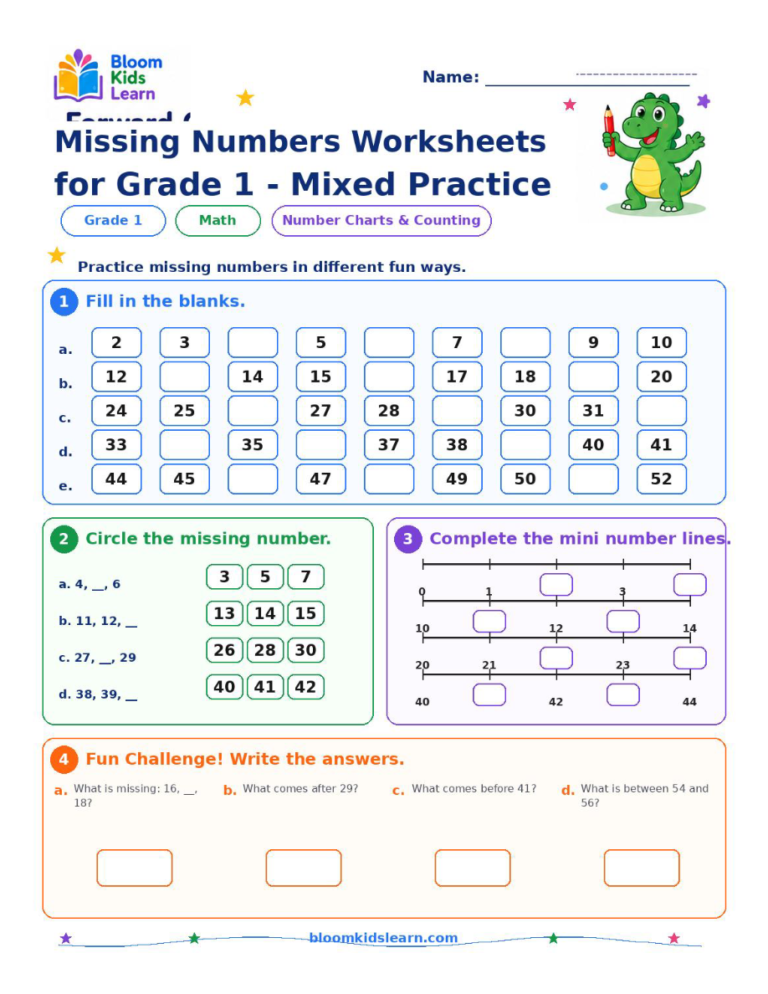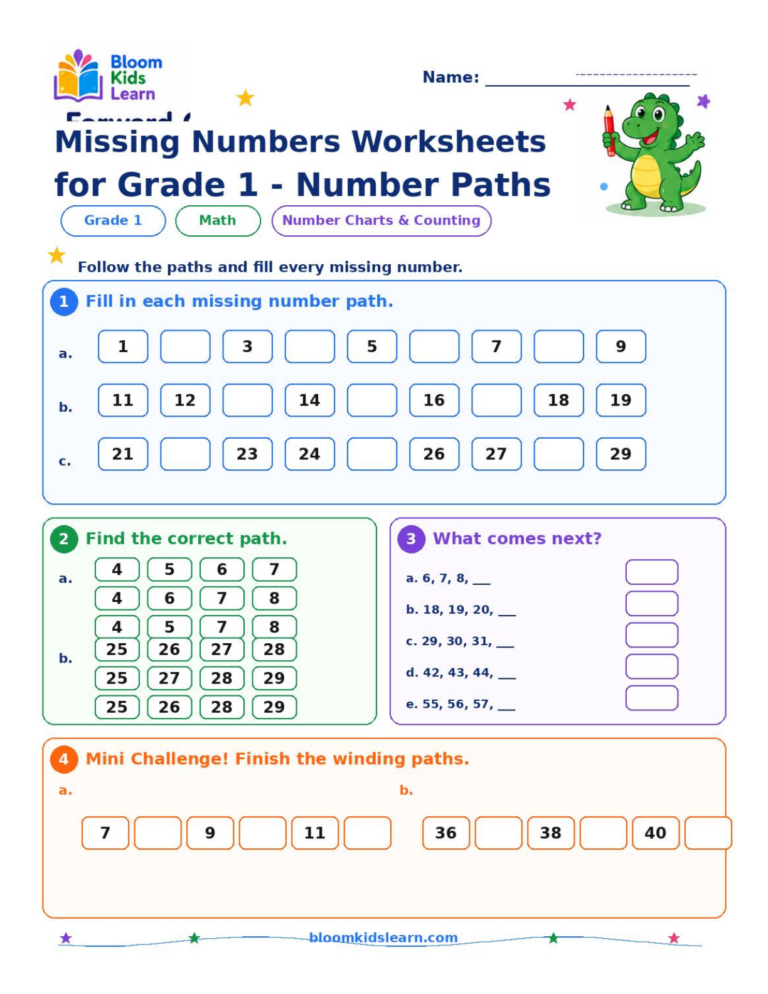

Missing Numbers Challenge Worksheet for Grade 1
- Skill: Advanced missing numbers, sequence errors, and number reasoning
- Learning goal: Solve missing-number challenges through 90 and explain sequence corrections.
- Format: Printable PDF worksheet
 Download Worksheet PDF
This free missing numbers challenge worksheet for Grade 1 is designed for learners who are ready to use number order with less support. The page combines long sequences, missing-number clues, error spotting, and a final set of problems that ask children to explain what comes before, after, or between two values. It is a useful stretch activity after basic missing-number practice because the clues are shorter and the starting numbers change.
Missing Numbers Worksheet Skills
Challenge work should still feel structured. Invite the learner to look for the smallest helpful clue, count one step at a time, and check the completed row. These habits matter more than speed and help children transfer counting knowledge to unfamiliar layouts.
- Complete sequences from 1 through 60.
- Find a number after, before, or between given values.
- Spot the missing value in an incorrect sequence.
- Explain a pattern using one more or one less.
- Work independently and check answers aloud.
Grade 1 Learning Objective
After finishing this activity, a Grade 1 learner should be able to solve missing-number problems through 90 and explain why a number belongs in a particular position. The learner should notice skipped values, use neighboring numbers, and describe a correction clearly.
How to Use the Challenge Page
Warm up with a short oral sequence such as 38, 39, 40, __, 42. Ask the child to explain the missing step before opening the page. Section 1 is a broad review: complete each row, then read it from left to right. Section 2 is a clue section; ask the learner to underline the word after, before, or between before writing. In section 3, the sequence contains one missing value. The learner should write the value that repairs the row, not simply copy a nearby number. Section 4 is the independent super challenge. Allow a number chart for the first attempt, then invite the child to try again without it.
Worked Examples
In “1, 2, 3, __, __, 6,” the missing values are 4 and 5. For “After 17,” move one step forward to 18. For “Before 30,” move one step backward to 29. A sequence “6, 7, __, 9” needs 8 because the numbers increase by one. If a row reads “18, 19, 21, 22,” the missing number is 20. For “Between 79 and 81,” the only whole number that fits is 80.
Common Mistakes and Helpful Prompts
Children sometimes fill a blank with a number that looks close but does not preserve the whole sequence. Ask them to read three values before and after the blank. Another error is solving the clue in the wrong direction. Point to the given number and say, “Before means one step back; after means one step forward.” In the error-spotting section, learners may write the first number they notice rather than the missing value. Have them circle the gap in the spoken sequence and then write it.
Differentiation and Extension
For support, let the child complete section 2 first and use a 1–100 chart. Cover extra rows so only one challenge is visible at a time. For extension, ask the learner to write a new sequence with two blanks and one deliberate mistake, then trade it with a partner. A confident child can start at 90 and write six numbers forward orally, then reverse the direction and count six numbers backward.
Answer Guidance
Section 1 answers follow consecutive counting: rows include 4 and 5; 16, 18, 21, and 23; 26, 29, 31, and 34; 40, 42, 45, and 47; and 52, 54, 57, and 59. Section 2 answers are 18, 29, 43, and 59. Section 3 missing values are 8, 20, 32, and 49. Section 4 answers are 62 and 64 for the first sequence, 80 for the between clue, and 91 for the “after 90” clue.
Related Missing Numbers Practice
Use the Missing Numbers Mixed Practice worksheet for a gentler mix of formats. The Before and After worksheet gives focused one-less and one-more practice, while the Number Paths worksheet adds sequence movement. Visit the Counting by 1s collection for more practice, and consult the official Grade 1 Common Core standards for context.
FAQs
Is this worksheet suitable for every Grade 1 learner?
It is best after basic sequence practice, but adults can choose only the sections that match a learner’s readiness.
Can a child use a number chart?
Yes. A chart is a scaffold, not a shortcut. Remove it when the child can explain the counting step.
Is the corrected PDF print-ready?
Yes. It is formatted for US Letter printing and works for independent practice, tutoring, or a math center.
Self-Check Routine
Before handing in the page, ask the learner to choose three answers and prove them aloud. They can name the number before, name the number after, and then read the complete sequence. If an answer still feels uncertain, use a pencil to mark the known neighbor and count one step. This simple routine turns checking into a math habit and helps children notice whether an error came from reading the clue or from writing the numeral. Celebrate a clear explanation, not just a fast page.

 Preview