
Short Vowel Worksheets for Grade 1
Explore six printable Grade 1 short-vowel resources, a practical learning order, teaching notes, and a complete answer key.
- Skill: Short vowel reading, spelling, and sound discrimination
- Learning goal: Help adults select focused or mixed short-vowel practice that matches a learner's needs.
- Format: Printable PDF worksheet
- Answer key: Separate PDF available
 View Answer Key
These Grade 1 short vowel worksheets give children focused practice with short A, E, I, O, and U, followed by a mixed-vowel review. The six printable worksheets use familiar words such as cat, bed, pig, dog, and sun to practice hearing the middle vowel sound, blending words, matching pictures, completing missing vowels, and reading simple sentences.
Teachers and parents can use one vowel worksheet at a time or move to the mixed review when a child is ready to choose between all five short vowel sounds.
Each resource has a different purpose. The five vowel pages introduce and reinforce one sound at a time; the mixed worksheet removes that clue and asks children to decide which vowel belongs in each word. All six PDFs are designed for printing on US Letter paper and share one complete answer key.
Grade 1 short-vowel worksheet collection
Short A Words Worksheet
This worksheet focuses on short a words such as cat, hat, map, and bag.
Children work with pictures, identify words with the short-a sound, complete missing letters, and use the words in simple reading and writing activities.
This is a good place to begin if short vowel sounds are new to the child.
Practice includes:
- hearing short a in words;
- reading simple short-a words;
- matching words and pictures;
- completing missing vowels; and
- using short-a words in simple sentences.
Short E Words Worksheet
The Short E worksheet gives children practice with words such as bed, hen, pen, net, red, and leg.
Short e can sometimes be difficult to distinguish from short i, so I like to have children say the word before they write anything.
For example, say bed slowly enough for the child to notice the middle sound. Then have them blend the word normally: /b/ /e/ /d/ → bed.
Practice includes:
- identifying the short-e sound;
- blending short-e words;
- matching pictures and words;
- filling in the missing e; and
- reading simple sentences.
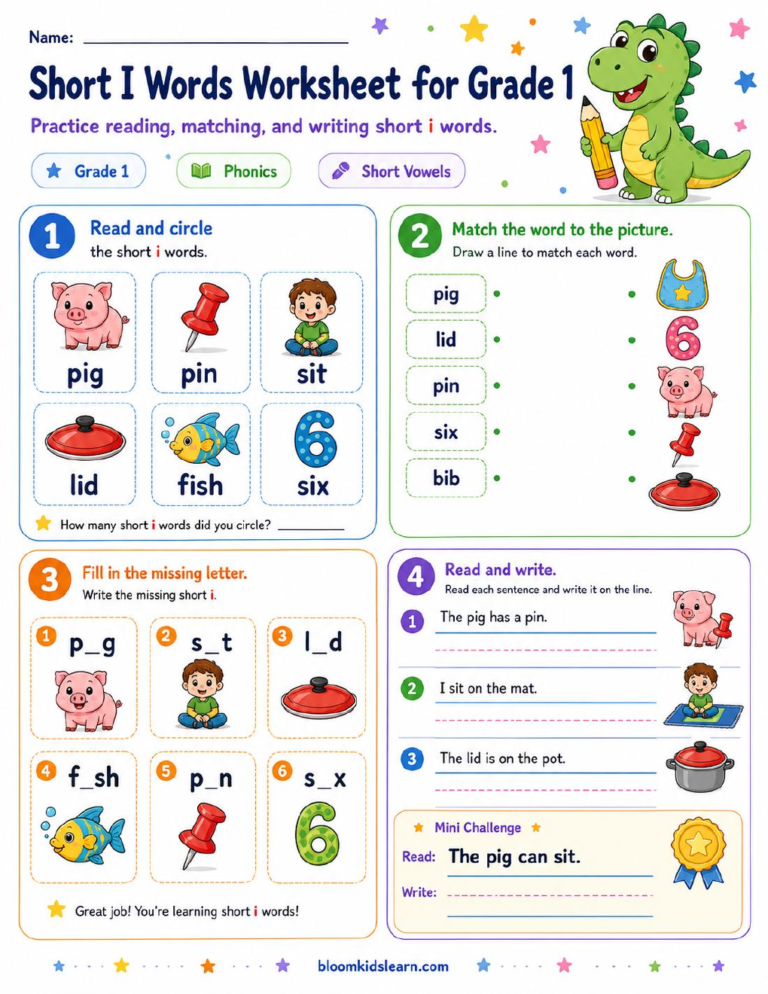
Short I Words Worksheet
This worksheet practices short i through words such as pig, pin, sit, lid, fish, and six.
Children first work with familiar words and pictures before moving into spelling and sentence practice.
If a child confuses i and e, don’t simply tell them which letter to write. Say two contrasting words such as pin and pen and ask them to listen carefully to what changes in the middle.
Practice includes:
- listening for short i;
- blending words from left to right;
- connecting pictures with printed words;
- completing missing vowels; and
- reading and writing simple sentences.
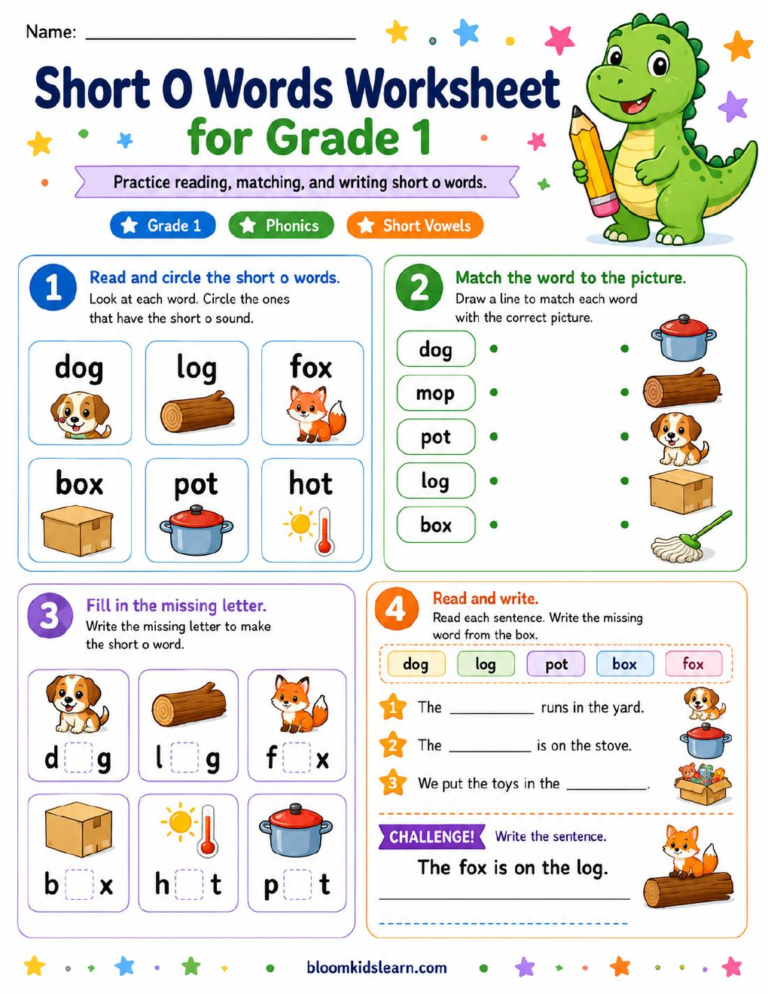
Short O Words Worksheet
The Short O worksheet uses familiar words such as dog, log, fox, box, pot, and hot.
Pictures give children some support, but I would still ask the child to read the word before using the picture to check the answer.
If the child sees dog, for example, encourage them to say each sound and then blend the whole word rather than identifying it only from the illustration.
Practice includes:
- hearing short o in the middle of words;
- reading common short-o words;
- matching words to pictures;
- completing missing letters; and
- reading short sentences.
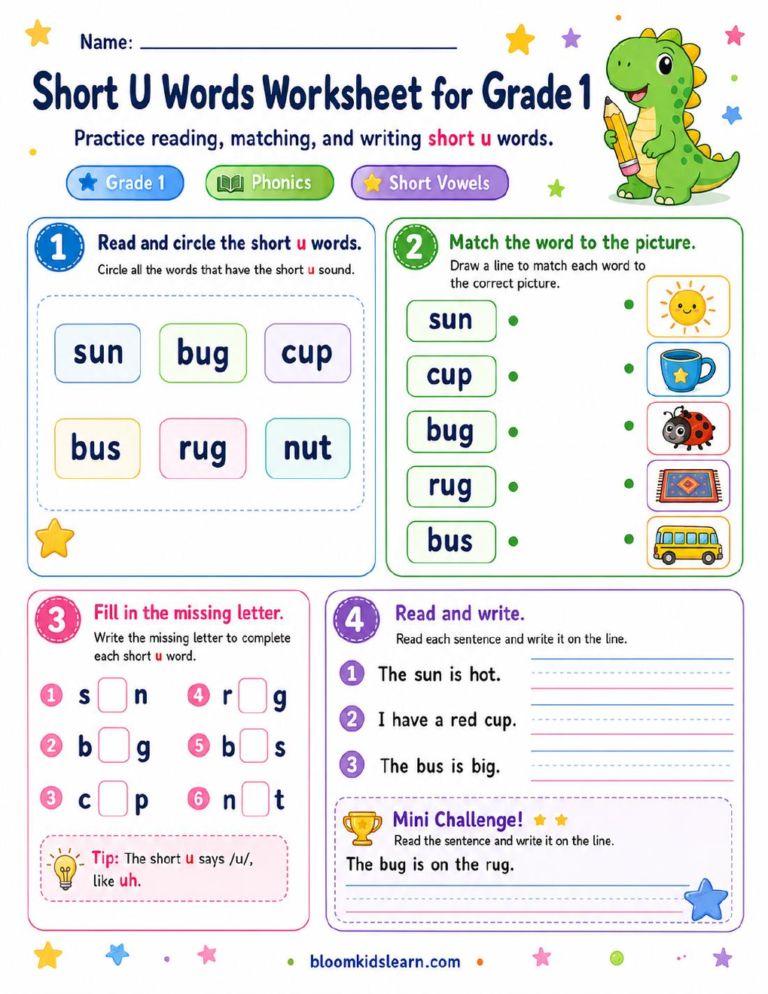
Short U Words Worksheet
This worksheet focuses on words such as sun, bug, cup, bus, rug, and nut.
One thing children sometimes do with the letter u is say its letter name—“you”—instead of using its short sound inside the word.
If that happens, show the child the letter and explain the difference simply:
“The letter is called U. In the word sun, it makes the short /u/ sound.”
Then say the sounds separately:
/s/ /u/ /n/
and blend them back together:
sun.
Practice includes:
- recognizing short u;
- blending short-u words;
- matching words and pictures;
- writing the missing middle vowel; and
- using short-u words in sentences.
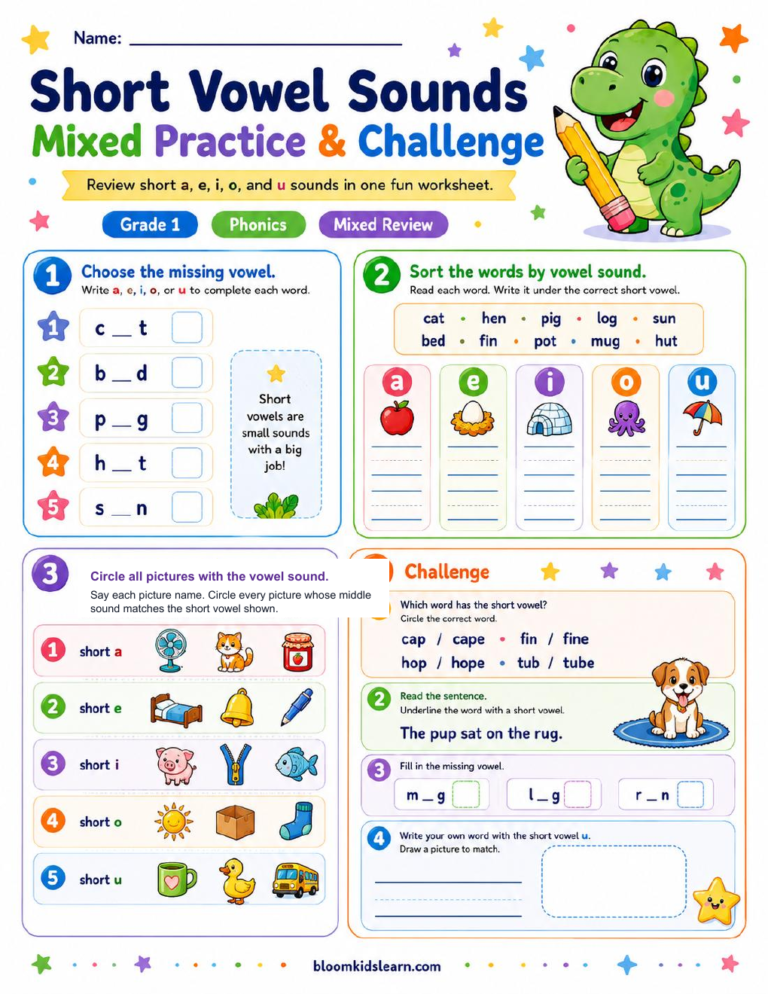
Mixed Short-Vowel Practice
I recommend saving this worksheet until children have had some experience with the five individual vowels.
There is an important difference between focused and mixed practice.
On a Short A worksheet, the child already knows that most answers are connected with a. On a mixed worksheet, they have to listen to the word and decide whether the missing vowel is a, e, i, o, or u.
That makes mixed practice useful for seeing whether the child can actually tell the vowel sounds apart.
Activities include missing vowels, word sorting, picture questions, short-vowel choices, sentence reading, and independent word work.
Download the complete answer key for all six worksheets.
What’s Included in this worksheet pack?
This printable set includes:
- 5 focused worksheets for short A, E, I, O, and U
- 1 mixed short-vowel review
- picture-supported reading activities
- missing-vowel spelling practice
- word and picture matching
- simple sentence practice
- challenge activities
- a complete answer key
What are short vowel sounds?
The letters a, e, i, o, and u can represent different sounds in English.
For this Grade 1 practice, children are working with the common short vowel sounds heard in:
- a — cat
- e — bed
- i — pig
- o — dog
- u — sun
Many beginning phonics words follow a CVC pattern.
CVC simply means:
consonant + vowel + consonant
For example:
cat = c + a + t
bed = b + e + d
pig = p + i + g
log = l + o + g
sun = s + u + n
These words are useful because children can practice looking at each letter, saying the sounds, and blending them into a complete word.
Not every useful short-vowel word is a perfect three-letter CVC word. A word such as fish, for example, still gives useful short-i practice even though the final sound is written with two letters.
A simple practice order
One manageable route is Short A → Short E → Short I → Short O → Short U → Mixed Review. This is a practice path, not a rule. A school program may introduce the sounds in a different sequence, and a child may need more attention on one contrast than another.
- Introduce one sound. Say several example words and listen for the middle sound before showing the spelling.
- Read with picture support. Blend the letters, then use the illustration to confirm meaning.
- Match and spell. Connect printed words to pictures and write the vowel that is missing.
- Remove some visual help. Reread familiar words after the picture is covered.
- Mix the vowels. Ask the child to select the middle vowel without announcing it in advance.
How I Would Use These Worksheets?
I wouldn’t begin by handing the child the worksheet and asking them to complete the whole page.
Start with the sounds.
Choose a few words from the worksheet and say them together. Ask the child to listen for the sound in the middle.
For example:
“Let’s say cat. What sound do you hear in the middle?”
Then break it into sounds:
/c/ /a/ /t/
Blend it again:
cat
After doing one example together, let the child try another.
Pictures are helpful, especially for beginning readers, but encourage children to look at the letters too. If they can answer every question by looking only at the pictures, they aren’t getting much reading practice.
A simple trick is to cover the picture after the child completes a word and ask them to read the word again.
How Do I Know When My Child Is Ready for Mixed Vowels?
Try five words without telling the child which vowel you are practicing:
cat — bed — pig — dog — sun
Ask the child to read them or tell you the middle sound.
They don’t have to be perfect.
If they can work through most of the words and are beginning to distinguish the different middle sounds, try the mixed worksheet.
If one particular vowel causes repeated difficulty, go back to that vowel for a little more focused practice.
For example, if cat, dog, and sun are easy but bed and pig keep getting mixed up, spend some time comparing short e and short i.
What Should I Do If My Child Keeps Guessing?
Guessing usually tells you that it’s time to make the task smaller.
Instead of giving five vowel choices, give two.
For example:
pen / pin
Say both words naturally.
Ask:
“Which one has the middle sound you hear in pig?”
You can also use letter tiles or small cards. Build pen, then replace only the vowel to make pin.
The child can see that one small letter change also changes the sound and the word.
Once the difference becomes easier to hear, return to the worksheet.
Practical teaching notes to teach Short vowel sounds.
- Say a word naturally before segmenting it. Overstretching a vowel can change the sound children are meant to hear.
- Ask learners to blend every option when two words look similar. Pictures should confirm reading, not replace it.
- Accept accent differences while teaching the sound-letter relationship used in the child’s speech and curriculum.
- Move from oral sounds to print, then from picture-supported print to words and sentences without pictures.
- Stop and reteach a specific contrast when errors repeat; more questions are not always more instruction.
Short-vowel questions
What are the five short vowel sounds?
They are the common vowel sounds represented here by a in cat, e in bed, i in pig, o in dog, and u in sun.
What is a CVC word?
CVC means consonant-vowel-consonant. Words such as map, red, fin, log, and cup follow this spelling shape and are useful for early blending.
Which short vowel should I teach first?
Follow the child’s school phonics sequence when possible. Short a is a common starting point, but consistency between classroom and home is more important than one universal order.
How much practice does a first grader need?
A few attentive minutes can be more useful than a long session. Finish one section, reread several words, and stop before guessing or fatigue takes over.
Why does my child mix up short vowels?
The sounds occur quickly inside words, and some pairs—especially short e and short i—can be close in speech. Oral comparisons, sound counters, and letter tiles help children notice the middle position.
Where to go next
Once the learner can identify and blend short vowels in mixed words, move into Grade 1 CVC word practice. CVC activities ask children to apply the same sound knowledge while building words, sorting word families, reading sentences, and working with less picture support.
 Preview
 PDF
PDF