
Short Vowels for Kids: Examples, Long vs. Short Vowels & Worksheets
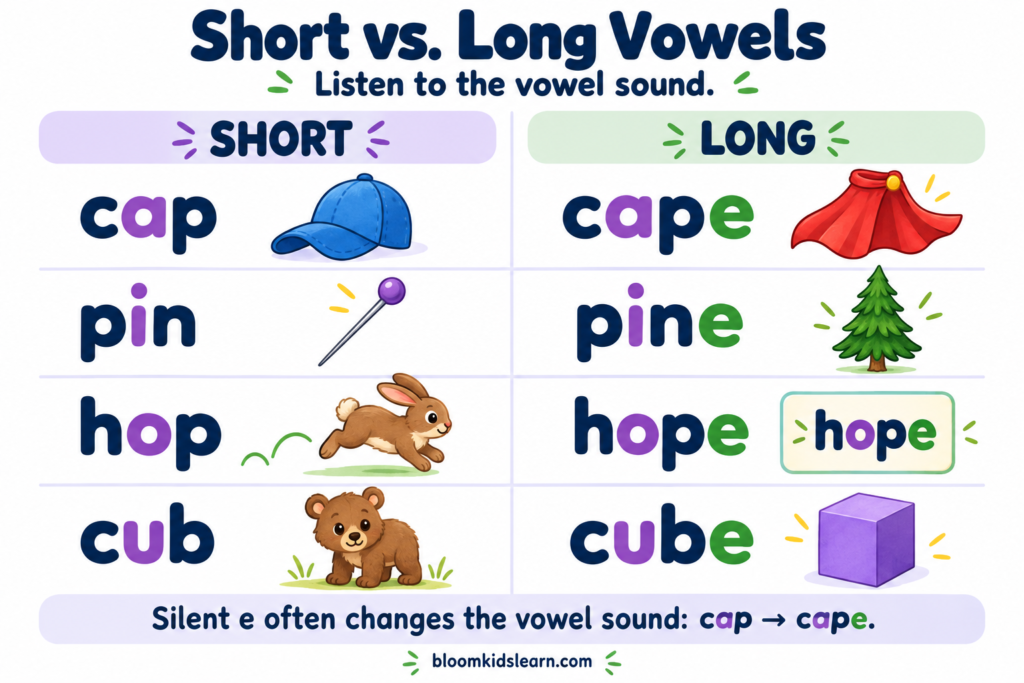
Say cap. Now say cape. One extra letter changes the vowel sound—and the word. That small difference can be puzzling when a child knows the alphabet but is just starting to read.
This guide explains short vowels with familiar words, compares them with long vowels, and gives you simple ways to practice. Looking for printable activities? Jump to the short-vowel worksheets below.
💡 Teacher’s Note
When I introduce short vowels to beginning readers, I start with listening before showing the letters.
For example, I say three words aloud: cat, map, sun. I ask, “Listen carefully to the middle sound. Which two words sound alike in the middle?” I repeat the words slowly if needed: cat … map … sun. Children usually begin to notice that cat and map share the same middle /a/ sound.
Then I write cat and map on the board and underline a in both words. We say the words together and stretch only enough to notice the sounds: c-a-t, m-a-p. Next, I change just one letter to make cat → hat → mat. Children read each new word and tell me what stayed the same. This helps them see that although the beginning sound changes, the short a sound remains.
I then check whether they can use the idea independently. I say sun, bag, fan and ask, “Which two have the short-a sound?” Instead of giving the answer immediately, I ask the child to say each word and listen to the middle sound.
Finally, children write one or two short-a words and use one in a simple sentence, such as “The cat is on the mat.”
What I look for: I do not consider the activity successful just because a child can circle the letter a. I check whether the child can hear the sound, connect it to the letter, blend it in a word, and read the word without depending on a picture.
— Shekhar Dhama, Primary Teacher | M.A. Psychology | PGDGC | Teaching since 2017
What are short vowels?
Short vowels are the vowel sounds heard in words such as cat, bed, sit, hot, and sun. In early phonics, children usually learn five short-vowel sounds, associated with the letters a, e, i, o, and u.
Think about the middle of cat. The a represents the short-a sound, not the letter name you say when reciting the alphabet. Knowing a letter’s name and recognizing its sound in a word are related—but different—skills.
“Short” does not mean the word has to be short, and it doesn’t tell children to rush the sound. It is a phonics label. Start with clear spoken examples instead of asking a learner to judge how long a sound lasts.
Short vowel examples: a, e, i, o, and u
Read one row aloud, then invite your child to repeat the words. Listen for the vowel in the middle rather than the first consonant.
| Vowel | Anchor word | More examples |
|---|---|---|
| Short a | cat | map, bag, hat, jam |
| Short e | bed | hen, pet, red, ten |
| Short i | sit | pig, pin, lip, fin |
| Short o | hot | pot, mop, fox, log |
| Short u | sun | cup, bus, mud, rug |
These examples use common U.S. English pronunciations. Vowels can sound different across accents, especially short o. Model words naturally in the child’s variety of English; an accent difference is not automatically a reading mistake.
Many beginning words follow a consonant–vowel–consonant, or CVC, pattern: c-a-t, b-e-d, s-i-t. With suitable words, children can connect three individual sounds to their spellings, then blend them into a whole word. Use words containing consonant sounds the learner already knows.
Long vs. short vowels: what changes?
A long vowel usually sounds like the vowel’s letter name. Compare the a in cap with the a in cape. Short a and long a are different sounds—not simply the same sound spoken quickly or slowly.
| Vowel | Short sound | Long sound |
|---|---|---|
| a | cap | cape |
| e | bed | feet |
| i | pin | pine |
| o | hop | hope |
| u | cub | cube |
The comparison chart uses more than one spelling pattern. Feet has the vowel team ee; cape, pine, hope, and cube have a final silent e. Long u also needs a little care: phonics programs commonly include both the sound in cube and the “oo” sound in flute when teaching long-u spellings.
For a first lesson, you don’t need every pattern at once. Work with one contrast, such as cap/cape, until the child can hear and read the difference. Add another pair when that distinction makes sense.
Two spelling clues worth teaching
A consonant after the vowel often keeps it short
In a closed syllable, one vowel is followed by one or more consonants, and the vowel is usually short. Cat, bed, and sit are simple starting examples. Later, children can meet words such as fish and hand, which also have short vowels but are not simple three-letter CVC words.
A final silent e often signals a long vowel
Put cap on paper. Read it together, add an e, then read cape. The final e isn’t spoken as an extra syllable in this word. Repeat with pin/pine or hop/hope.
Treat this as a useful pattern, not a promise about every word ending in e. Have and give are familiar exceptions. Long vowels can also appear without silent e, as in me, rain, and boat. Reading Rockets’ phonics guidance explains closed syllables, vowel–consonant–e patterns, and other syllable types in more detail.
How to teach short vowels without making it confusing
Start with listening
Say map, cat, and sun. Ask which two share the same middle vowel sound. If the child chooses map and cat, have them say both again. This oral activity lets you check listening before handwriting or printed letters become part of the task.
If the choice is difficult, use just two words and model the comparison. There is no need to introduce all five vowels in one sitting.
Connect the sound to a letter
Write mat and say its three sounds. Point to the corresponding letter as you say each sound, then blend them into mat. Ask the child to point to the letter representing the middle sound. Say the whole word again so the exercise stays connected to reading, rather than becoming a list of disconnected sounds.
Keep consonant sounds clean. Adding a strong “uh” after every consonant can make blending harder. Reading Rockets describes the connection between letters, sounds, and whole-word reading in its phonics and decoding overview.
Change one sound at a time
Build pet with letter cards, then replace e with i to make pit. Ask what changed in the spelling and what changed in the spoken word. Keeping the beginning and ending steady draws attention to the vowel.
After reading, dictate one of the words. Let the child say its sounds and choose the letters. This checks whether they can use the sound–spelling connection in both directions.
Finish with meaning
Reading the word accurately matters, but so does understanding it. Ask the learner to use cup in a spoken sentence or show what hop means. Then try a short written sentence made from words they can decode, such as The pig is in mud, providing help with any unfamiliar word.
Short vowel worksheets for Grade 1
Choose the vowel your child is practicing rather than printing every page at once. Open these Bloom Kids Learn worksheet pages to see the previews and available download options.
- Short A Words Worksheet for Grade 1
- Short E Words Worksheet for Grade 1
- Short I Words Worksheet for Grade 1
- Short O Words Worksheet for Grade 1
- Short U Words Worksheet for Grade 1
- Short Vowel Sounds Mixed Practice
- Browse the Short Vowel Worksheets for Grade 1 collection
Before a picture activity, agree on the object’s name. A child might call an image a puppy when the intended word is dog; that changes the sounds they are analyzing. Afterward, ask them to read a few words without the pictures. This helps you distinguish word reading from picture guessing.
These links support short-vowel practice, rather than a complete set of long-and-short-vowel comparison worksheets.
When a child mixes up vowel sounds
If a child reads pin as pen, return to those two words instead of correcting an entire list at once. Say each naturally, let the child repeat it, and point to the different middle letter. In some accents, vowels before n sound alike; choose another contrast, such as pet/pit, when needed.
If they say a vowel’s letter name in every word, compare cap and cape again. Ask them to look through the whole word before choosing the sound. Avoid teaching “one vowel always means short” or “two vowels always means long.” English spelling has patterns and exceptions, not one rule that solves every word.
Quick questions about short vowels
Are short vowels always in the middle?
No. They can occur at the beginning of words such as ant, end, ink, on, and up. Middle sounds in simple CVC words are just a convenient starting point.
Should children learn short or long vowels first?
Many early phonics sequences introduce short vowels in simple words before silent-e and vowel-team patterns. Follow the child’s school sequence where possible, and move on based on understanding rather than a fixed number of worksheets.
Is every vowel sound either short or long?
No. English also has sounds and patterns such as oi in coin, ou in out, and vowel–r combinations. The five short vowels and common long-vowel patterns are a starting framework, not the whole vowel system.
What should we practice today?
Pick one sound, read a few suitable words, and try a matching worksheet. End by asking the child to explain one answer. A clear connection between the spoken sound and the written letter is a better sign of progress than a page finished through guessing.