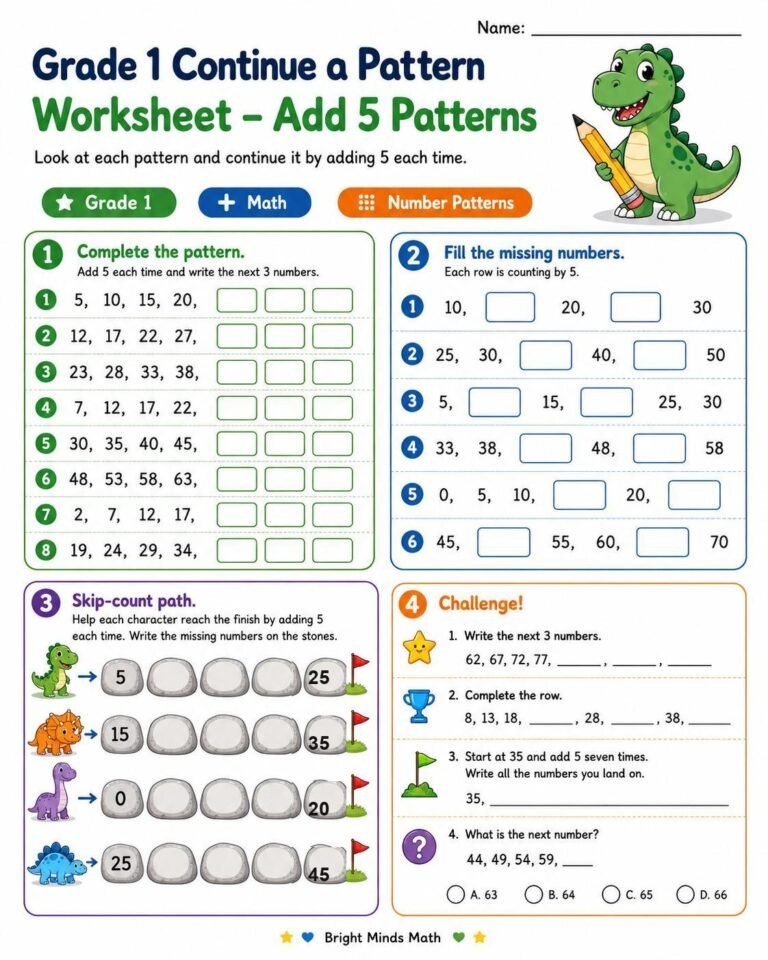
Number Pattern Challenge Worksheet for Grade 1
A Grade 1 number-pattern challenge with increasing and decreasing rules, number paths, error correction, and rule reasoning. Includes answers.
- Skill: Solve and explain multi-rule number pattern challenges
- Learning goal: Identify, extend, and repair increasing and decreasing patterns using constant and doubling rules.
- Format: Printable PDF worksheet
- Answer key: Separate PDF available
 Download Worksheet PDF
 View Answer Key
This number pattern challenge asks Grade 1 learners to do more than fill the next blank. Children must compare increasing and decreasing sequences, follow paths, spot an incorrect term, and name a rule. It is best used after focused work with equal jumps, when you want to see whether the child can select a strategy without being told what to add or subtract.
What the challenge measures
Section one contains eight different patterns, including +2, −3, +5, −2, +3, and −10. Section two mixes familiar skip-counting with an add-3 sequence and a doubling pattern. The number paths require children to infer the rule from printed stones. The big challenge asks them to continue +4, repair 4, 8, 12, 17, 20, 24, extend a doubling sequence, and choose the next two multiples of 6.
Teach children to prove a rule
Encourage a three-step explanation: name the direction, state the size of the change, and test it twice. In 7, 11, 15, 19, 23, the numbers increase; each jump is 4; and +4 works from 7 to 11 and from 11 to 15. Therefore 27 and 31 follow. This short proof is more reliable than choosing a rule because the numbers “look right.”
For a decreasing example, use 18, 15, 12, 9, 6. Subtracting 3 twice confirms the rule, so the next values are 3 and 0. The corrected worksheet keeps decreasing answers at zero or above, making the task mathematically appropriate for this level.
What different mistakes may mean
- Correct continuation but wrong rule name: review add, subtract, and multiply vocabulary.
- One correct answer followed by an incorrect one: the child may have guessed instead of repeating the rule.
- Failure on 3, 6, 12, 24: explain doubling with equal groups; this is the page’s stretch item.
- Replacing 17 with 16 but not checking 20 and 24: ask the learner to verify the repaired row from start to finish.
Use it as a short assessment
Complete the page in two sittings if needed. Avoid explaining each rule before the child attempts it; instead, ask, “How did you decide?” Record whether errors involve direction, jump size, calculation, or rule vocabulary. That observation tells you which focused worksheet to use next.
Answers and follow-up
The dedicated answer key PDF includes every challenge response and the corrected wrong-number row. For targeted review, return to the mixed number patterns worksheet or select an add-2, add-5, or add-10 page from the complete Continue a Pattern collection. Children ready for more rule identification can also try the Find the Pattern Rule worksheet.
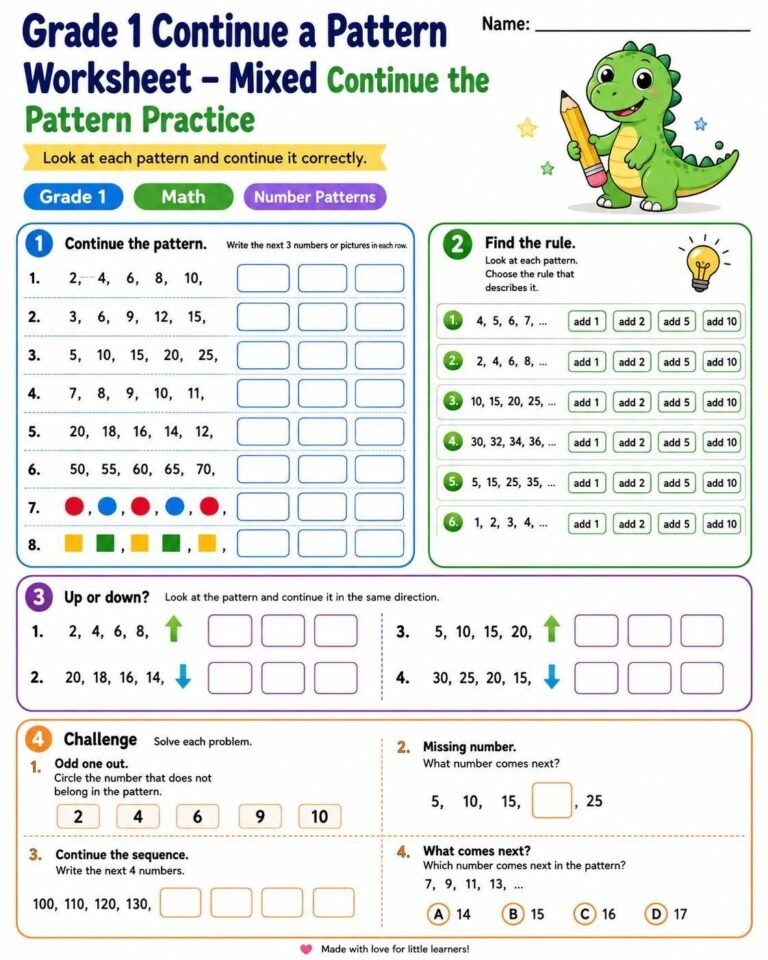
 Preview