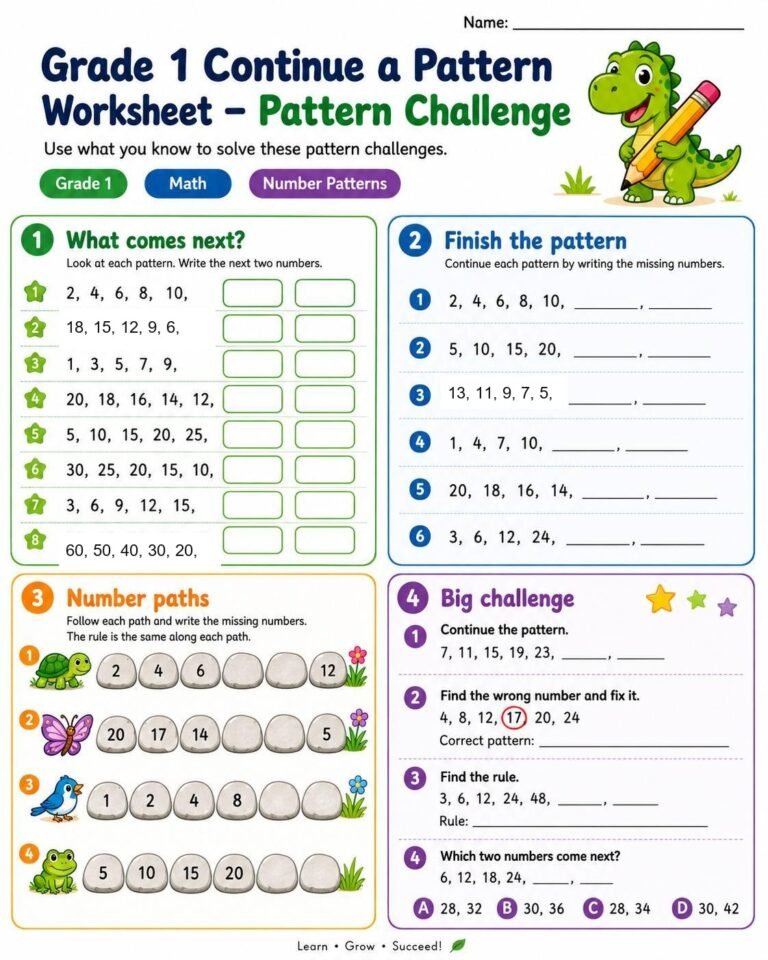

Find the Pattern Rule Worksheet for Grade 1
A printable Grade 1 worksheet for naming, choosing, and matching the rule behind each number pattern.
- Skill: Describe number pattern rules using add and subtract language.
- Learning goal: Compare consecutive terms, identify the constant change, and state the pattern rule.
- Format: Printable PDF worksheet
 Download Worksheet PDF
Completing a sequence shows that a child can use a pattern. Naming the rule shows that they understand how the pattern is built. This find the pattern rule worksheet asks Grade 1 learners to write, choose, and match rules such as add 1, add 2, add 5, subtract 1, subtract 2, and subtract 5.
The numbers remain readable and the step sizes are familiar, so attention stays on the relationship between consecutive terms.
How to find a number pattern rule
Start by deciding whether the sequence goes up or down. Then compare two neighboring terms to find the size of the change. In 10, 12, 14, 16, 18, the numbers increase by 2, so the rule is add 2. In 30, 28, 26, 24, 22, they decrease by 2, so the rule is subtract 2.
Finally, test the rule on every step. A rule that works only once is not enough.
Writing a rule is different from choosing one
Section 1 leaves the response open. A child may write “add 5,” “count by 5s,” or “5 more each time”; all express the same idea. Section 2 supplies three choices, which reduces the writing demand. Use the choice section first if the learner understands patterns but finds mathematical language difficult.
Rule matching makes comparison visible
In Section 3, children draw lines between four sequences and four rules. Encourage them to solve each sequence before drawing. Otherwise, crossed lines can make a correct idea look confusing. A small rule label beside each left-hand box can keep the work organized.
A worked example
Consider 15, 13, 11, 9, 7. The sequence is decreasing. The difference from 15 to 13 is 2, and 13 to 11 is also 2. The rule is subtract 2. Applying it again would make the next number 5.
What errors can tell you
If a child writes “subtract 5” for 5, 10, 15, 20, 25, they may be noticing the step size but not the direction. Ask whether the numbers are getting larger or smaller. If they choose add 2 for 6, 7, 8, 9, 10, have them count the distance between 6 and 7 rather than looking at how many terms appear.
Accept clear rule language
Young learners do not need one perfect phrase. “Add 2,” “go up by 2,” “2 more each time,” and “count by 2s” all communicate the same rule in the appropriate rows. Praise the mathematical idea, then model the concise form used on the worksheet. What matters is that the direction and step size are both clear. If an explanation is vague—“the numbers get bigger”—ask, “How much bigger each time?”
Answer guidance
The written rules are add 1, add 2, add 5, subtract 1, subtract 2, and subtract 5. In Section 2, choose add 1, add 2, subtract 2, and subtract 5. The rule matches are add 2, subtract 1, add 5, and subtract 2. The challenge uses add 4, subtract 5, and add 3, with next numbers 27, 25, and 18.
For a multiple-choice follow-up, move to the Choose the Rule Number Patterns Worksheet. Find the whole sequence of lessons on the Number Pattern Worksheets for Grade 1 page.
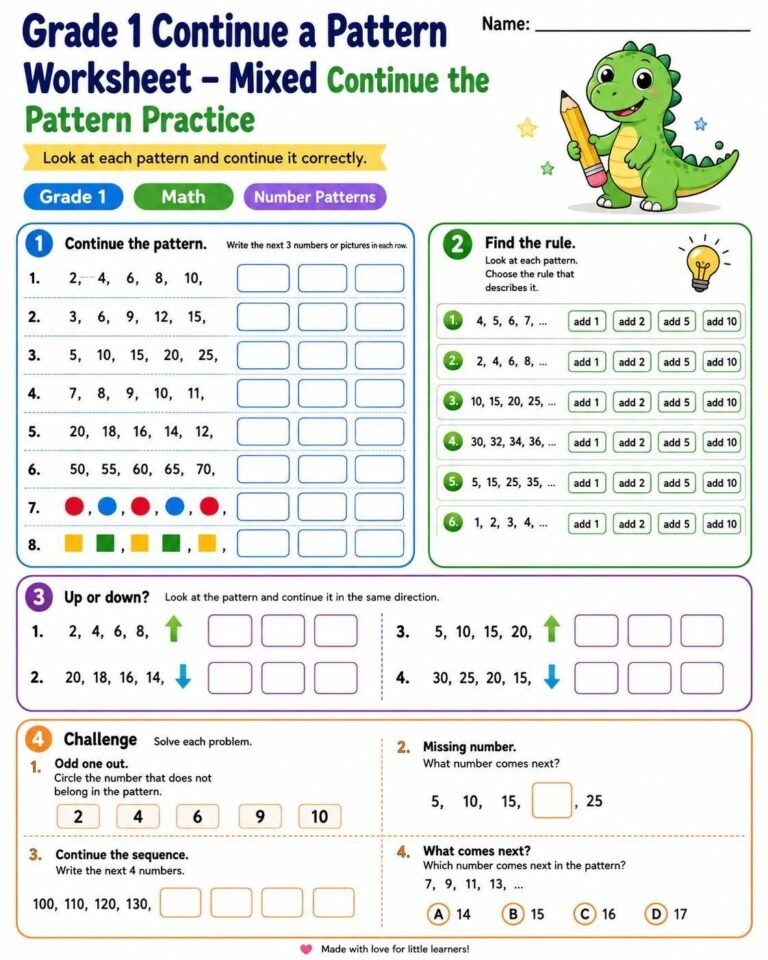
 Preview