Counting by 10s Missing Numbers Worksheet for Grade 1
Fill missing multiples of ten in number rows, lines, and trains up to 150. Includes four challenge clues, with larger numbers up to 250.
- Skill: Counting by 10s, missing numbers, number lines, ten more and ten less
- Learning goal: Find missing multiples of ten in sequences to 150, with extension clues using numbers up to 250.
- Format: Printable PDF worksheet
 Download Worksheet PDF
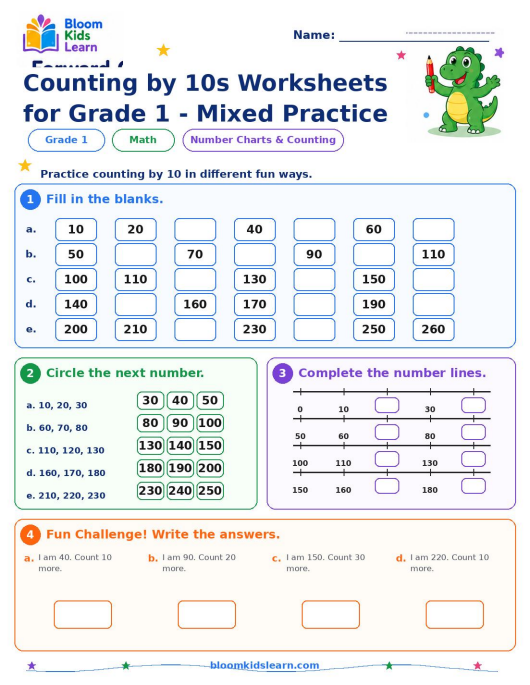
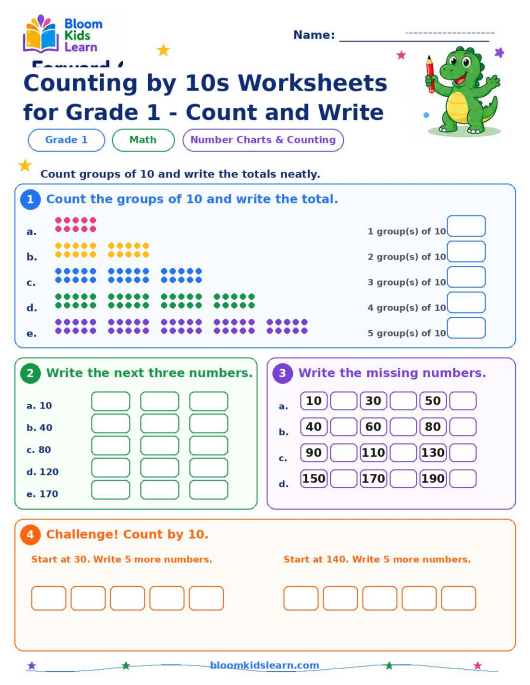
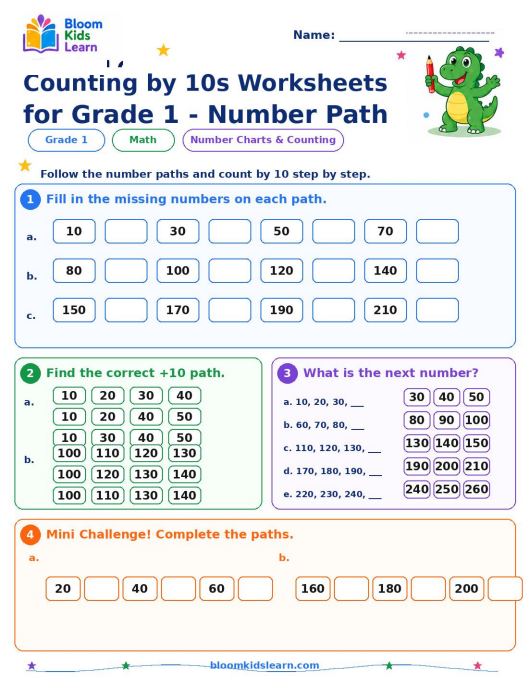
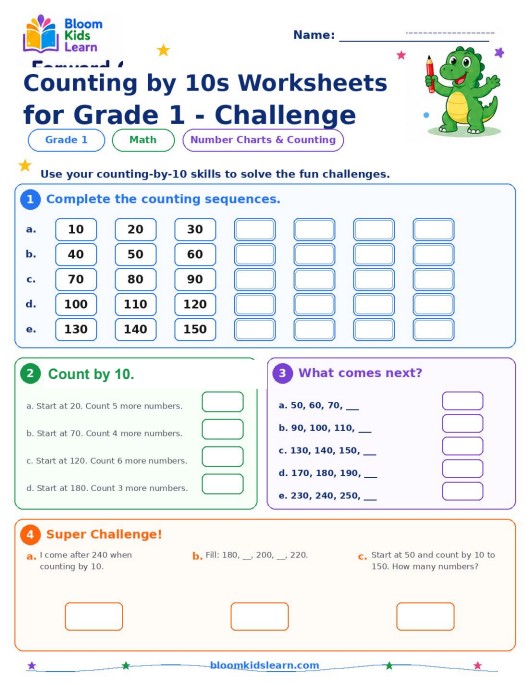
This counting by 10s missing numbers worksheet for Grade 1 asks children to use the numbers around a blank, rather than simply finish a counting chant. Its one printable page includes five number rows, three number lines, three counting trains, and four written clues.
Check the range before assigning it: the main activities work with multiples of ten up to 150. The final challenge goes further, including the number before 250 when counting by ten. Treat those larger-number clues as an extension if your learner is still working within 100.
What children will practice
The goal is to find missing multiples of ten by adding or subtracting 10 and checking neighboring values. The rows and trains offer written clues on both sides of a blank. The number lines show equally spaced steps. The final questions ask children to interpret “after,” “between,” and “before.”
Model one blank, then let the child explain
Start with the first row: 10, __, 30. Ask, “What is ten more than 10?” After the child writes 20, check the other direction: 20 plus 10 is 30. This two-sided check is useful when a missing number is in the middle of a row.
On the last counting train, 110, __, 130, __, 150 becomes 110, 120, 130, 140, 150. Point to each box as you count. The numbers cross 100, but the size of each jump stays the same.
Read the challenge clues aloud if needed. For “before 250,” ask whether the answer should be smaller or larger, then take one ten-step back to 240. In the “between 120 and 140” clue, the worksheet’s counting-by-ten rule gives 130.
Support without giving away the answer
Use bundles of ten objects to show one more or one fewer group. A chart extending to at least 150 supports the main sections; a 1–100 chart alone does not cover them all. Cover later rows if the page feels busy, and leave the larger challenge numbers for another session.
If the learner writes 31 after 30, ask them to add a group of ten, not one object. If they put 260 before 250, return to the word “before” and check the direction. Encourage an explanation such as, “240 is ten less than 250.”
Choose a useful starting number
A child does not need to begin at 10 every time a box is empty. Encourage them to look for the closest printed number. If 90 appears immediately after a blank, one step backward gives 80. If 70 appears immediately before it, one step forward gives the same answer. Being able to use either clue is more useful than memorizing where a number sits on the page.
Try this routine with one row: point to a printed number, say whether you will move forward or backward, fill one blank, then read the completed stretch aloud. Leave the other blanks for the learner. This keeps the example short while showing a strategy they can reuse independently.
Use the three layouts to check understanding
The rows, number lines, and trains ask for the same ten-step relationship in different arrangements. A learner who completes a train confidently but hesitates at a number line may need help reading the layout, rather than more practice reciting tens. Show where the line starts and explain that each marked position represents the next step in this activity.
Compare the completed number line containing 110, 120, 130, 140, and 150 with the train using that range. Ask what stayed the same and what changed. The pictures and spaces changed; the order of the numbers did not. Avoid using the physical length of a printed gap to guess an answer. The labels and the counting rule tell us what belongs there.
Make the practice manageable
For a learner who is secure below 100, select a row and a line in that range first. Move to the hundreds only after they can explain a missing value. Read larger numbers together if pronunciation is getting in the way of the mathematics. Saying “one hundred twenty” while pointing to 120 can help connect the spoken number with its written form.
For a quick independent check, cover the answer guidance and ask the child to explain one forward step, one backward step, and one middle blank. Note which kind needs support instead of judging the whole page by its total number of mistakes. As an optional extension, let the child write three consecutive multiples of ten on scrap paper, hide the middle one, and ask an adult to solve it. Their explanation should check both neighbors.
Answers for checking
No separate answer-key PDF is supplied. The missing entries, read left to right, are:
- Section 1: a. 20, 50; b. 40, 70; c. 40, 60, 80; d. 60, 80; e. 60, 90.
- Number lines: 20, 40; 70, 90; 120, 140.
- Counting trains: 20, 40; 70, 90; 120, 140.
- Challenge: a. 80; b. 130; c. 190; d. 240.
Related practice
For more supported sequences, use counting by 10s basic practice. For a different layout, try the counting by 10s number path. Choose the next page by its number range as well as its activity type.
 Preview