
Counting by 10s Mixed Practice Worksheet for Grade 1
Practice +10 number rows, next-number choices, and number lines through 260. Finish with four clues using one, two, or three jumps of ten.
- Skill: Skip counting by 10s in mixed number patterns
- Learning goal: Complete +10 patterns through 260 and use one, two, or three ten-jumps to solve more-than clues.
- Format: Printable PDF worksheet
 Download Worksheet PDF
This counting by 10s mixed practice worksheet for Grade 1 checks whether children can use the same counting rule in several formats. On one printable page, they fill number rows, circle a next number, complete number lines, and solve “more than” clues.
The sequences include numbers through 260. Use the larger-number items as extension work for learners who can already count by tens within 100. The final section also asks for 20 more and 30 more, so children need to make two or three ten-jumps rather than always one.
What is included?
- Five missing-number rows beginning at 10, 50, 100, 140, and 200.
- Five multiple-choice questions asking for one next number.
- Four number lines with two missing labels each.
- Four challenge clues asking for 10, 20, or 30 more than a stated number.
The learning objective is to apply a +10 rule across written and visual sequences, then use repeated ten-jumps to solve the challenge clues.
Use the formats to check understanding
Start with a familiar row. In 10, 20, __, 40, __, 60, __, the missing entries are 30, 50, and 70. Ask the child to read the completed row aloud and check each step.
The choice questions need only one circled answer. After 60, 70, 80, choose 90 from 80, 90, and 100. Repeating 80 makes no jump; choosing 100 skips a ten.
On the line marked 100, 110, __, 130, __, the labels are 120 and 140. Let the learner trace the spaces and explain that each equal interval represents ten. This can reveal whether they understand the spacing or are just reciting numbers.
Read the challenge carefully
“I am 90. Count 20 more” means 90 to 100 to 110. “I am 150. Count 30 more” means 150 to 160 to 170 to 180. Mark one small jump for each ten, then write only the final total in the answer box.
If a child adds ten to every clue, underline the amount to add before trying again. If they reverse digits, such as 201 for 210, ask them to read the number and show its tens with a place-value model. A chart ending at 100 will not support the whole page; use an extended number line for the larger values.
Plan a short mixed-practice lesson
Before starting, ask the child to explain what counting by tens means and continue a short sequence from a number other than 10. This tells you whether to use the page for supported practice or an independent check. It does not need to be a timed test. Give the learner enough time to read the instruction that belongs to each section.
Choose one smaller-number item from the rows, choices, and lines first. Moving between formats at a familiar level helps you see whether the learner understands the task itself. Then introduce a larger-number example. Changing the layout and the number range together can make it harder to identify why an answer went wrong.
Notice when the question changes
Most of this page uses one ten-step between neighboring numbers. The final clues deliberately change the amount to add. Ask the learner to identify the starting value and the amount of increase separately. For 30 more, they can hold up three fingers and lower one after each ten-jump. This makes the number of jumps visible without confusing three jumps with an increase of three.
Encourage children to say their route quietly before writing the final answer. The intermediate values help them reason, but the single answer box is for the endpoint. An adult can jot the route beside the page during supported practice, then let the learner attempt another clue without that written help.
Use mistakes to choose the next step
A repeated starting number in a choice question suggests the learner may not have taken the first jump. A correct pattern that breaks at 100 suggests they need practice with the change of hundred. A challenge answer that is ten too small may mean they stopped one jump early. These are different errors, so they should not all lead to the same instruction.
Record a brief note under three headings: sequence accuracy, reading the format, and repeated ten-jumps. One example in each category is more useful than simply writing “needs more practice.” Let the child correct an item and explain what changed. The explanation helps distinguish an understood correction from copying an adult’s answer.
For an optional extension, invite the learner to write a new “20 more” clue using a familiar multiple of ten. Ask them to solve it with two jumps and check it by taking two jumps back. Keep this extra task separate from the printed worksheet so it is clear which work is included in the download.
Checked answers
No separate answer-key PDF is supplied. The answers below follow the worksheet’s order:
- Section 1, blank entries: a. 30, 50, 70; b. 60, 80, 100; c. 120, 140, 160; d. 150, 180, 200; e. 220, 240.
- Section 2, circle: 40, 90, 140, 190, 240.
- Section 3, number lines: 20, 40; 70, 90; 120, 140; 170, 190.
- Section 4, challenge: 50, 110, 180, 230.
Choose follow-up practice
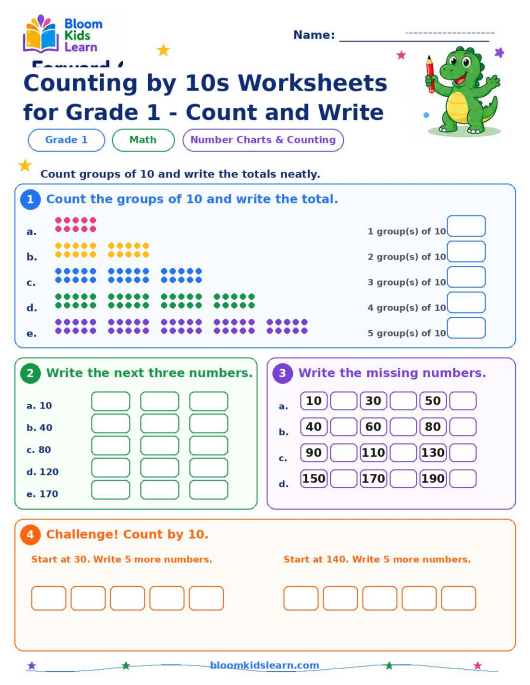
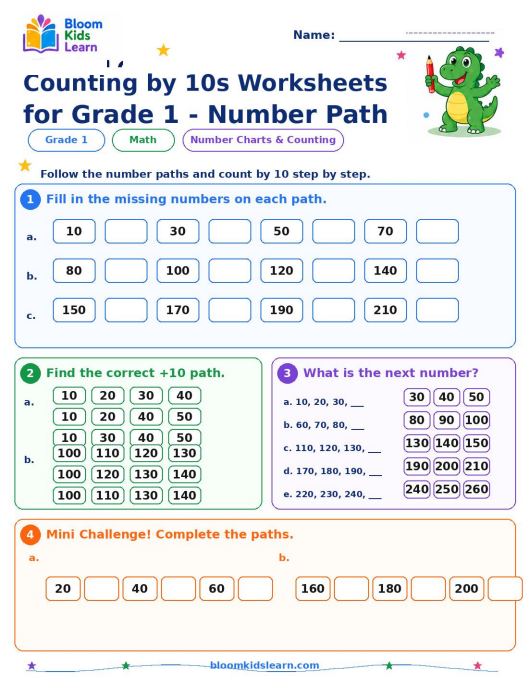
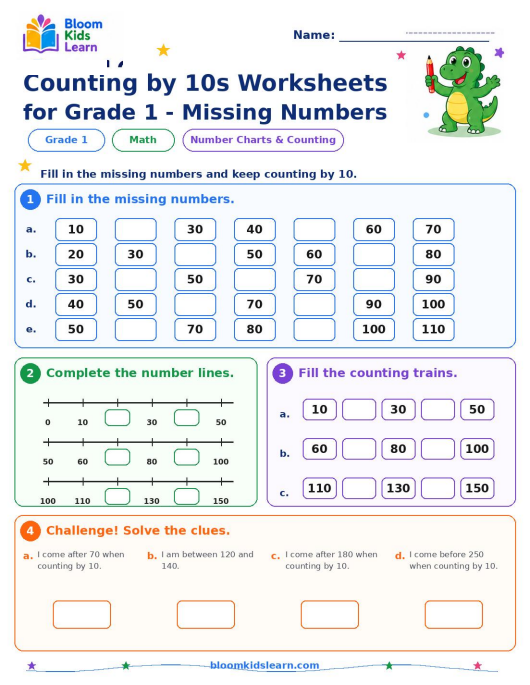
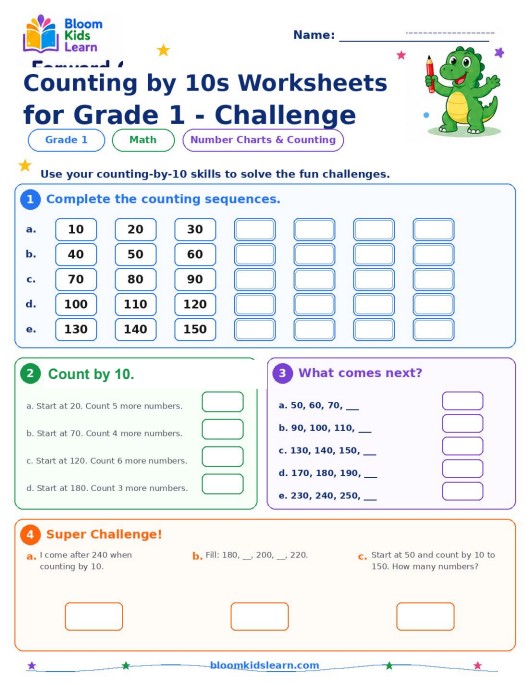
If the learner needs help connecting numbers to quantities, use the Count and Write worksheet with groups of ten. If they can recite the pattern but miss an incorrect step, try the number-path worksheet. Choose one area to revisit rather than repeating the entire page automatically.
 Preview