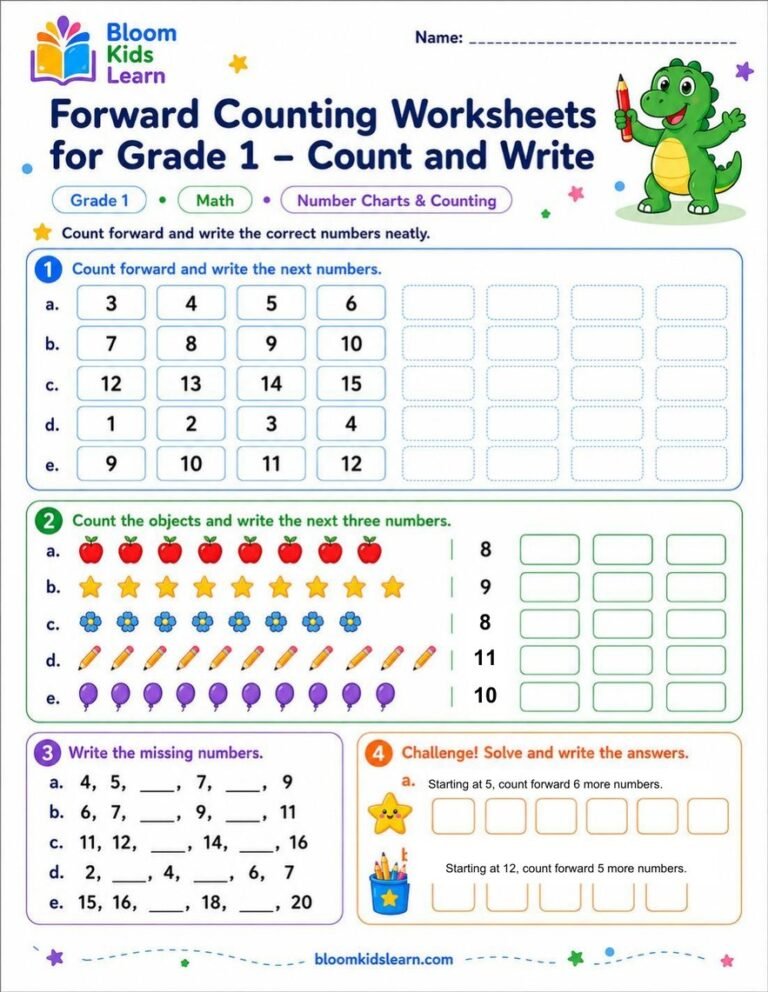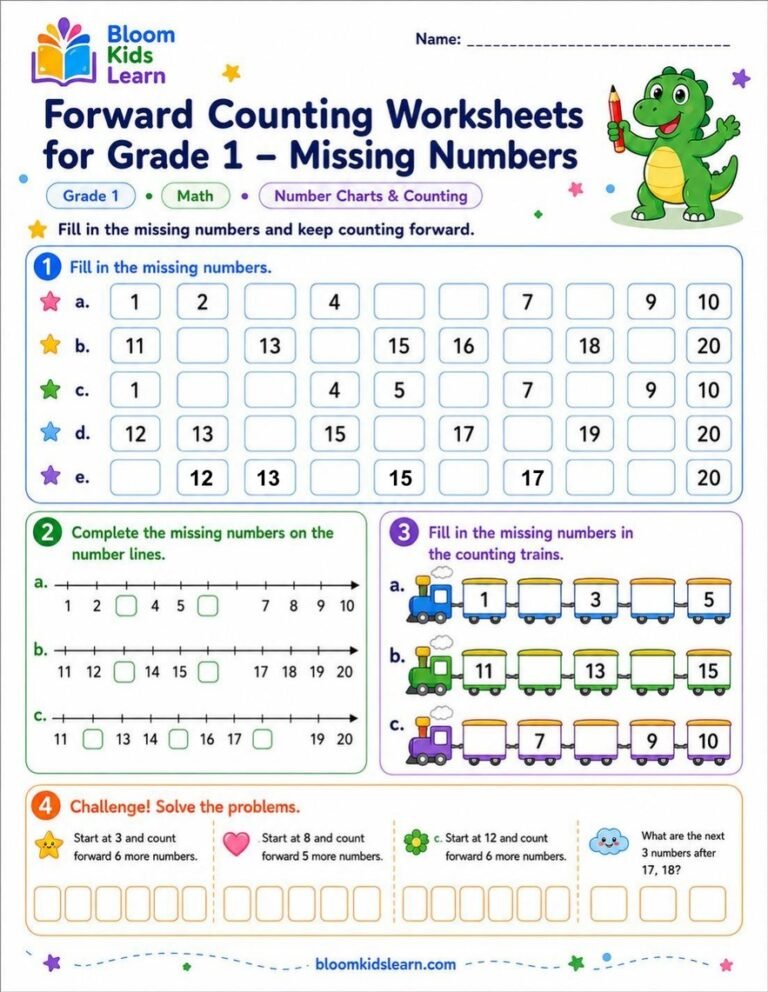

Forward Counting Mixed Practice Worksheet for Grade 1
A varied review page with missing numbers, next-number choices, number lines, and short counting clues.
- Skill: Forward counting review
- Learning goal: Apply forward counting to sequences, number lines, and next-number questions.
- Format: Printable PDF worksheet
 Download Worksheet PDF
This free Forward Counting Mixed Practice worksheet for Grade 1 helps children use the same one-more rule across several question formats. One section contains number rows, another asks for the number that comes next, another uses number lines, and short “count more” clues add a reasoning step. The activities stay within 21.
Mixed practice is useful after a learner has completed focused forward-counting pages. When the layout changes, the child must recognize the number relationship instead of depending on a familiar pattern of boxes or pictures.
Skills reviewed on this worksheet
- counting forward by 1 from different starting values;
- filling gaps in sequences within 21;
- choosing the number immediately after a given number;
- reading and completing number lines;
- solving short count-more clues; and
- checking answers for skipped or repeated numbers.
The page also helps adults observe whether a student counts on from the given value or restarts at 1 for every answer.
Prepare with a quick oral warm-up
Choose three starting values, such as 6, 12, and 18. Ask the child to say the next four numbers from each one. Then ask two direct questions: “What comes after 9?” and “What is one more than 15?”
Review that moving forward means the numbers become larger by one. On a standard number line, one more is one space to the right. This common rule connects every section of the printable.
Work through one section at a time
- Read the direction for the current section.
- Identify the starting number and the type of answer required.
- Say the short sequence before writing or circling.
- Complete one problem at a time.
- Check the section before moving to a new format.
Covering the unused sections can help a learner concentrate. The directions change, but the mathematical thinking remains based on one more.
Strategies for missing-number rows
Read the complete row and say “blank” at an empty space. Return to the nearest printed value before the gap and count forward one step. Then check the answer against the printed number after it.
For 13, __, 15, the missing value is 14. It is one more than 13 and one less than 15. When two blanks appear together, solve the first and use the new answer as the clue for the second.
Strategies for “what comes next?” questions
Ask the child to decide the next number before looking closely at any answer choices. If the given number is 17, say 17, 18. One more than 17 is 18.
A learner who restarts at 1 can practice very short responses. State the given value together and ask only for the next one or two numbers. Gradually increase the length of the count.
Strategies for number lines
Place a finger on the labeled starting position and move one tick to the right for each new number. Pair every movement with one spoken value. Write the value on a blank tick only after reaching it.
If the child skips a tick, return to the last correct label rather than restarting the whole line. One position should match one number in the spoken count.
Understand count-more clues
A clue asking for one more requires one forward step. A clue asking for two more requires two separate steps. Begin at the stated number and count the moves, not the starting position.
For example, two more than 8 can be found by moving from 8 to 9 for the first step and from 9 to 10 for the second. The landing number is 10. Counters or a hand-drawn number line can make the moves visible.
Common mistakes and helpful corrections
Some students continue the instruction from the previous section without reading the new one. Ask the learner to underline or repeat the direction before answering. Others write the starting value again; remind them that the first new answer must be one more.
On number lines, a child may move left and begin counting backward. Ask whether the answer should be larger or smaller, then show one rightward move. If a two-digit numeral is reversed, have the student say it, identify the tens digit, and rewrite it carefully.
Use mixed practice as an informal assessment
Let the learner complete the page independently before correcting it. Sort any errors by format: sequence, next number, number line, or count-more clue. A pattern of mistakes is more useful than one overall score because it identifies the best next lesson.
If only the number-line section is difficult, return to a visual path. If mistakes appear in every format, practice one more with counters and short number rows before repeating mixed work.
Support for developing learners
Reveal one section at a time and allow a twenty chart, number line, counters, or fingers. Complete the first example in each format together. Ask the child to name the strategy before writing.
Students working within 10 can begin with only the lower-number problems. Introduce the transition from 9 to 10 separately before extending through 21.
Extensions for confident students
Ask the learner to create one original problem in each format: a missing-number row, a next-number question, a short number line, and a two-more clue. The child should solve and explain each answer.
Another extension is to continue a completed sequence for five more values or begin from a new number chosen by an adult.
Classroom and home uses
This printable works as morning work, a math-center task, homework, small-group review, or a short progress check. In pairs, children can compare one section and explain corrections using one more.
Avoid timing the page. Flexible thinking and accurate strategy changes are more valuable than a fast finish.
How to check the completed worksheet
Read each completed sequence and number line from its starting value. Every forward step should increase by exactly one. For count-more clues, recount the stated number of moves and confirm the landing value.
Ask the child to explain at least one answer from every format. Statements such as “I moved one tick right” or “18 is one more than 17” show that the solution is based on number relationships.
Related Forward Counting worksheets
If the number-line section is difficult, revisit the Forward Counting Number Path worksheet. Children who complete the mixed page accurately can continue with the Forward Counting Challenge worksheet. The expanded Forward Counting collection explains the complete six-page progression.
Frequently asked questions
When should a child use mixed practice?
Use it after focused counting rows, missing-number work, and visual paths are reasonably comfortable.
Can visual tools still be used?
Yes. A number line or chart is appropriate support. Reduce it gradually as the learner counts on more independently.
Should every section be completed in one sitting?
No. Two shorter sessions can protect attention and handwriting quality.
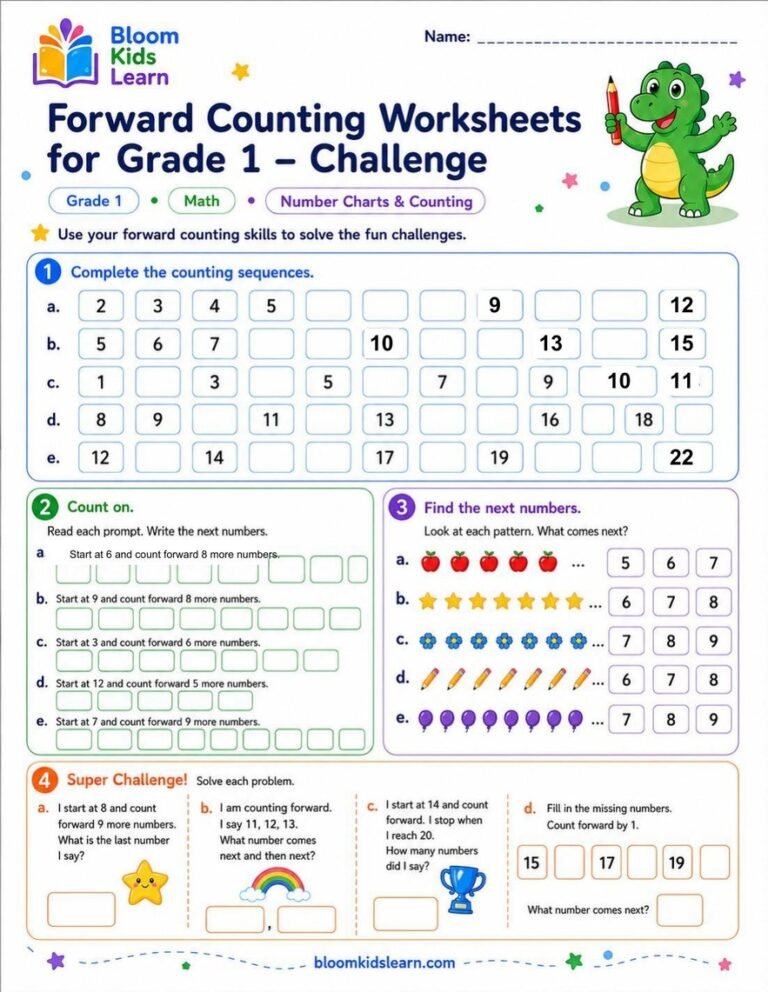
 Preview