
Worksheet Topic
Forward Counting Worksheets
These free forward counting worksheets for Grade 1 help children see, say, and write numbers in increasing order. The collection includes six printable PDF activities with short sequences, missing numbers, visual paths, picture counting, mixed review, and a final challenge. Each page stays within 20 while building the confidence to begin counting from numbers other than 1.
Start with Basic Practice for a learner who is still developing the one-more idea. Move through the worksheets in order, or choose the format that matches the child’s needs. The cards below provide quick access to every printable; the teaching guide after the worksheet grid explains how to use the set at home or in class.
Each PDF is formatted for US Letter paper with clear spaces for developing handwriting. Parents, teachers, tutors, and homeschool families can use the pages for guided lessons, independent review, homework, or a short math-center activity.
What forward counting means in Grade 1
Forward counting is the ability to say and write whole numbers in increasing order. A flexible counter does not always need to begin at 1. If a teacher says 8, the child can continue 9, 10, 11, and 12. That ability is often called counting on.
Counting on helps children understand that each new whole number is one more than the number before it. This relationship supports missing-number work, comparing nearby values, reading number lines, and early addition. It also prepares students to extend a sequence beyond the range shown on a worksheet.
Choose the right forward counting worksheet
1. Basic Practice
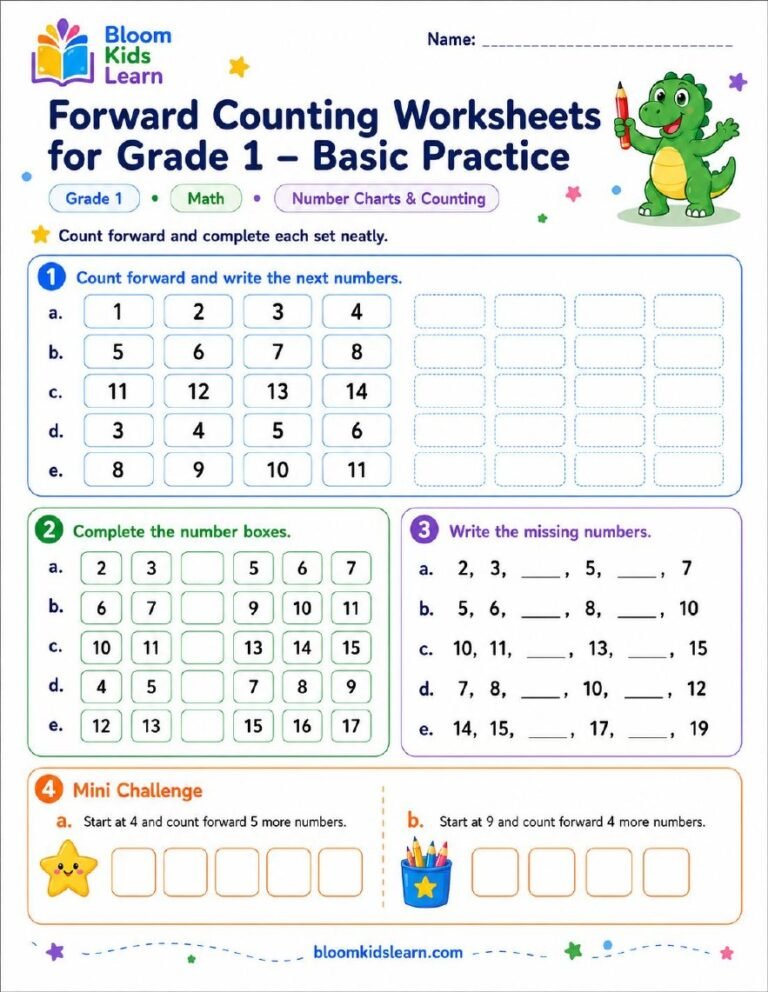
The Forward Counting Basic Practice worksheet uses supported number rows within 20. Choose it for a child who can recite part of the count but needs printed starting values and generous writing spaces.
2. Missing Numbers
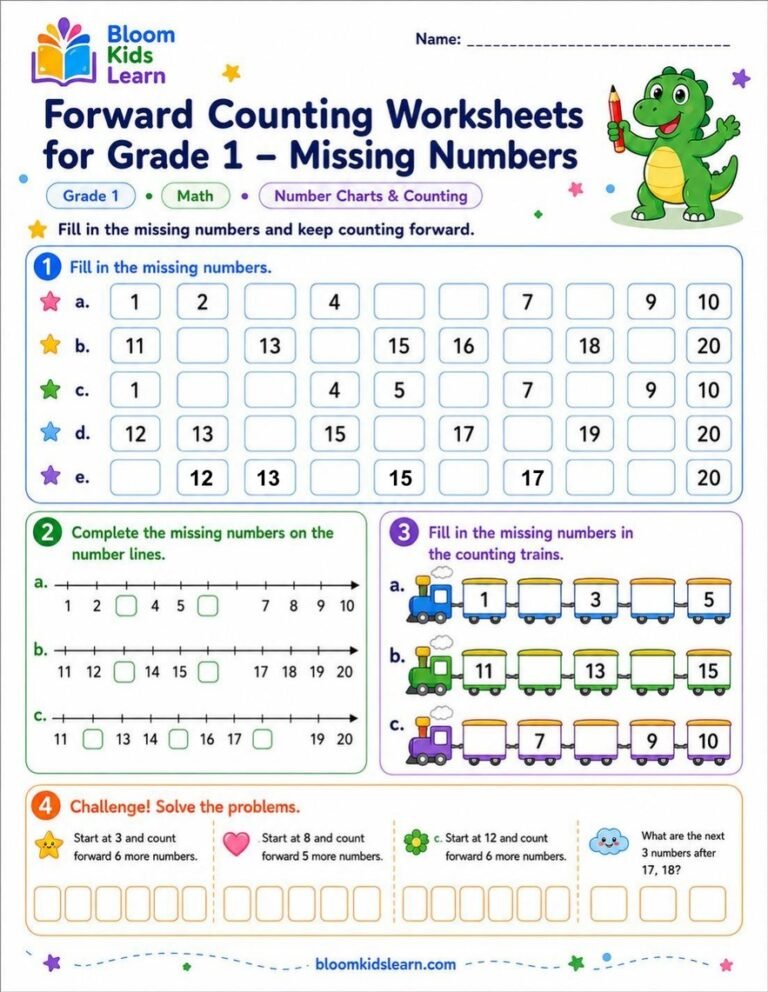
The Forward Counting Missing Numbers worksheet adds number lines, trains, and gaps with clues on both sides. It is useful when students are ready to decide which value belongs in a particular position.
3. Number Path
The Forward Counting Number Path worksheet presents sequences on stepping stones and winding routes. The visual movement is helpful for learners who benefit from tracing, pointing, or moving a counter one step at a time.
4. Count and Write
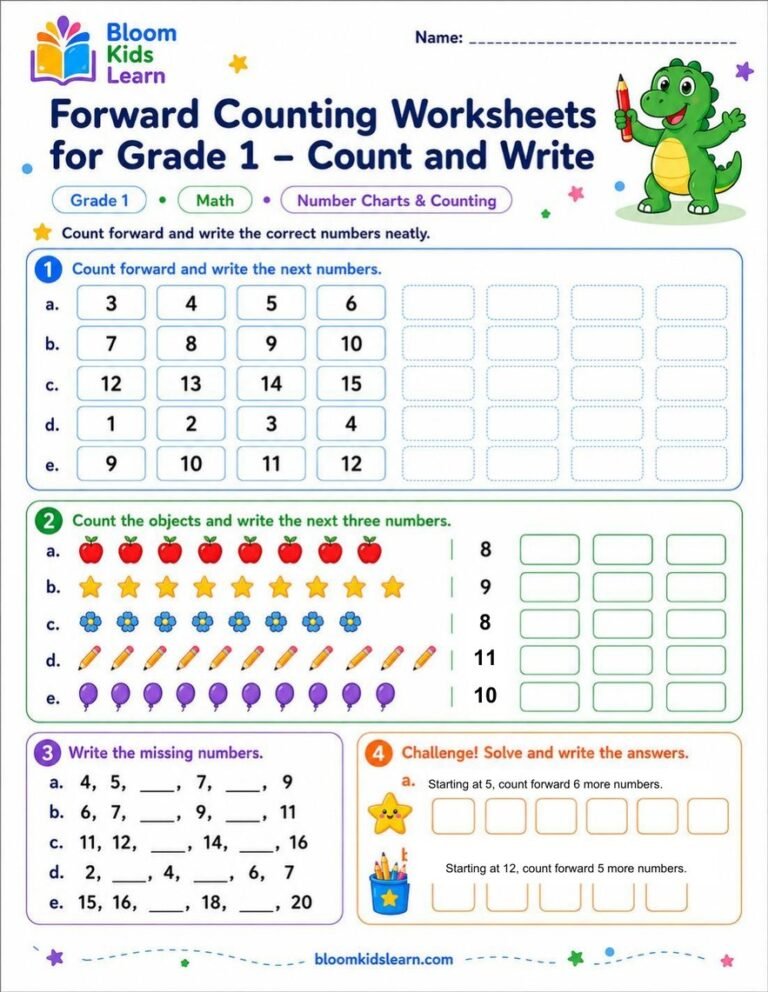
The Count and Write Forward Counting worksheet connects pictured quantities with number order. Children count groups of familiar objects and then write the next three numbers.
5. Mixed Practice
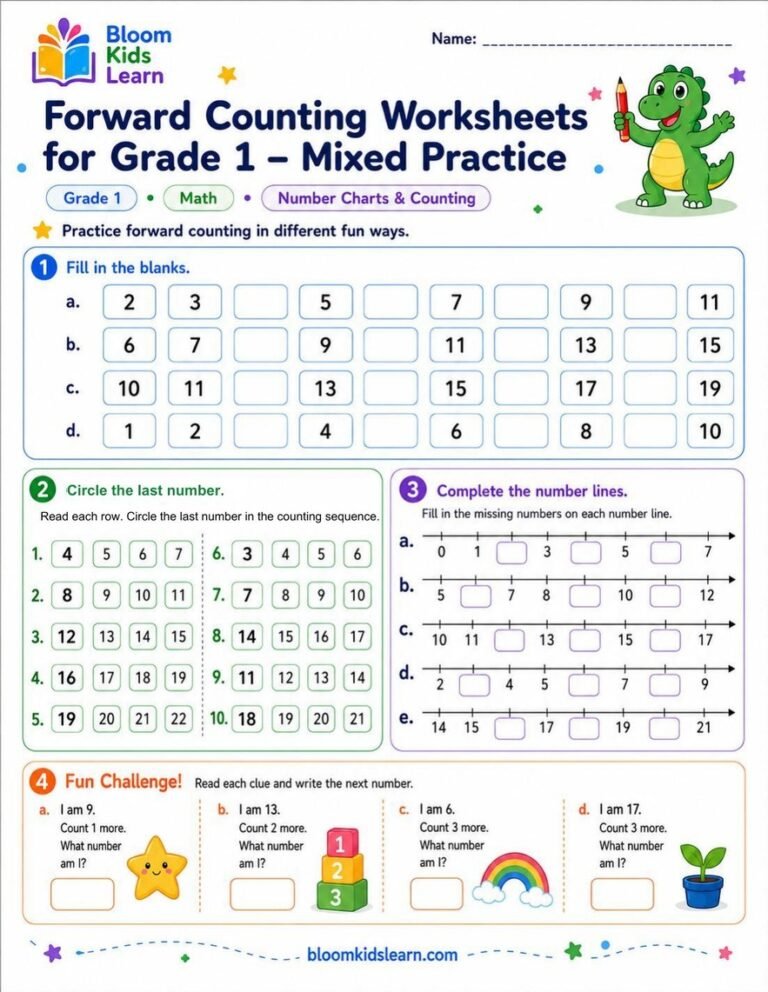
The Forward Counting Mixed Practice worksheet combines several question styles. Use it after focused practice to see whether the child can apply the one-more rule when the layout changes.
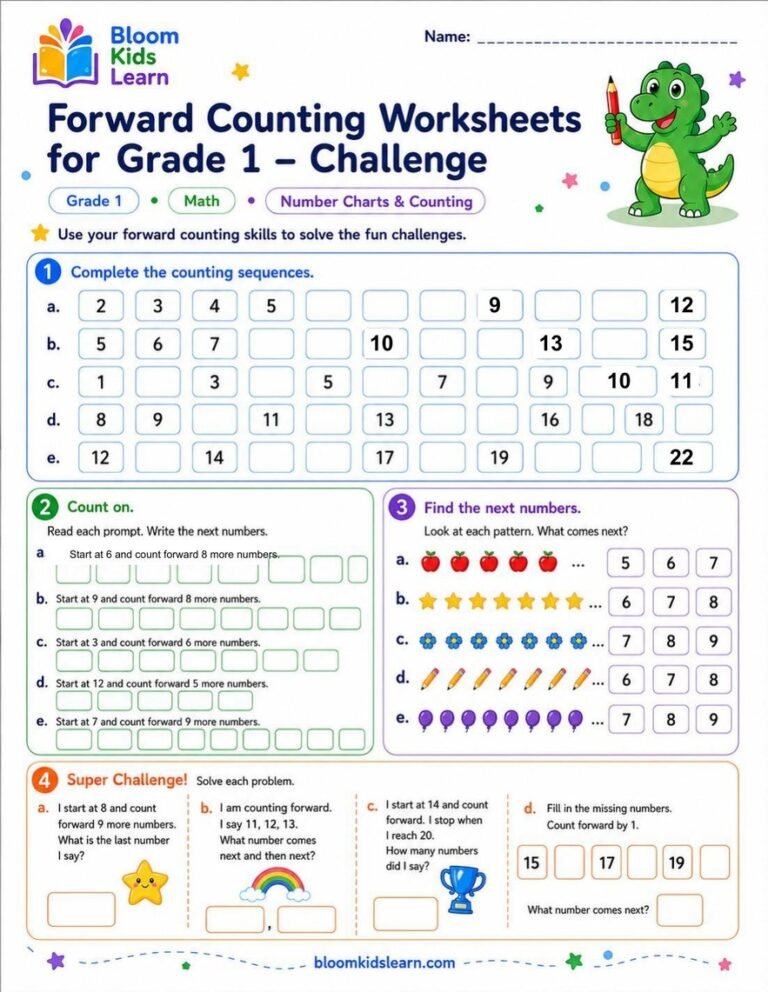
6. Challenge
The Forward Counting Challenge worksheet requires more independent reasoning. It works well as the final page in the sequence, an enrichment activity, or an informal end-of-topic check.
Skills covered across the six printables
- counting forward by 1 within 20;
- starting a sequence from a number other than 1;
- finding the number immediately after a given value;
- using one more to complete missing-number rows;
- following number lines and visual paths;
- connecting object quantities with written numerals;
- writing two-digit numbers in the correct order; and
- explaining how an answer fits between neighboring values.
The collection intentionally moves from strong visual support toward greater independence. A child does not need to complete all six pages at once. One focused worksheet followed by a short oral game is usually more productive than a long session.
A simple teaching routine: see, say, write, check
- See: Ask the learner to identify the starting number and look at the printed clues.
- Say: Read the sequence aloud before adding pencil work.
- Write: Complete one blank at a time by finding one more.
- Check: Reread the full row and confirm that every step increases by exactly 1.
This routine works for number rows, trains, paths, and picture groups. Saying a value before writing it can reduce skipped numbers and help a child keep the counting sequence separate from numeral formation.
Worked forward counting examples
For the row 7, 8, __, 10, begin with 8 and count one more. The missing value is 9. Check both sides: 9 is one more than 8 and one less than 10.
For 13, __, __, 16, solve one position at a time. One more than 13 is 14, and one more than 14 is 15. Reading 13, 14, 15, 16 confirms that the sequence has no gap.
When counting a picture group, establish the total first. If there are 6 objects, the following values are 7, 8, and 9. The child should not write 6 again when the direction asks for the next numbers.
Common forward counting mistakes
Restarting at 1
A learner may count from 1 to reach every answer. Give short oral prompts that begin at varied values: “Start at 11 and tell me the next four numbers.” Gradually make the starting number less predictable.
Skipping or repeating a number
Have the child touch one box, tick, or path space for each spoken number. Return to the nearest correct value rather than restarting the entire worksheet. One physical movement should match one number.
Confusing before and after
Use direction language with a number line. Moving right means one more and the number after; moving left means one less and the number before. Keep the focus on the relationship instead of memorizing a visual trick.
Reversing two-digit numerals
Ask the child to say the intended number and identify the tens digit first. Writing slowly and leaving enough space can prevent 12 from becoming 21.
Support and differentiation
For extra support, reveal one section at a time and allow counters, fingers, a number line, or a twenty chart. Complete one example together, then reduce the prompts. Children who are still working within 10 can use only the first part of a page before extending to higher values.
For an extension, ask the learner to continue a finished sequence for five more numbers, create a new missing-number row, or explain the one-more relationship in words. A confident student can begin from an adult-chosen value and count toward 20 without a visual guide.
Ideas for classroom and home practice
Use a worksheet as a morning warm-up, math-center task, small-group activity, homework page, or brief progress check. Place a printable in a dry-erase sleeve when repeated practice would help. At home, count toys, steps, crayons, or snack pieces and then say the next three numbers.
A simple three-session plan can keep practice manageable:
- Session 1: Basic Practice and a short oral count-on game.
- Session 2: Missing Numbers or Number Path with a number line available.
- Session 3: Count and Write followed by Mixed Practice or the Challenge page.
Adjust the sequence to the learner. Accuracy, clear reasoning, and comfortable handwriting matter more than completing every page quickly.
How to check answers without guessing
Read every completed sequence from its starting number. Each new value must be exactly one more than the previous value. For a blank between two clues, check both relationships. In 14, __, 16, the answer must be one more than 14 and one less than 16.
When an answer is incorrect, ask the child to return to the closest correct printed number and count on. A useful correction includes a reason: “I changed the answer to 15 because 15 comes after 14.” Self-correction provides stronger evidence of understanding than copying an adult’s answer.
Grade 1 standards context
The official Common Core Grade 1 counting expectation includes counting to 120 starting at any number below 120, and reading and writing numerals. These worksheets provide focused practice within 20 before learners extend the same one-more pattern to larger numbers.
A worksheet collection cannot cover an entire standard by itself. Combine the printables with spoken counts, manipulatives, classroom discussion, and practice beyond 20 when the child is ready.
Related Grade 1 counting practice
If a child needs concentrated work on consecutive number order, use the Counting by 1s worksheets. After forward counting is secure, introduce the Backward Counting worksheets to explore one less. Learners ready to make larger equal jumps can continue to the Counting by 2s collection.
Frequently asked questions
How far should a first grader count forward?
Begin with a range the child can understand accurately. These pages stay within 20; the Grade 1 Common Core expectation later extends counting to 120.
Should children memorize the sequence?
Fluency develops with repetition, but understanding one more is essential. Children should be able to use objects, a number line, or neighboring values to explain the sequence.
Can the worksheets be reused?
Yes. Print another copy or place a page in a dry-erase sleeve. On a later attempt, reduce visual support or ask the learner to explain more answers.
How often should we practice?
Short sessions two or three times per week are usually more useful than a single long lesson. Mix worksheets with movement, objects, and oral counting.
What should come after this collection?
Continue beyond 20, practice backward counting, or begin skip counting by 2s. Choose the next step based on accuracy and the child’s ability to explain one more.
Learning Objectives
✓Count forward by 1 within 20.
✓Identify the number that comes next.
✓Fill missing numbers in short sequences.
✓Use objects and number paths to show number order.
6 Worksheets
 Preview
 PDF