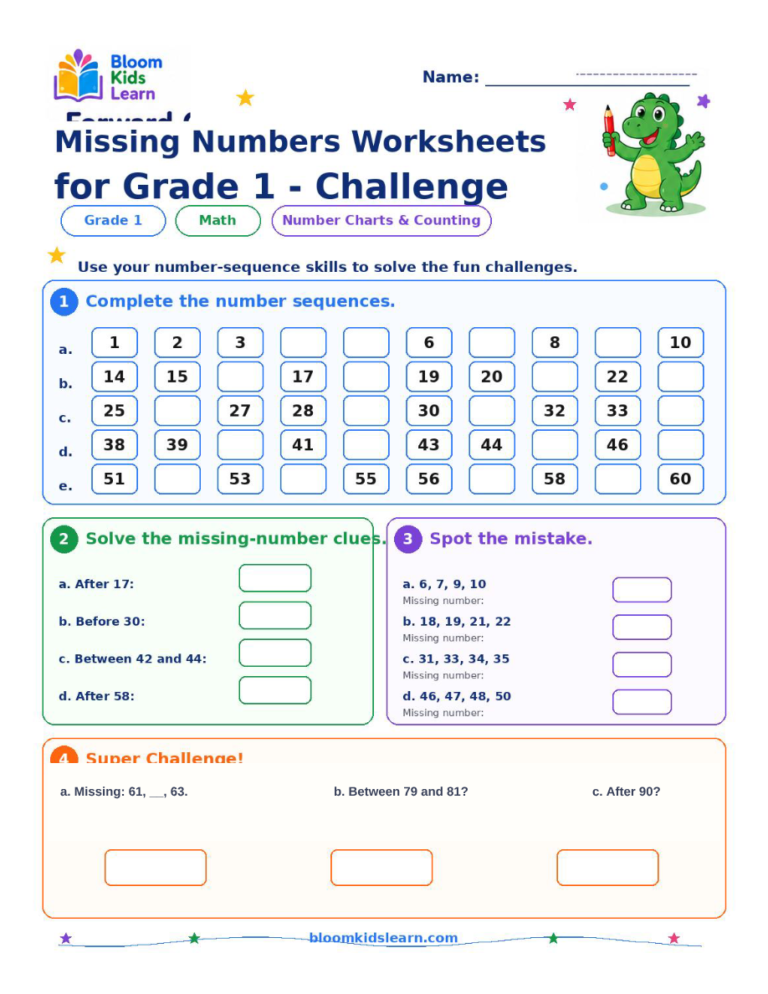
Counting by 1s Challenge Worksheet for Grade 1
Free Grade 1 counting-by-1 challenge with error correction, number clues, and sequence writing through 120 in a printable PDF.
- Skill: Reasoning about number order within 120
- Learning goal: Correct counting sequences and solve one-more and one-less clues.
- Format: Printable PDF worksheet
 Download Worksheet PDF
This free Grade 1 counting by 1s challenge worksheet asks children to use number-order knowledge in several ways. Instead of only filling predictable blanks, students find and correct errors, solve clues involving one more and one less, and complete a final sequence to 120. The changing tasks make this a useful final review for learners who are already comfortable with basic forward counting.
A challenge page should feel thoughtful, not confusing. Every problem still relies on one clear idea: consecutive whole numbers differ by exactly one. Students apply that idea to decide whether a sequence is correct and to explain how they know.
What this challenge worksheet practices
- counting forward by 1 from different starting numbers;
- spotting a number that breaks a sequence;
- replacing an incorrect value with the correct number;
- using before, after, one more, and one less language;
- reading and writing numbers across 100; and
- completing a sequence accurately to 120.
These tasks combine counting fluency with reasoning. A child must notice the rule, apply it, and check whether an answer fits with the numbers on both sides.
Who should use this worksheet?
This printable is best for a first grader who can count forward by 1 within 120 and complete ordinary missing-number sequences with reasonable independence. It can be used after the focused Counting by 1s pages, at the end of a small unit, or as an informal skills check.
Quick warm-up before the challenge
Start with three short oral prompts. Ask the child to count forward five numbers from 58, name one more than 89, and name one less than 100. Then read a deliberately incorrect sequence, such as 42, 43, 45, 46, and ask what went wrong.
Explain that mathematicians check whether every step follows the rule. On this page, the rule is “one more” when moving forward. The student should expect each new value to increase by exactly one.
Step-by-step directions for students
- Read the directions for one section at a time.
- Identify the starting number and the rule.
- Say the sequence aloud before writing.
- For an error problem, compare each number with the one immediately before it.
- For a clue, decide whether to move one step forward or one step back.
- Write the answer neatly and check it using nearby numbers.
- Complete the final count to 120 without skipping a value.
Students may underline an incorrect number before replacing it. This separates the work of finding the mistake from the work of correcting it.
How to solve error-finding sequences
Begin at the first number and read slowly. After each value, ask, “Is the next number exactly one more?” Stop at the first place where the rule fails. Check both sides of the suspected error so the corrected value fits the complete sequence.
For example, in 67, 68, 70, 71, the jump from 68 to 70 skips 69. Replacing 70 is not correct because the following 71 would then repeat the pattern incorrectly. The number occupying the third position should be 69, giving 67, 68, 69, 70 if the rest of the problem is adjusted as shown. Encourage children to examine the whole printed sequence rather than changing the first number that looks unusual.
Using one more and one less clues
“One more” means move forward one number. “One less” means move backward one number. Before and after describe the same relationships in number-order language: the number before is one less, and the number after is one more.
A learner who mixes up the terms can sketch three boxes. Put the clue number in the middle, write one less on the left, and one more on the right. Then reread the question and select the required box. The sketch should be a temporary thinking tool, not an extra task for every problem.
Counting accurately across 100
When a sequence approaches 100, say the transition aloud: 98, 99, 100, 101, 102. The change from two digits to three does not change the counting rule. Each step is still one more.
Make space for all three digits and check that 100 contains two zeros. Students sometimes write 10, repeat 99, or jump to 110 because the new place value feels unfamiliar. Returning to 99 and adding one object can make the transition concrete.
Common mistakes and constructive responses
If a child changes a correct number, ask them to read the values immediately before and after it. If both steps follow the one-more rule, the number should remain. If a clue answer is reversed, point to the direction word and have the student show one step forward or backward on a number line.
When a student skips a number near 120, restart from the closest correct value rather than from 1. This practices the important skill of counting on. For a reversed numeral, say the intended number by tens and ones, then rewrite it clearly.
How to use the challenge as an assessment
Let the child attempt the page independently before giving hints. During review, note whether errors involve counting order, direction words, crossing 100, or writing numerals. That information is more useful than a single score because it points to the most helpful next lesson.
Ask the learner to explain at least one corrected sequence. A statement such as “69 belongs here because it is one more than 68 and one less than 70” demonstrates stronger understanding than an answer alone.
Support and extension options
For support, cover the unused sections, allow a number line, and solve one example together. For an extension, ask the child to write a four-number sequence containing one deliberate error for an adult to find. The student should also be able to explain the correction.
Checking the completed worksheet
Read every corrected sequence from beginning to end. Each value must be one more than the previous value. Check clue answers by saying the original number and moving exactly one step in the stated direction. Finally, inspect the sequence to 120 for missing, repeated, or reversed numbers.
When an answer is wrong, have the student correct it with the strategy that matches the error. Explaining the correction turns review into another round of useful practice.
Review and move to the next skill
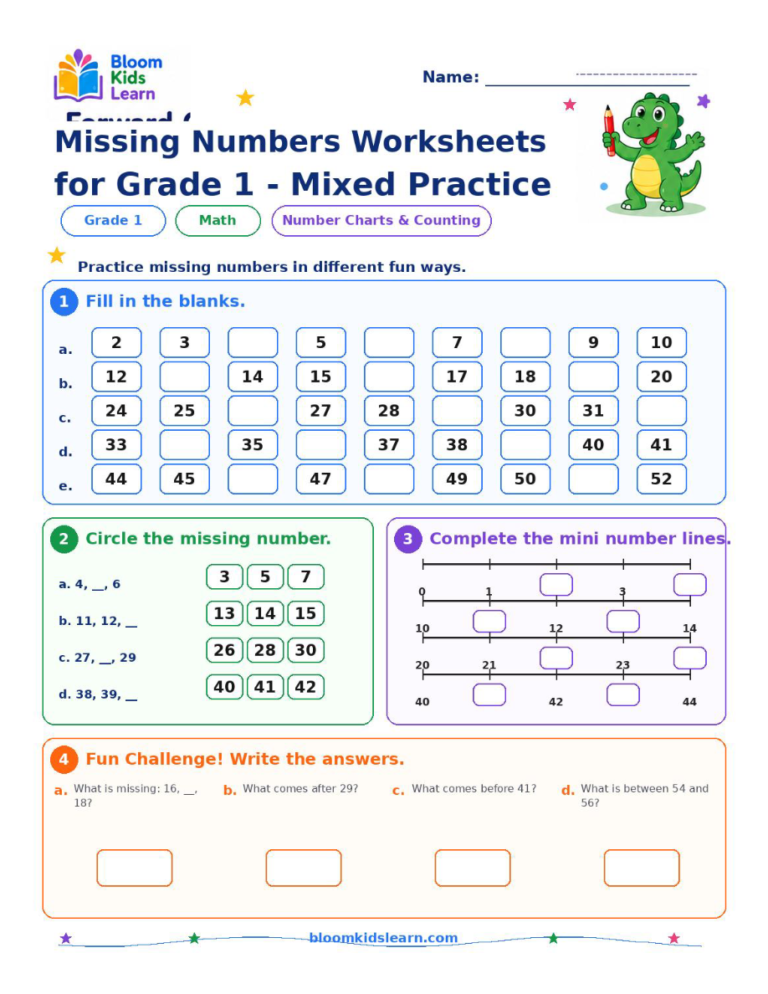
If part of the page is difficult, revisit the Counting by 1s Mixed Practice worksheet or choose a focused activity from the complete Counting by 1s collection. When the challenge is accurate and the learner can explain the strategies, continue to the Grade 1 Counting by 2s worksheets.
Frequently asked questions
Does a student need to finish without any help?
For an assessment, begin independently. During regular practice, brief prompts and a number line are appropriate as long as the child supplies the answers.
What should we review after an error?
Review the specific idea involved: counting on, one more, one less, crossing 100, or numeral formation. A short focused activity is usually better than repeating the entire page immediately.

 Preview