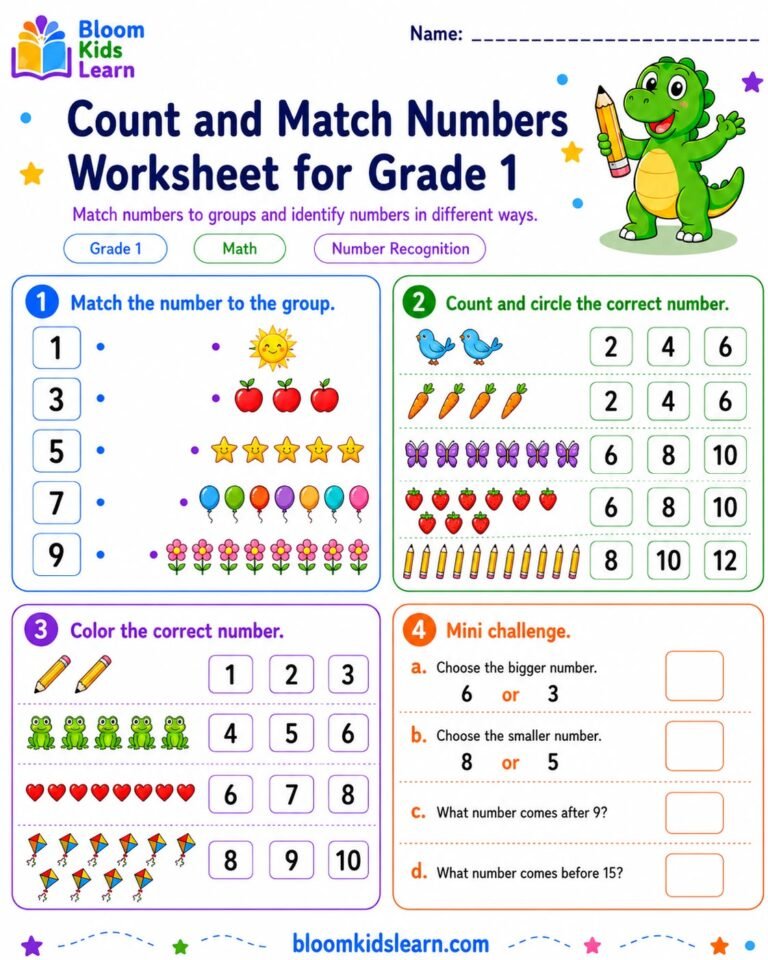

Number Recognition Mixed Practice Worksheet for Grade 1
Free Grade 1 number recognition mixed practice worksheet with number clues, object counting, true-or-false review, and comparison questions.
- Skill: Read, count, and compare numerals through 20
- Learning goal: Use number clues, pictured quantities, and order language to recognize numbers.
- Format: Printable PDF worksheet
 Download Worksheet PDF
Number recognition mixed practice worksheet for Grade 1 gives children several short ways to read, count, and compare numbers. The free page opens with clue-based multiple choice, then moves to counting pictured objects, true-or-false statements, and a final mini challenge. The variety is intentional: learners meet the same number ideas through words, pictures, symbols, and quick decisions.
Skills students practice
This mixed practice page supports numeral recognition through 20, counting with one-to-one correspondence, number-order vocabulary, and simple comparison. Children read clues such as “I am after 6” or “I have 1 ten and 5 ones,” choose a matching numeral, and write totals for groups of objects. They also decide whether statements are true or false and use before, after, larger, and smaller language. These connected tasks help a learner move from memorizing a sequence to understanding what each numeral represents.
Learning objective
After the lesson, a learner should be able to identify a numeral from a verbal clue, count a pictured set, check a statement about number order, and solve a missing-number problem. Ask children to explain one answer in a complete sentence. For example, “15 is correct because it has one ten and five ones.” A short explanation reveals whether the child is reasoning or choosing by guesswork.
How to teach with the printable
Read the first five clues together. Before the child circles a choice, model the thinking with one example: after 6 is 7, before 10 is 9, and between 12 and 14 is 13. Next, cover the answer boxes in the counting section and have the learner touch each picture once. In the true-or-false section, invite the child to use a small number line or whisper the sequence. Finish with the mini challenge only after the earlier tasks feel comfortable.
Worked examples
For the clue “I am the smallest number after 17,” count 17, 18, 19 and choose 18. If a row shows six apples, the answer box should contain 6, even if the pictures are spread out. For “9 is before 10,” read 9 and 10 in order and mark True. For a prompt asking for the number after 14 and before 16, the only number that fits is 15. Encourage the learner to point to both neighbors before writing.
Common mistakes
- Reading “after” as “before.”
- Counting a picture group from memory instead of touching each item.
- Ignoring the tens digit in a clue such as 15.
- Marking True or False without rereading the entire statement.
When an error appears, ask the child to show the answer on a number line or with counters. A calm recount is more effective than telling the answer immediately.
Differentiate and extend
For extra support, reduce the choices to two, use a 1–20 chart, and complete one row at a time. Let the child build “one ten and five ones” with ten frames and single counters. For extension, ask a confident learner to write a new clue for a partner, or to make a true statement and a false statement about the same number. They can also sort a set of numbers into less than 10 and greater than 10.
Answer guidance
Check that selected numerals match the clue, then recount every pictured group before accepting the written total. In true-or-false tasks, ask the learner to correct any false sentence orally. For the final questions, have the child locate the answer on a number line. This creates a visible trail of reasoning and makes self-correction easier.
Classroom and home uses
Use the page as a guided small-group lesson, math-center station, tutoring review, or homework sheet. It prints on US Letter paper. A dry-erase sleeve allows repeated practice, while a clean copy can be saved for an assessment or progress check.
Related resources and FAQs
Explore the Number Recognition worksheets for additional numeral tasks. The Counting by 1s topic strengthens sequence fluency, and Number Words Basic Practice connects spoken number words with symbols.
Can a child use counters?
Yes. Counters, fingers, and a number line are useful supports while number ideas are becoming automatic.
Is the page only for struggling learners?
No. Strong readers can work independently, explain their choices, or write new clues for a partner.
How often should we repeat it?
Use it once as guided practice and revisit selected sections later for a short review.
This activity supports Grade 1 number-sequence, numeral-recognition, and number-representation skills connected with CCSS.Math.Content.1.NBT.A.1.

 Preview