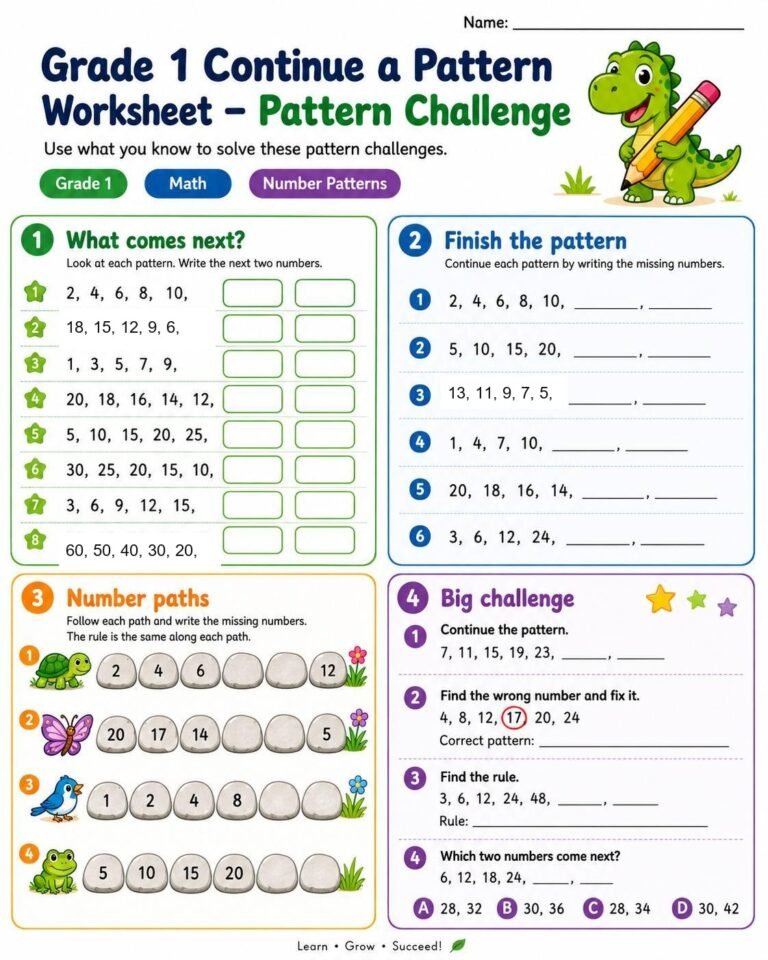

Skip Counting by 2s Pattern Worksheet for Grade 1
Grade 1 skip-counting by 2s practice with even and odd starting points, missing numbers, paths, and a short challenge. Answer key included.
- Skill: Continue number patterns by adding 2
- Learning goal: Use a constant add-2 rule to complete skip-counting sequences from even and odd starting numbers.
- Format: Printable PDF worksheet
- Answer key: Separate PDF available
 Download Worksheet PDF
 View Answer Key
Skip counting by twos is more than saying 2, 4, 6, 8. A learner also needs to recognize that the same rule works when a pattern begins at 3, 5, or 17. This Grade 1 printable uses both even and odd starting points, helping children focus on the size of the jump rather than memorizing one familiar list.
What the add-2 patterns check
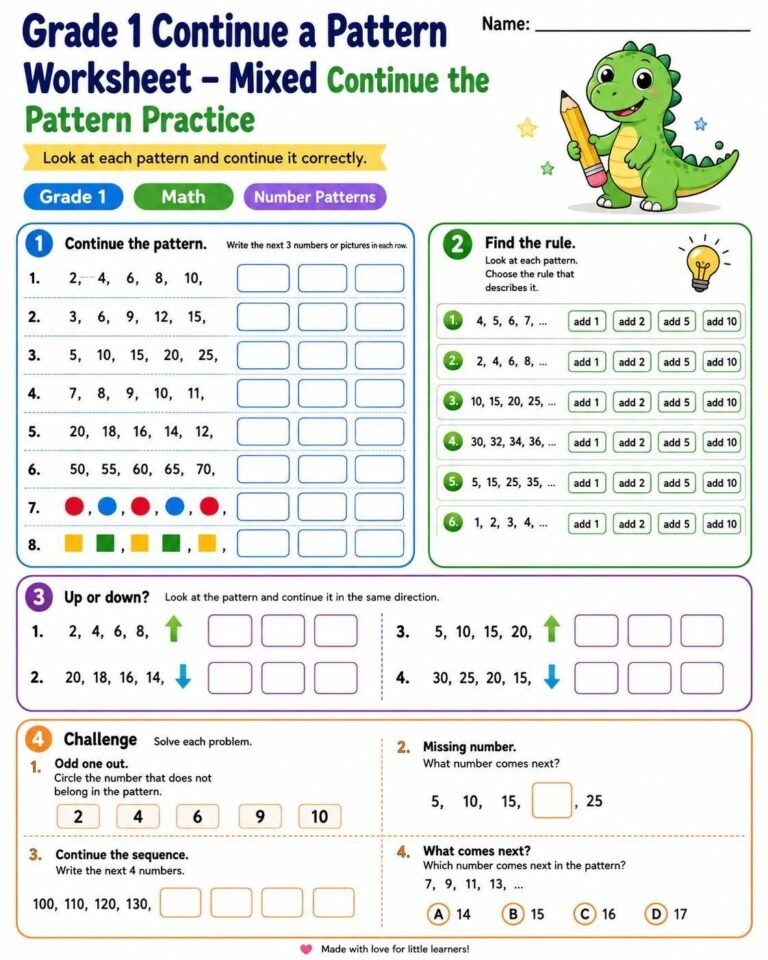
Children first write the next three numbers in rows such as 2, 4, 6, 8, 10 and 7, 9, 11, 13, 15. Next, they fill blanks placed inside sequences. The pattern-path section asks them to begin with a single number and make three equal jumps. The final challenge includes numbers before and after 14 in an add-2 pattern, a partially completed row, a five-number continuation, and a multiple-choice item.
A clear strategy for adding 2
Have the child say, “add one, then add one more,” while moving two spaces on a number line. For 7, 9, 11, begin at 7, touch 8 silently, and land on 9. Repeat to land on 11. Once the learner sees the equal jump, replace the two single moves with the phrase “add 2.” This keeps the rule meaningful.
Point out that an add-2 pattern keeps the same even-or-odd type. A row that begins with 2 stays even; a row that begins with 3 stays odd. Use this as a checking tool, not as the only method. For example, 3, 5, 7, 8 should look suspicious because 8 breaks the odd-number pattern.
Errors to watch for
- Adding 1: the child may fall back on ordinary forward counting. Mark two hops between each pair.
- Skipping from 8 to 11: ask the child to calculate each jump instead of guessing from rhythm.
- Assuming every answer is even: revisit a row that begins with an odd number.
- Starting from the blank rather than the printed value: read the entire row before writing.
Different ways to use the page
For support, cover all but one row and use counters grouped in pairs. For independent practice, let the learner complete the blue and green sections without help, then explain one path aloud. For extension, choose a new starting number such as 21 and ask for the next six values. The explanation “I added 2 each time” matters as much as the final answers.
Checking answers and moving forward
Subtract neighboring numbers: the difference should always be 2. Use the printable answer key for a quick check. Learners ready for larger jumps can continue with the skip-counting by 5s pattern worksheet. Children who struggle to name the rule may benefit first from the choose-the-rule number patterns worksheet.
 Preview