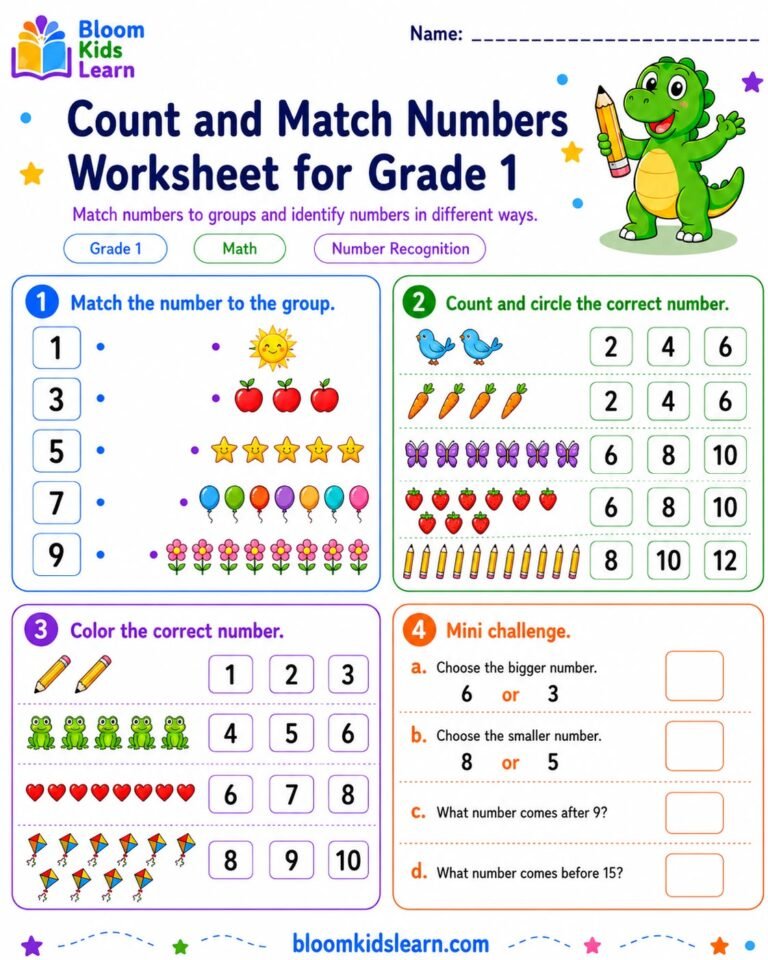
Number Recognition Challenge Worksheet for Grade 1
Free Grade 1 number recognition challenge worksheet with number trails, counting groups, mystery clues, and comparison practice.
- Skill: Recognize, compare, and reason with numerals through 20
- Learning goal: Complete number trails, count sets, solve number clues, and compare values.
- Format: Printable PDF worksheet
 Download Worksheet PDF
Number recognition challenge worksheet for Grade 1 is a final review for children who are ready to use several number ideas together. The free printable asks learners to complete a number trail, count groups and choose a numeral, solve number clues, and handle missing numbers, odd-one-out choices, and largest-or-smallest decisions. It is challenging without turning the page into a speed test; careful reading and clear explanations matter more than finishing first.
Skills and objective
This challenge strengthens numeral recognition through 20, one-to-one counting, sequence completion, comparison, and simple reasoning from clues. By the end, a learner should recognize a target numeral, count a pictured set, locate a missing neighbor, and explain why one number is larger, smaller, or different from the others. The page is a useful bridge between guided practice and independent work because each section uses a different representation of number.
Before you begin
Review the counting sequence from 1 to 20 with a short oral warm-up. Keep a number line or a small set of counters nearby, but invite the child to try each item independently first. Read the title and the directions together. Point out that the number trail follows the order of counting, while the clue section requires reasoning. Remind the learner to check the entire row before writing an answer.
Worked examples
In a trail showing 1, 2, blank, 4, 5, the missing number is 3. If a row contains seven apples and the choices are 6, 7, and 8, count each apple once and select 7. For the clue “I am 2 more than 14,” start at 14 and count two steps: 15, then 16. For “I am one less than 20,” the answer is 19. In an odd-one-out task, compare the values in each group and identify the number that does not follow the visible pattern.
Common mistakes
- Skipping a number when moving along the trail.
- Choosing a numeral because it looks familiar without counting the pictures.
- Adding two when a clue says one more or one less.
- Calling the largest value the smallest after reading too quickly.
Ask the child to point, say, and write. If a mistake appears, return to the exact clue and circle the words that matter. A quick number-line check often lets the learner fix the answer without adult correction.
Support and extension
For support, complete the trail with a number line and cover the challenge boxes until the earlier tasks are finished. Use ten frames for groups of objects and let the child build “one ten and five ones” with counters. For extension, ask a confident learner to write a new mystery clue, create an alternative number trail, or explain two different ways to prove that 18 is greater than 15. A partner can solve the new clues and check the reasoning.
Answer guidance
Check sequence items by reading the complete row aloud. Recount every object group and verify the chosen numeral. For clue questions, underline the operation words—after, before, more, less, and between—then use a number line. For comparison tasks, have the learner say the relationship in a sentence. If an answer is wrong, ask which step changed the result and let the child revise it.
Classroom uses
Use this page as a review center, a short intervention assessment, a homeschool lesson, or an extension for a learner who finishes basic number-recognition work quickly. It prints on US Letter paper and can be placed in a sheet protector for repeat practice. Save one completed copy as a progress sample so growth is easy to discuss.
Related worksheets and FAQs
Visit the Number Recognition topic hub for the full sequence. If the challenge feels too difficult, step back to the mixed practice worksheet or build fluency with Counting by 1s worksheets.
Is this an assessment?
It can be used as an informal check, but children learn most when adults discuss the strategies behind each answer.
May children use a number line?
Yes. A support tool is appropriate while the goal is accurate reasoning and recognition.
How can I extend the page?
Ask the learner to write a new clue or explain an answer using a drawing, counters, or a number sentence.
This activity supports Grade 1 number-sequence, numeral-recognition, and number-representation skills connected with CCSS.Math.Content.1.NBT.A.1.

 Preview