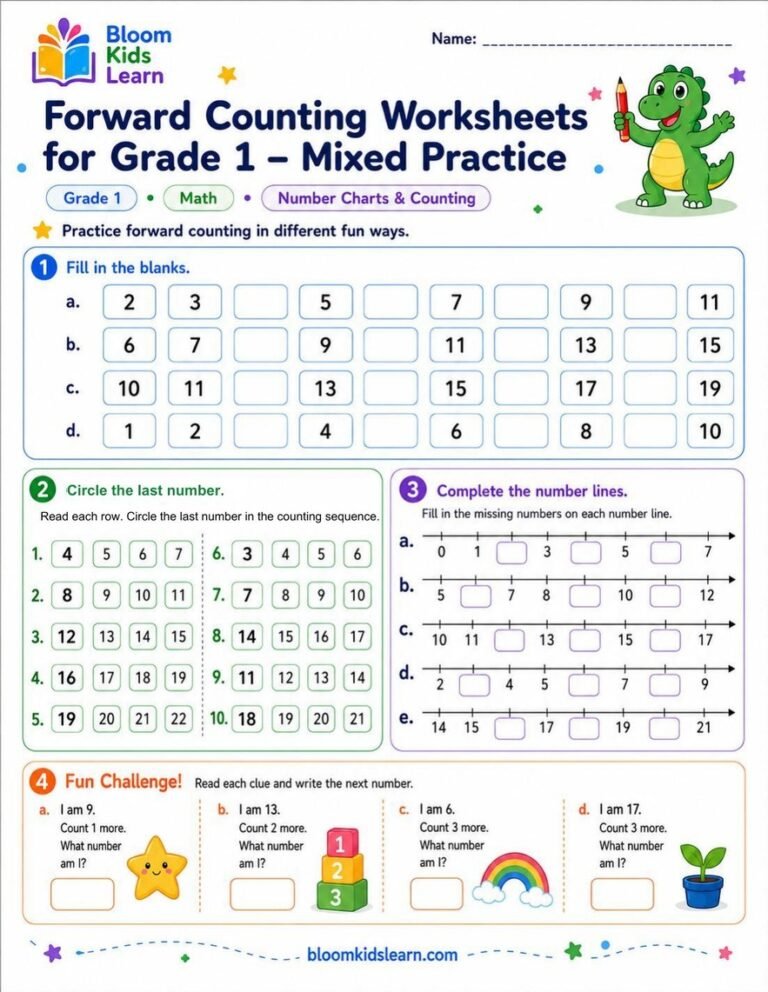
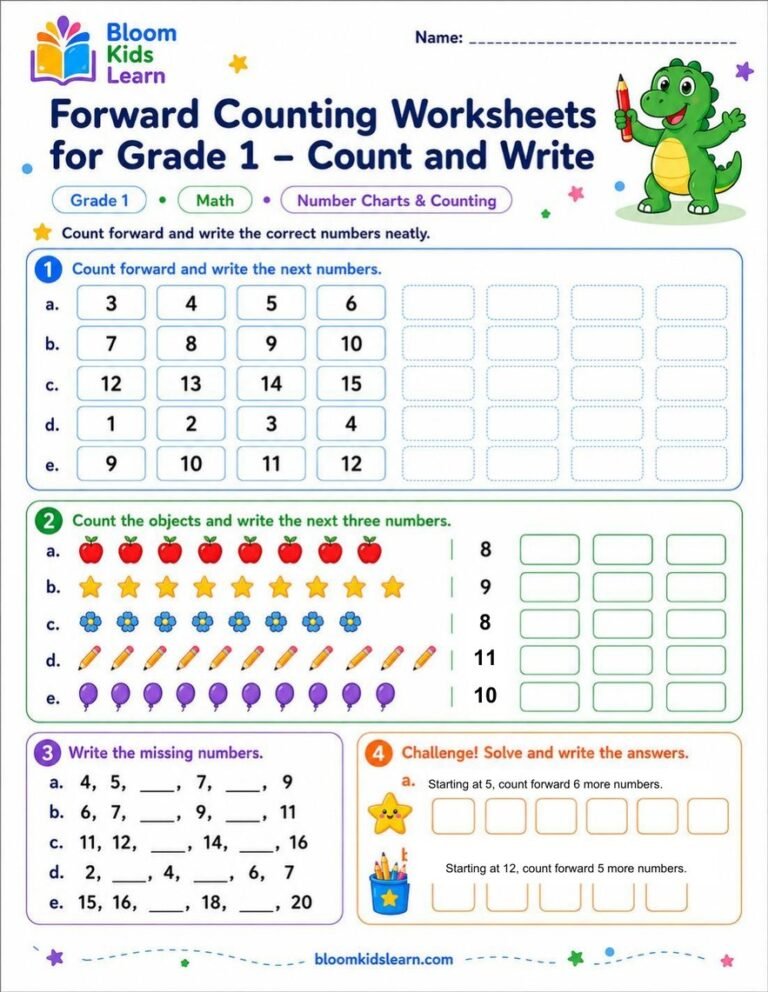
Forward Counting Basic Practice Worksheet for Grade 1
A friendly first step for children who are learning to continue number sequences by 1 within 20.
- Skill: Forward counting by 1
- Learning goal: Count forward and continue short number sequences within 20.
- Format: Printable PDF worksheet
 Download Worksheet PDF
Ask a first grader what comes after 6 and the answer may arrive quickly. Put the same idea into a longer row of boxes, though, and it requires more attention. This free Forward Counting Basic Practice worksheet for Grade 1 helps children count by 1 within 20, continue short sequences, and write the number that comes next.
The page begins with several values already in place, giving learners a secure starting point. Children can hear the pattern, add one for each new box, and check their writing by reading the completed row aloud.
What children practice
- counting forward by 1 within 20;
- starting a count from numbers other than 1;
- recognizing which number comes immediately next;
- completing small gaps in a sequence;
- writing numerals in increasing order; and
- checking a sequence for skipped or repeated values.
The activities use a familiar rule in slightly different layouts. That variety helps students apply number order instead of copying one repeated pattern.
Prepare with a quick hands-on count
Place five small objects on a table. Count them, add one more, and count again. Say, “We had 5. One more is 6.” Repeat with a different starting amount. This makes the relationship between forward counting and increasing quantity visible.
Next, choose a number within 20 and ask the child to say the next four numbers. Try 7, 12, and 16 as starting points. Beginning in different places builds the ability to count on without restarting at 1.
Step-by-step directions for students
- Find the first printed number in a row.
- Point to each value and read the printed part aloud.
- At an empty box, think of one more than the previous number.
- Write that numeral neatly.
- Continue one box at a time until the row is complete.
- Read the full sequence aloud to check the order.
Complete the first example together, then allow the learner to try the next row independently. Saying the answer before writing can help children who lose their place while forming a numeral.
Teach the meaning of one more
Forward counting is easier when the child understands that each new number represents one additional item. If the current number is 9, the next number is 10 because 10 is one more than 9.
A number line offers another visual model. Place a finger on the starting value and move one space to the right. Each rightward move increases the number by exactly one. Encourage the learner to move only one space for each empty box.
Gradually reduce the visual tools. Ask for a mental answer first, then use counters or a number line only when needed.
Worked forward-counting examples
Suppose a row begins 8, 9, 10, __. One more than 10 is 11, so 11 belongs in the blank. Check by reading 8, 9, 10, 11.
For two empty boxes, such as 13, 14, __, __, solve one at a time. One more than 14 is 15, and one more than 15 is 16. The completed sequence is 13, 14, 15, 16.
When a row crosses from 9 to 10, remind the student that the rule does not change. The next numeral uses two digits, but 10 is still exactly one more than 9.
Common mistakes and helpful corrections
A child may skip a number when trying to fill several boxes quickly. Return to the last correct printed value and point to one box at a time. Reading the completed row aloud will usually reveal the missing step.
Some learners repeat the current number in the first blank. Ask, “We already have this number. What is one more?” Others may reverse the digits in values such as 12 or 15. Have the child say the intended number, identify the tens digit first, and rewrite it slowly.
If the student starts counting backward, ask whether the values should become larger or smaller. Add one counter to show that forward counting increases the quantity.
Support for developing learners
Cover the lower sections and reveal one row at a time. Allow fingers, counters, or a number line. The learner can touch each printed number, say the next value, and then write.
If sequences above 10 are difficult, practice within 5 and then within 10. Introduce the transition from 9 to 10 separately before returning to longer rows. Short, accurate sessions are more useful than completing the page while frustrated.
Extensions for confident students
Ask the child to choose a starting number within 20 and write the next six numbers. Another option is to make a new sequence with two missing values for an adult to solve.
For a reasoning extension, hide one printed clue and ask what belongs there using the numbers before and after it. The learner should explain that the missing value is one more than the number before it and one less than the number after it.
Classroom and home uses
This printable works as morning practice, homework, a math-center task, small-group review, or a brief warm-up. Teachers can place it in a dry-erase sleeve for repeated use. At home, an adult and child can take turns saying alternate numbers in each completed row.
The worksheet does not need to be timed. Accurate counting, clear numeral formation, and an explanation of one more are more valuable than speed.
How to check the completed worksheet
Begin at the first value in each row and read from left to right. Every new number should be exactly one more than the previous number. Check that no box was missed and that two-digit numerals were written in the correct order.
When an answer is wrong, restart from the nearest correct value instead of counting from 1. Ask the child to explain the correction: “15 belongs here because it is one more than 14.”
Continue the Forward Counting sequence
When the basic rows feel comfortable, move to the Forward Counting Missing Numbers worksheet, where students use clues on both sides of a blank. Browse all six printable levels in the Grade 1 Forward Counting collection. Children ready for a visual route can also try the Forward Counting Number Path worksheet.
For curriculum context, the official Grade 1 Common Core counting standard includes counting on from numbers other than 1.
Frequently asked questions
Should a child use counters?
Yes. Counters make one more visible and are a useful temporary support. Reduce their use as the child begins answering mentally.
What if the learner always restarts at 1?
Practice very short counts from varied starting numbers. Say 12 together, then ask only for 13, 14, and 15.
How long should practice last?
Five to ten focused minutes is enough for many first graders. Pause when attention or handwriting quality begins to fade.
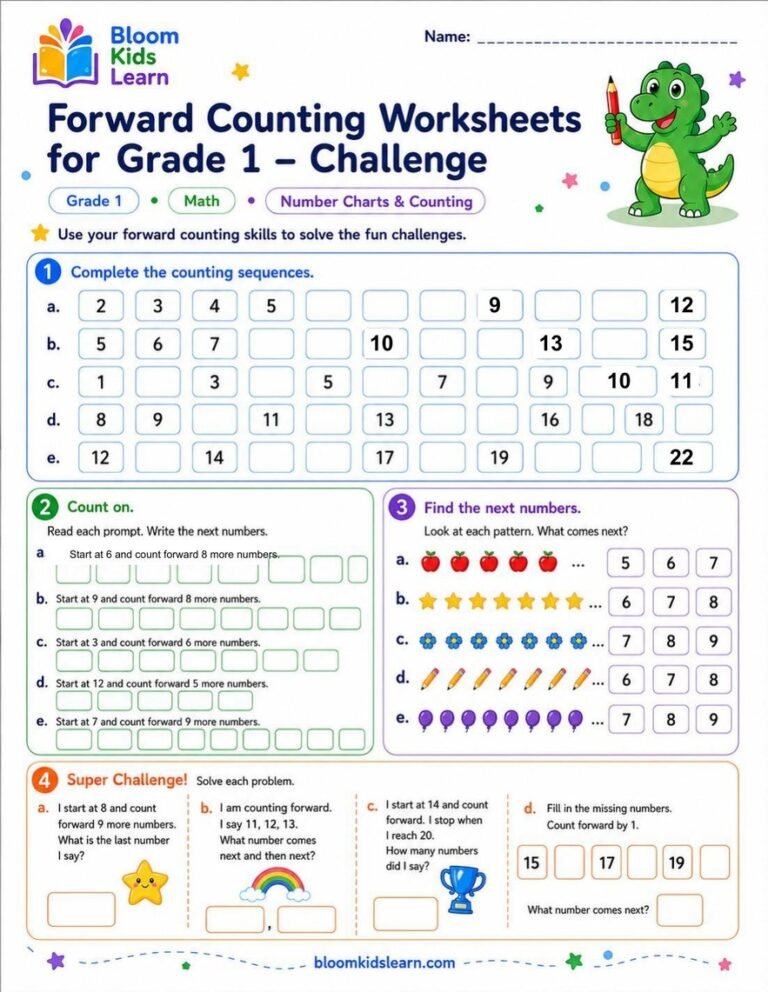
 Preview