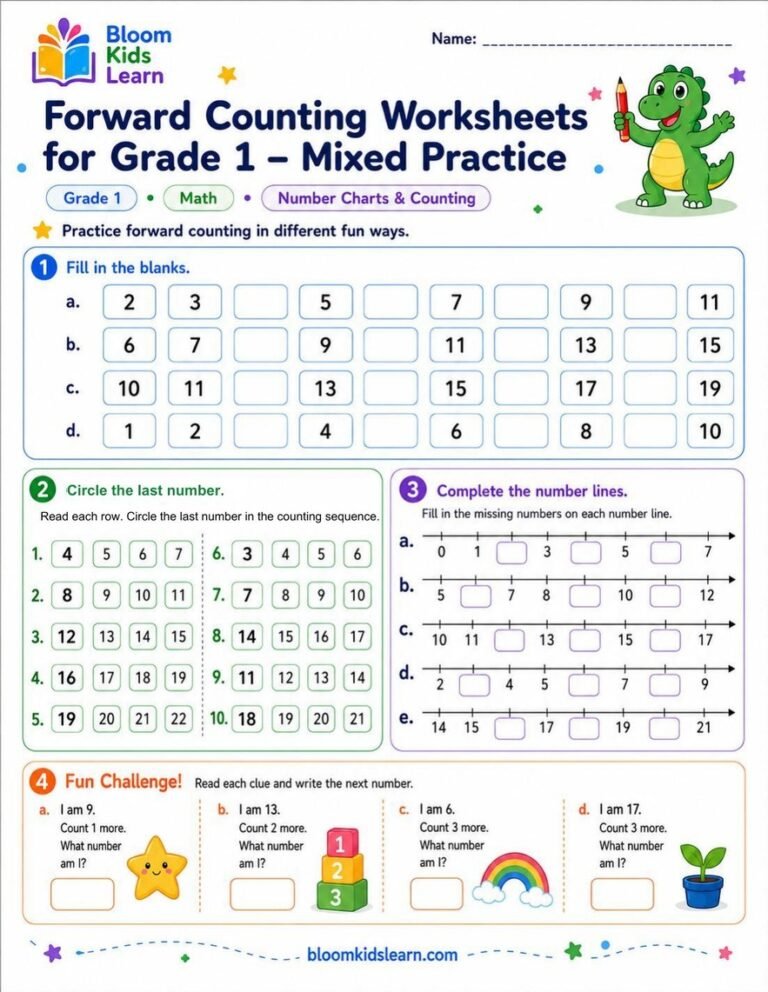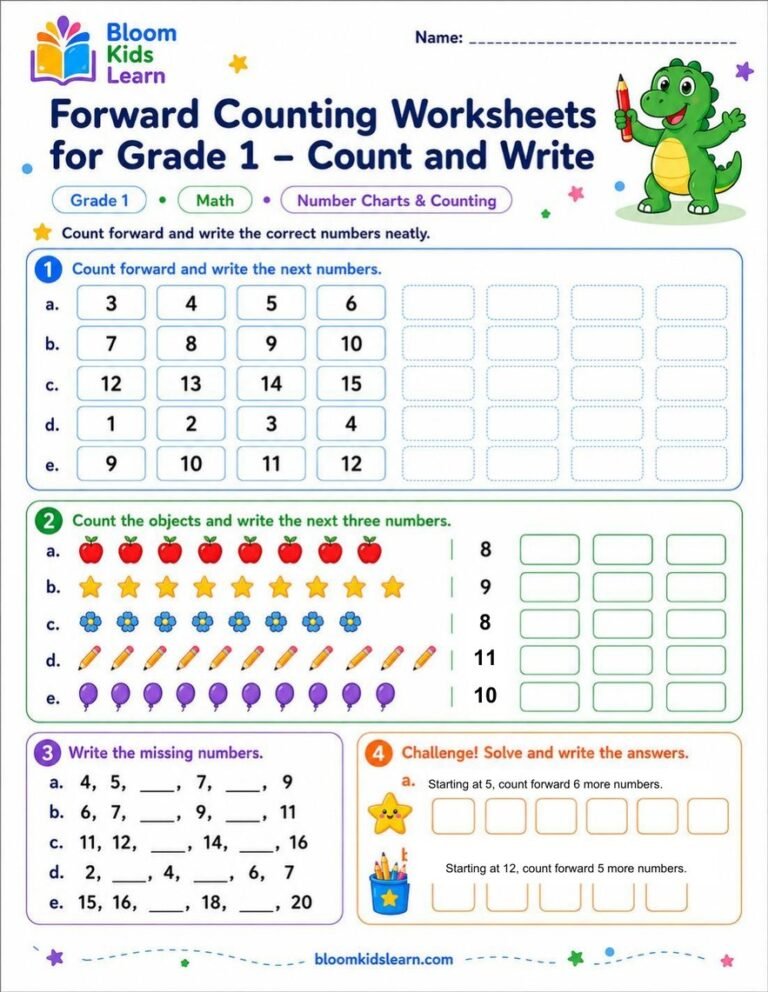

Forward Counting Missing Numbers Worksheet for Grade 1
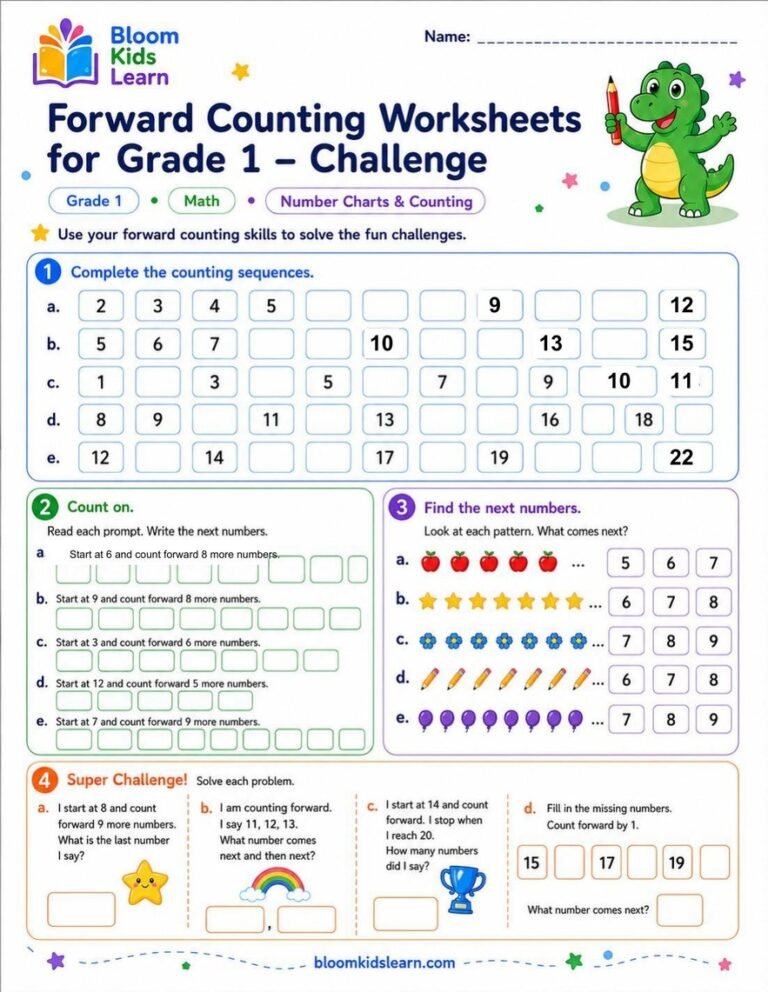
Children fill gaps in number rows, number lines, and counting trains while practicing number order within 20.
- Skill: Number order and missing numbers
- Learning goal: Fill missing numbers in forward-counting sequences within 20.
- Format: Printable PDF worksheet
 Download Worksheet PDF
A row such as 11, __, 13 gives a first grader two useful clues: the number before the gap and the number after it. This free Forward Counting Missing Numbers worksheet turns that small puzzle into varied practice with number rows, labeled number lines, colorful counting trains, and short count-on prompts.
Every activity increases by 1 within 20. The layouts change, but the underlying question stays the same: which number belongs next in the forward sequence?
What students practice
- counting forward by 1 from different starting numbers;
- filling gaps in sequences from 1 through 20;
- using numbers on both sides of a blank as clues;
- reading and completing labeled number lines;
- continuing counting trains in the correct order; and
- writing the next few numbers after a given value.
Seeing the same skill in several formats helps children understand number order instead of depending on one familiar type of row.
Warm up with an oral missing-number game
Say a short sequence and replace one value with the word “blank”: “6, 7, blank, 9.” Ask the child to repeat the count with the missing number included. Try another example that begins somewhere other than 1.
If the learner hesitates, repeat only the number immediately before the blank and ask for one more. Then use the number after the blank to check. Keep the warm-up brief and move to the worksheet while the strategy is fresh.
A three-step strategy for every gap
- Read the full sequence and say “blank” for the empty space.
- Return to the printed number immediately before the blank and count one more.
- Write the answer, then check that the following printed number is one more again.
When two blanks are next to each other, complete the first blank before solving the second. The newly written number becomes the next clue.
Worked missing-number examples
For 11, __, 13, begin with 11. One more than 11 is 12, and one more than 12 is 13. Therefore, 12 belongs in the blank.
For 15, __, __, 18, find the values one at a time. One more than 15 is 16, and one more than 16 is 17. The completed sequence reads 15, 16, 17, 18.
If a gap appears at the beginning, such as __, 8, 9, use the clue after the blank. The missing value must be one less than 8, which is 7. Read the complete row forward to confirm 7, 8, 9.
How to complete the number lines
Place a finger on the first labeled tick and move one mark to the right for every new number. Say one value for each move. When a tick is blank, write the number you said at that exact position.
A common mistake is jumping over a tick mark. Slow the finger movement and pair each physical step with one spoken number. Use nearby labels to verify that the count has not skipped or repeated a value.
How to use the counting trains
Follow the train from the first car to the last in the direction of the printed sequence. Read each numbered car and fill the empty cars with consecutive values. The colorful design changes the visual context, but each next car still holds one more.
Encourage the child to finish one train before moving to another section. Switching between rows while counting can make it easier to lose the starting number.
Continue from a given starting number
For prompts that ask for the next few numbers, say the starting number first and then count on. If the prompt begins at 14, the next values are 15, 16, and 17. Students should not restart their spoken count at 1.
Beginning from varied values is an important sign of flexible counting. If the child always needs to begin at 1, practice short oral counts of only three or four numbers from several starting points.
Common mistakes and helpful corrections
Some students guess from the shape of a nearby numeral. Ask them to read the entire sequence instead. Others repeat the number before the blank; use the phrase “one more” and add one counter to make the increase visible.
A learner may write the number after the gap instead of the missing value. Check both sides: the answer must be one more than the previous number and one less than the next printed number.
Digit reversals can change 12 into 21 or 15 into 51. Ask the child to say the intended number, identify the tens digit, and write slowly inside the available space.
Support for learners who need more help
Cover the unused sections and work on one format at a time. Allow a number line, a twenty chart, counters, or fingers. Ask the child to say the missing value before writing it.
Begin with gaps that have printed numbers on both sides. Move to blanks at the beginning or end after the student can explain how the surrounding clues work.
Extensions for confident students
Ask the learner to create a new five-number sequence with two blanks for an adult to solve. The child should provide enough printed clues and check the completed answer.
Another extension is to cover one labeled number on a completed line or train and ask the student to identify it from the neighboring values. Request an explanation using one more and one less.
Classroom and home uses
This printable works as a math center, morning warm-up, homework page, small-group activity, or short skills check. In pairs, one child can read a sequence while the other fills the blank, then they can switch roles.
For independent assessment, let the child complete the page without prompts and note which format causes errors. Use that information to choose the next focused activity.
How to check the completed worksheet
Read every number row, line, and train in forward order. Each value should be exactly one more than the previous value. Confirm that no blank was missed and that every written numeral fits between its printed clues.
When an answer is incorrect, restart from the nearest correct value rather than counting from 1. Ask the learner to explain why the corrected number belongs in that location.
Choose the next practice page
Children who need a gentler introduction can use the Forward Counting Basic Practice worksheet. For a more visual follow-up, try the Forward Counting Number Path worksheet. The complete Forward Counting collection keeps all six Grade 1 printables together.
Frequently asked questions
Can a child use a number chart?
Yes. Cover the target value, let the child predict it, and uncover it to check. Reduce the support as confidence develops.
What if two blanks appear together?
Solve the first blank, then use that new answer as the clue for the second. Work one step at a time.
Should the worksheet be timed?
No. Accurate counting and explaining the clues are more important than speed.
 Preview