
Forward Counting Number Path Worksheet for Grade 1
A visual counting worksheet with stepping-stone paths, number mazes, next-number choices, and short trails within 20.
- Skill: Visual number sequencing
- Learning goal: Follow number paths and identify missing numbers within 20.
- Format: Printable PDF worksheet
 Download Worksheet PDF
Some children understand a number sequence more easily when it looks like a route they can travel. This free Forward Counting Number Path worksheet for Grade 1 places numbers on stepping stones, connected boxes, and winding picture trails. Each empty space represents one more step forward.
The changing path designs make counting practice feel visual without changing the rule. Students begin at a printed value, follow the route in order, and write the missing numbers as the count increases by 1.
What is included on the worksheet
The first path begins at a flag and runs from 1 to 10. Later routes start at 5 and 10, which encourages children to count on without always returning to 1. Other activities ask learners to finish a short number route, choose the value that comes next, and complete two picture paths.
Stepping stones, boxes, and trails provide different visual settings for the same number-order skill. This variety helps a child transfer forward counting from a straight row to a less familiar layout.
Skills developed by number paths
- counting forward by 1 within 20;
- following a visual route in the correct direction;
- starting a count from 5, 10, or another given number;
- writing missing values along a path;
- choosing the number that comes next; and
- checking for skipped or repeated numbers.
Moving a finger or counter along the trail can also support visual tracking. One movement is paired with one spoken number.
Introduce the route before writing
Begin at the flag on the first path. Ask the learner to touch each stone while counting aloud from 1 to 10. Do not fill blanks yet; the first goal is to understand where the route begins and how it moves.
Repeat the tracing count and pause at each empty space. The child should say the missing number before writing it. This separates the counting decision from the task of forming the numeral.
Step-by-step directions for students
- Find the starting point and first printed number.
- Look at how the path connects to the next space.
- Move a finger or pencil tip one step along the route.
- Say the number that is one more.
- Write it when the space is blank.
- Continue to the end, then trace and read the complete path again.
Finish one route before starting another. Jumping between picture paths can make it harder to remember the current value and direction.
Worked number-path examples
If a route begins 5, 6, __, 8, the missing number is 7. It is one more than 6 and one less than 8. Reading 5, 6, 7, 8 confirms that the answer fits.
For a path that starts at 10 and contains two empty spaces after 11, solve one step at a time. One more than 11 is 12, and one more than 12 is 13. Write 12 first, then use it as the clue for 13.
When a route bends or changes direction, the number rule stays the same. Follow the connected spaces instead of assuming that the next number must always appear directly to the right.
How to solve “what comes next?” choices
Read the current number and decide the answer before looking closely at the choices. Think, “One more than ___ is ___.” Then select the option that matches.
If the current value is 14, the next number is 15. A number line can confirm the answer by showing one step to the right. This strategy prevents a child from choosing a numeral only because it looks similar.
Try a movement version
Place number cards on the floor in a simple path and remove one or two cards. Let the learner walk one card at a time, say the count, and name the missing values. Then return to the printable while the physical sequence is fresh.
A small toy or counter can also travel across the printed path. Move it only after saying the next number. The physical pause can reduce skipped spaces.
Common mistakes and helpful corrections
Some students follow a nearby picture instead of the connected route. Ask the child to trace the line from the current position before moving. Others skip a space when the trail curves; return to the last correct value and travel one step at a time.
A child may restart at 1 when a later path begins at 5 or 10. Point to the printed starting value and ask for only the next three numbers. Short count-on practice builds confidence from varied starting points.
If a numeral is reversed, have the learner say the intended number and identify the tens digit first. Correct the writing, then reread the path to keep attention on number order.
Support for developing learners
Cover the unused routes and reveal only the first path. Allow a finger, counter, number line, or twenty chart. Complete the first blank together, then let the child continue with fewer prompts.
Begin with the path from 1 to 10 before using routes that start in the middle of the count. If visual curves are distracting, trace the connecting line with a colored pencil before counting.
Extensions for confident students
Ask the learner to draw a new six-space path on scrap paper, choose a starting number within 20, and leave two spaces blank for an adult to solve. The child should check that the completed route increases by 1.
Another extension is to cover one printed anchor value and identify it using both neighbors. Ask for an explanation with one more and one less.
Classroom and home uses
This page works in a math center, small group, homeschool lesson, homework folder, or independent review. In pairs, one child can move a counter while the other says the numbers, then they can exchange roles.
The activity should not be timed. Careful route-following and accurate number order are more valuable than finishing quickly.
How to check the completed paths
Start at the beginning of every route and read each space in connected order. Each new value should be exactly one more than the previous value. Check that no path space was missed and every written numeral belongs on the correct trail.
If an error appears, return to the nearest correct printed number rather than erasing the entire path. Move forward one connected space at a time and correct the first value where the count breaks.
Build the sequence gradually
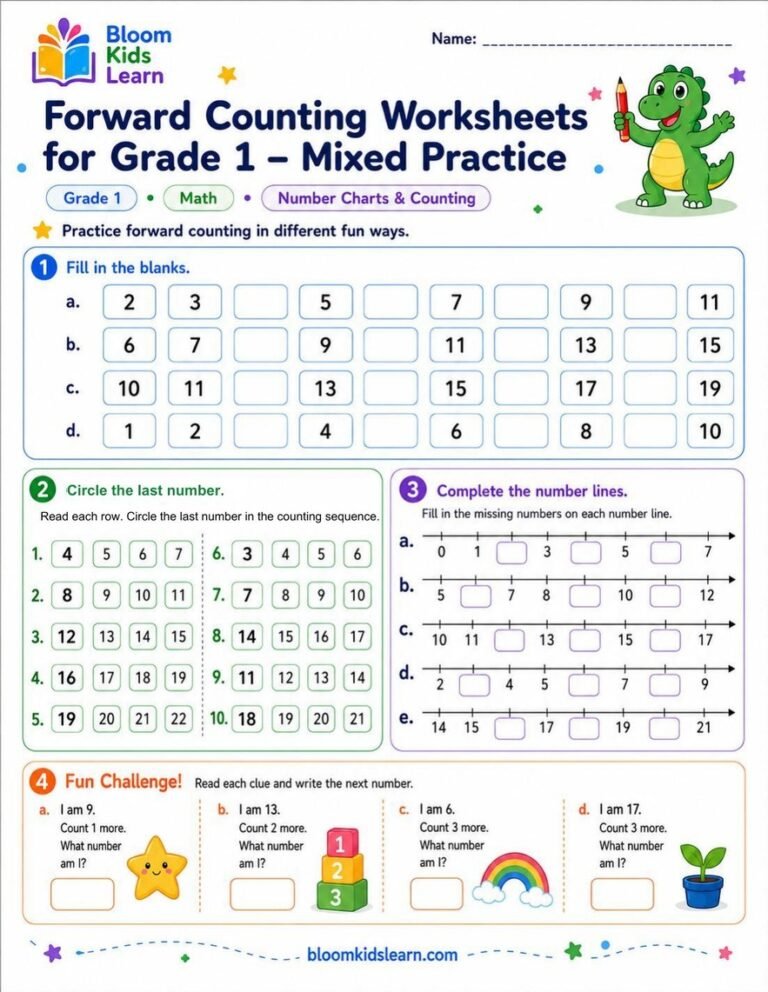
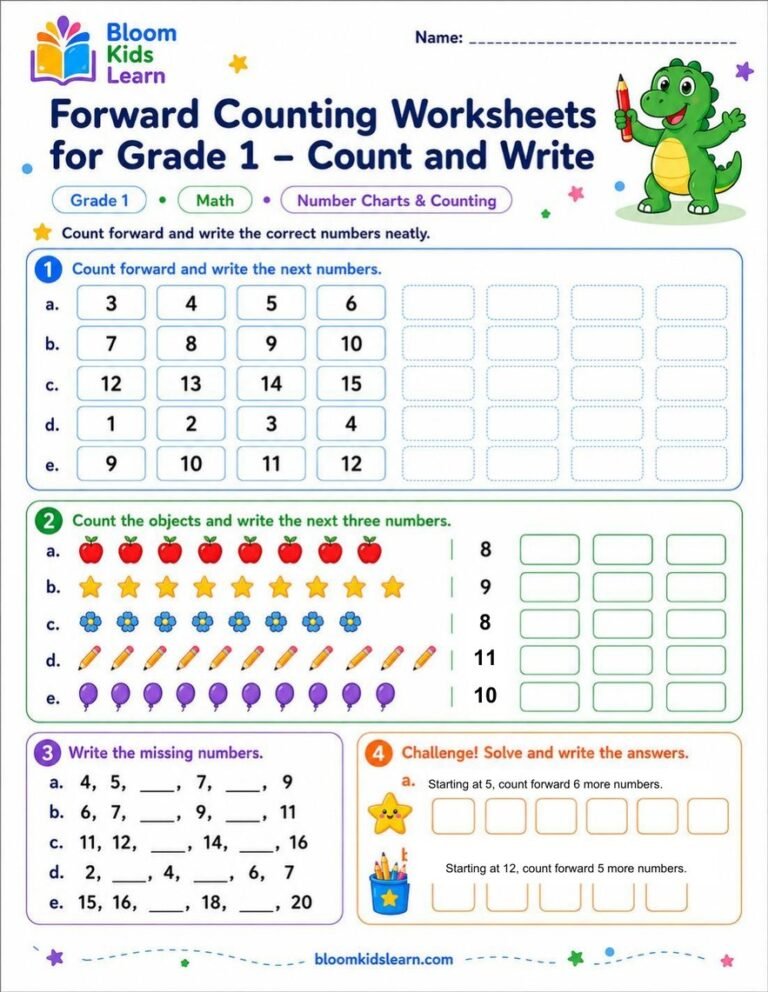
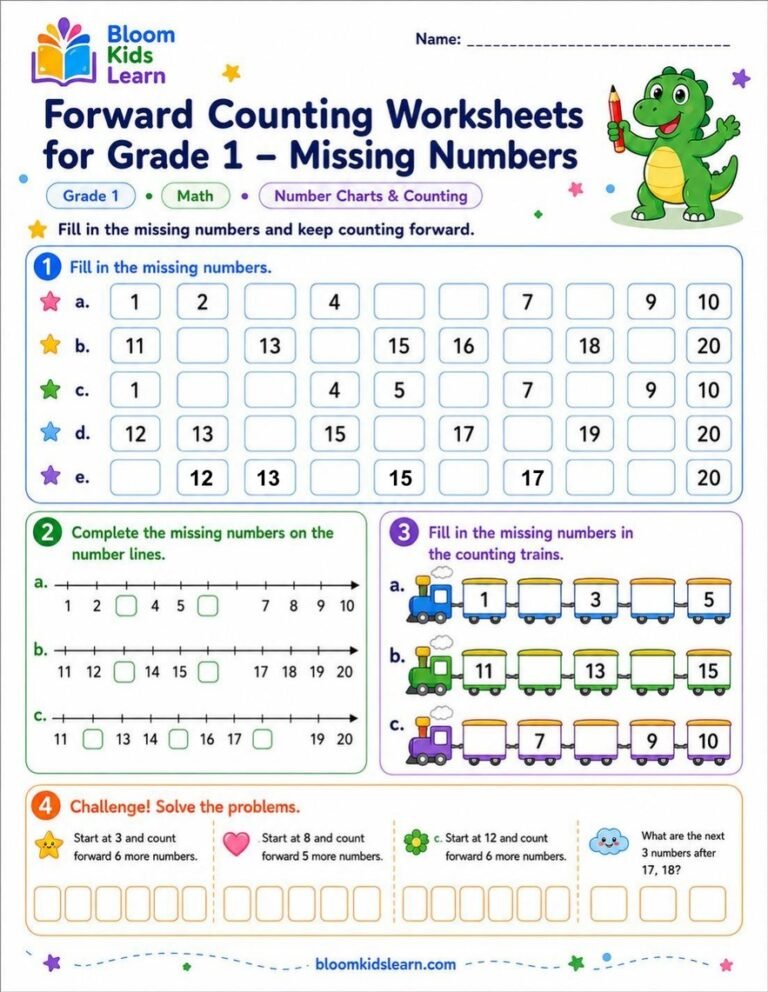
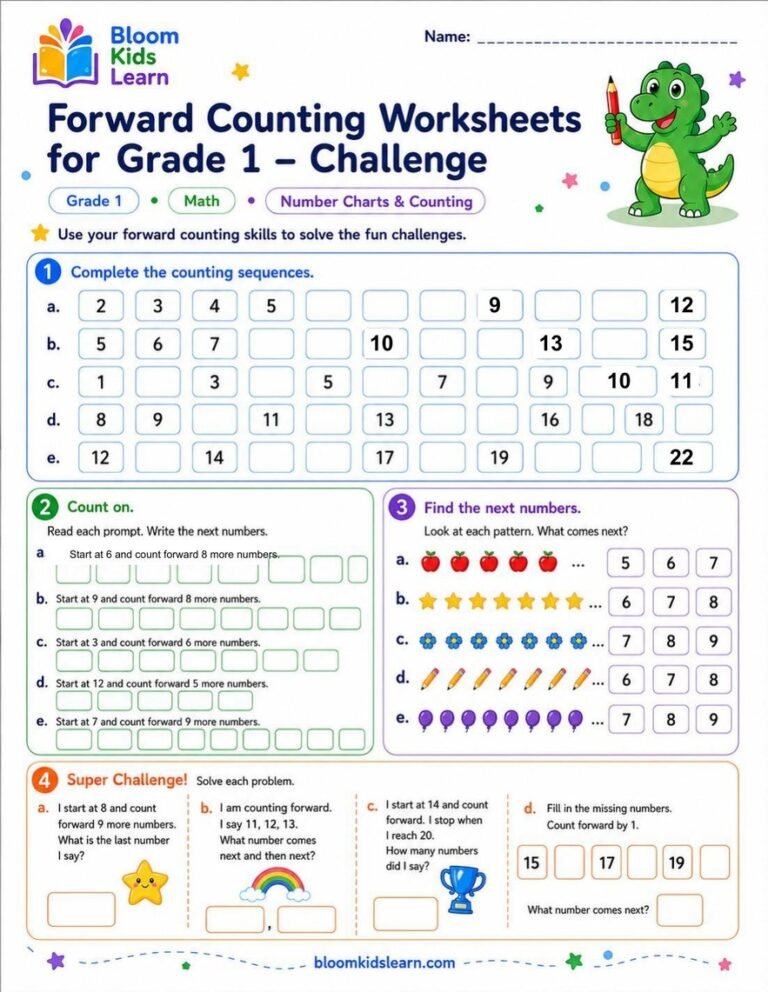
The Forward Counting Missing Numbers worksheet is a useful companion because it uses number lines and trains. After both visual pages, try the Forward Counting Mixed Practice worksheet. Browse the complete Grade 1 Forward Counting collection to choose another level.
Frequently asked questions
Should children trace before writing?
Yes. Tracing establishes the direction and complete count before handwriting is added.
Can a toy move along the path?
Yes. Pair each movement with one spoken number so the child does not skip a space.
What if the path design is distracting?
Cover the other activities and trace the connecting line with a finger or colored pencil. Focus on one route at a time.
 Preview