
Count and Write Forward Counting Worksheet for Grade 1
Children count familiar picture groups, name each total, and continue with the next three numbers.
- Skill: Quantity recognition and forward counting
- Learning goal: Count objects, name the total, and continue with the next three numbers.
- Format: Printable PDF worksheet
 Download Worksheet PDF
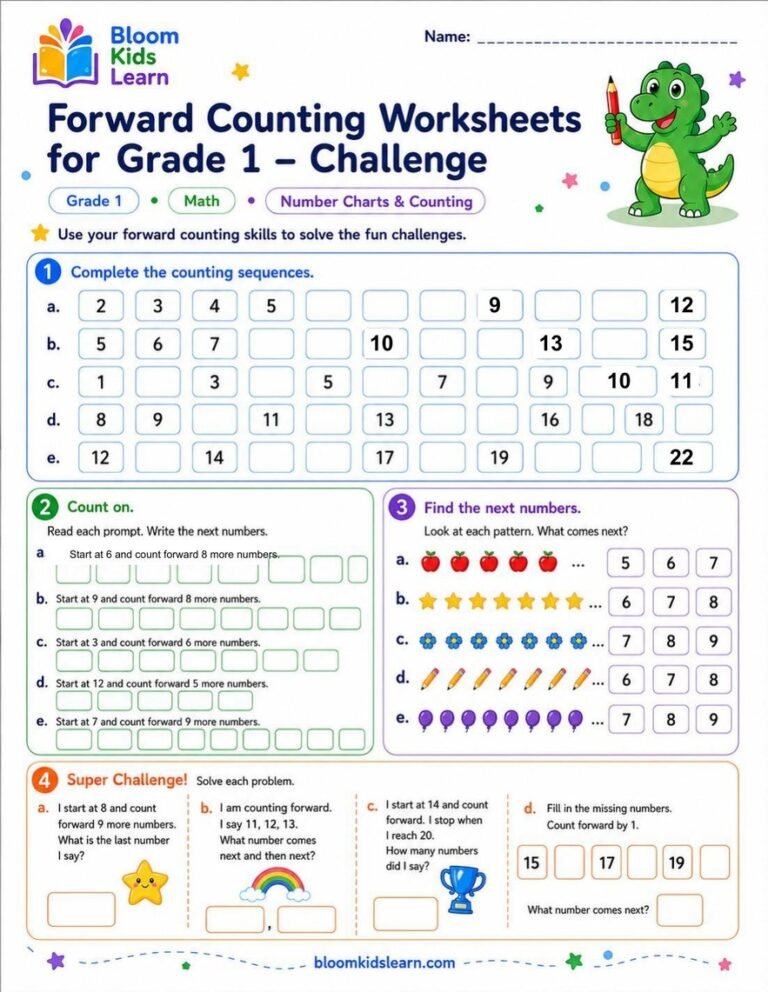
Knowing the counting words is one skill; connecting those words to an actual group is another. This free Count and Write Forward Counting worksheet for Grade 1 brings the two together. Children count groups of apples, stars, flowers, pencils, and balloons, then continue with the next three numbers.
The page begins with straightforward number rows, moves into picture-counting tasks, and finishes with missing-number questions and two short challenges. Students practice the same one-more relationship using numerals and real quantities.
Skills students practice
- counting pictured objects accurately;
- using one-to-one correspondence;
- matching a quantity to its numeral;
- counting on from the total instead of restarting at 1;
- writing the next three numbers; and
- completing short forward-counting challenges.
The shift from number rows to picture groups helps adults see whether a child can connect abstract numeral order with the size of a set.
Warm up with the number rows
Begin at the top of the page. Ask the learner to point to each printed number, say it, and complete the blanks one at a time. Review that every new value is one more than the number before it.
These rows prepare the child for the picture groups. Once the forward sequence is active, the learner can concentrate on counting objects and deciding where to continue.
Count each picture exactly once
Have the student touch each apple, star, flower, pencil, or balloon while saying one number. A steady left-to-right or top-to-bottom path can prevent objects from being skipped or counted twice.
After the last picture, repeat the total and pause: “There are ___ objects.” The total becomes the starting number for counting on. The child should not recount the pictures for each empty box.
Step-by-step directions for the picture section
- Choose one group of pictures.
- Touch every object once while counting aloud.
- Say the total and connect it to the printed or written numeral.
- Ask what number comes one more after the total.
- Write the next three numbers in order.
- Read the total and the three new values as one forward sequence.
Saying the sequence before writing can help students who lose track while forming their numerals.
Worked count-and-write example
Imagine a group contains 7 objects. Count the group and say, “There are 7.” The next three numbers are 8, 9, and 10. The complete spoken sequence is 7, 8, 9, 10.
Notice that 7 itself does not belong in the first answer box if the direction asks for the next numbers. The total is already the starting value. The first new answer must be one more.
If the next values cross from 9 to 10, remind the learner that the rule stays the same. The numeral becomes two digits, but 10 is still exactly one more than 9.
Make one-to-one counting visible
If an object is counted twice, ask the child to place a small removable counter over each picture after counting it or make a light mark beneath it. A finger can also move steadily from one item to the next.
Repeat the routine with household objects such as crayons, buttons, blocks, or toy cars. Count a group, write its total on scrap paper, and say the next three numbers. Changing the objects shows that the strategy works for any set.
How to approach the final questions
For missing-number items, read the whole sequence and use the printed values on both sides of a blank. For a short challenge, identify the starting number and decide whether the task asks for the next value or several following values.
Encourage the child to state the rule before answering: “I am counting forward by 1.” This short sentence can prevent accidental backward counting or skipping.
Common mistakes and helpful corrections
A learner may recount an object or miss one that is separated from the group. Recount along a consistent visual path and compare the two totals. Accurate object counting must come before counting on.
Some children write the group total again in the first box. Point to the total and say, “This is where we start. Which number comes next?” Others restart their spoken count at 1 after finding the total. Practice saying only the total and the next three values.
Digit reversals may appear in two-digit answers. Ask the child to say the intended number, identify the tens digit, and leave enough space for both digits.
Support for developing learners
Cover the rest of the page and work with one picture group at a time. Allow the child to mark each counted object and use a number line to find the next three values. Complete the first group together.
If counting on is difficult, build the same quantity with counters. Add one new counter for each next number. Gradually remove the objects while keeping the spoken one-more explanation.
Extensions for confident students
Ask the learner to draw a new group of between 5 and 12 objects, count it, and write the next five numbers. Another option is to create a count-and-write problem for an adult.
For deeper reasoning, add one object to a completed picture group and ask how both the total and the following sequence must change. The child should explain that every value becomes one greater.
Classroom and home uses
This printable works as a math-center activity, home practice, small-group lesson, or informal assessment. Partners can take turns counting a group and checking the following number sequence.
The page can be divided into two sessions. Complete the number rows and some picture groups first, then return to the final questions later. Accurate counting matters more than a fast finish.
How to check the completed worksheet
Recount each picture group independently and confirm the starting total. Then read the total followed by the three written answers. Every value should be exactly one more than the value before it.
Check the number rows and final challenges for skipped, repeated, or reversed numbers. When correcting an answer, first determine whether the mistake came from counting the objects or continuing the sequence.
Choose the next practice page
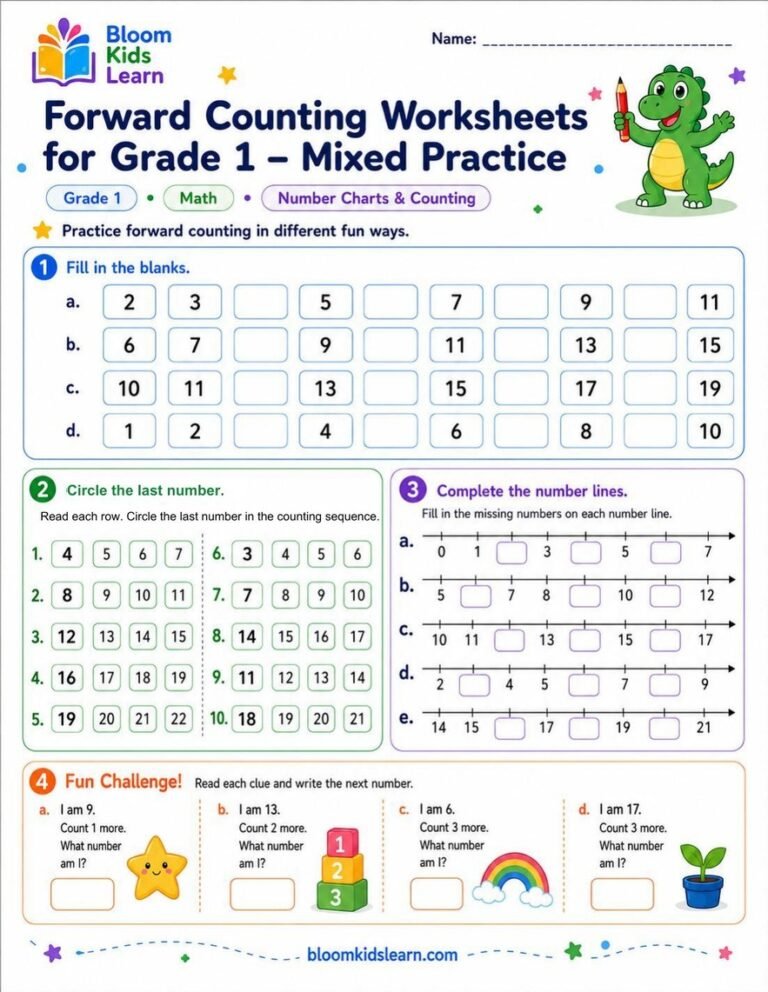
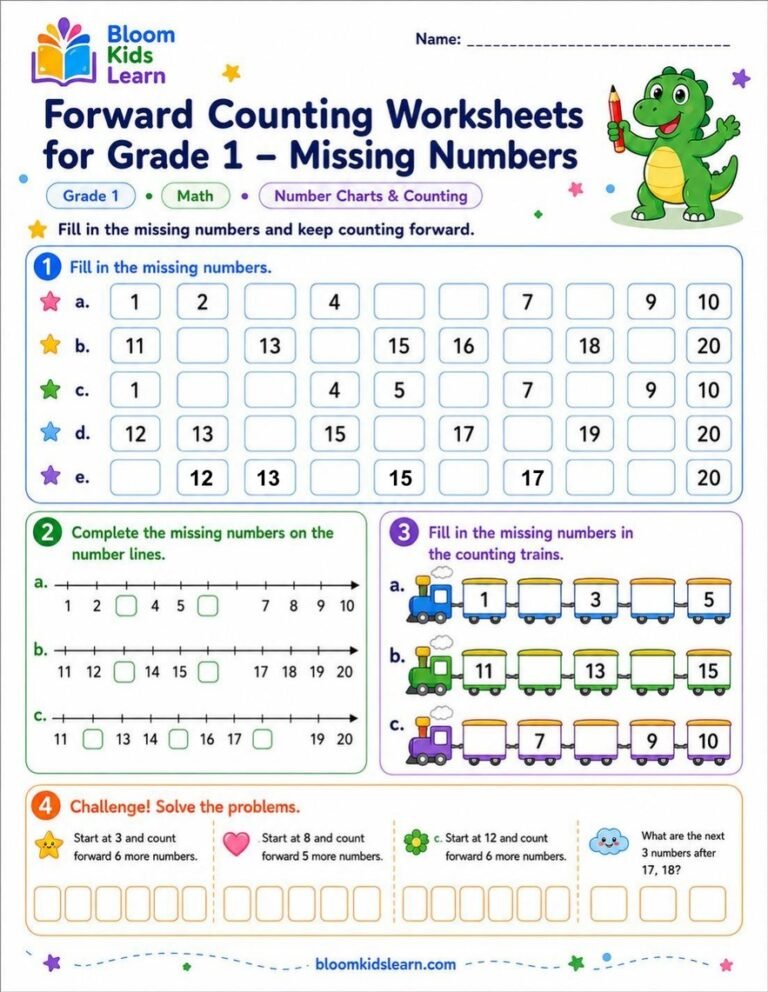
For more visual sequence work, use the Forward Counting Number Path worksheet. Children ready to combine several question styles can continue with the Forward Counting Mixed Practice worksheet. All six printables are organized on the Forward Counting topic page.
Frequently asked questions
Should children mark the pictures as they count?
Yes, if it prevents double counting. Use a light pencil mark or removable counter so the picture remains easy to see.
Does the child write the total again?
No when the instruction asks for the next numbers. The total is the starting value, and the first answer is one more.
Can real objects be used instead?
Yes. Household objects make the quantity-to-numeral connection concrete and provide useful extra practice.
 Preview