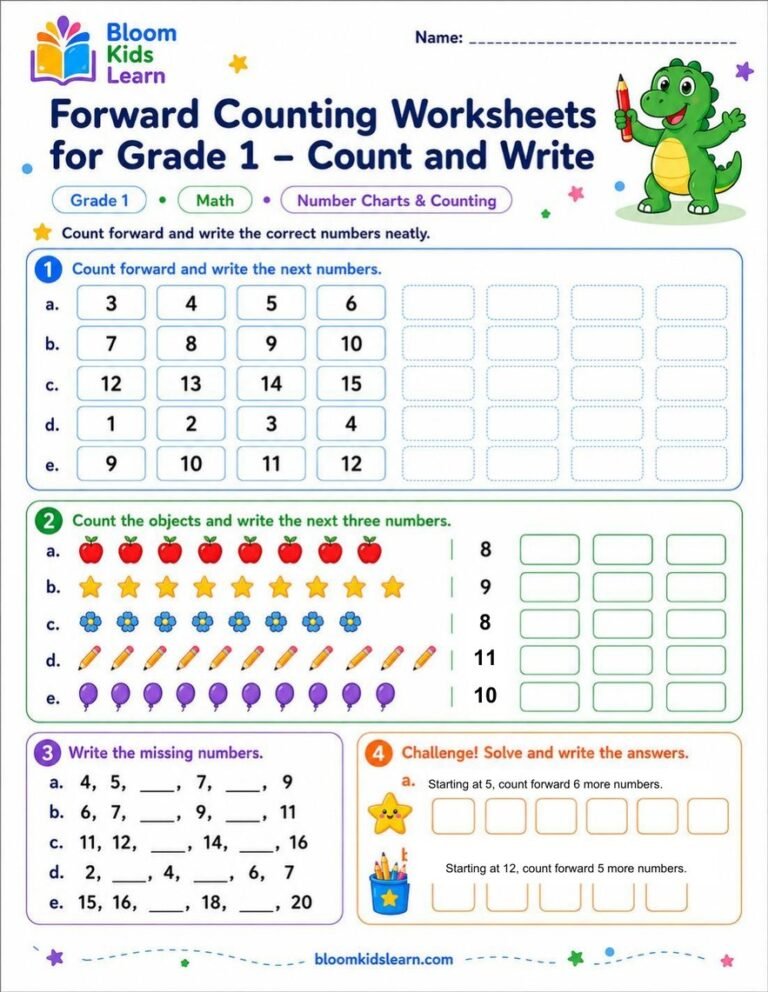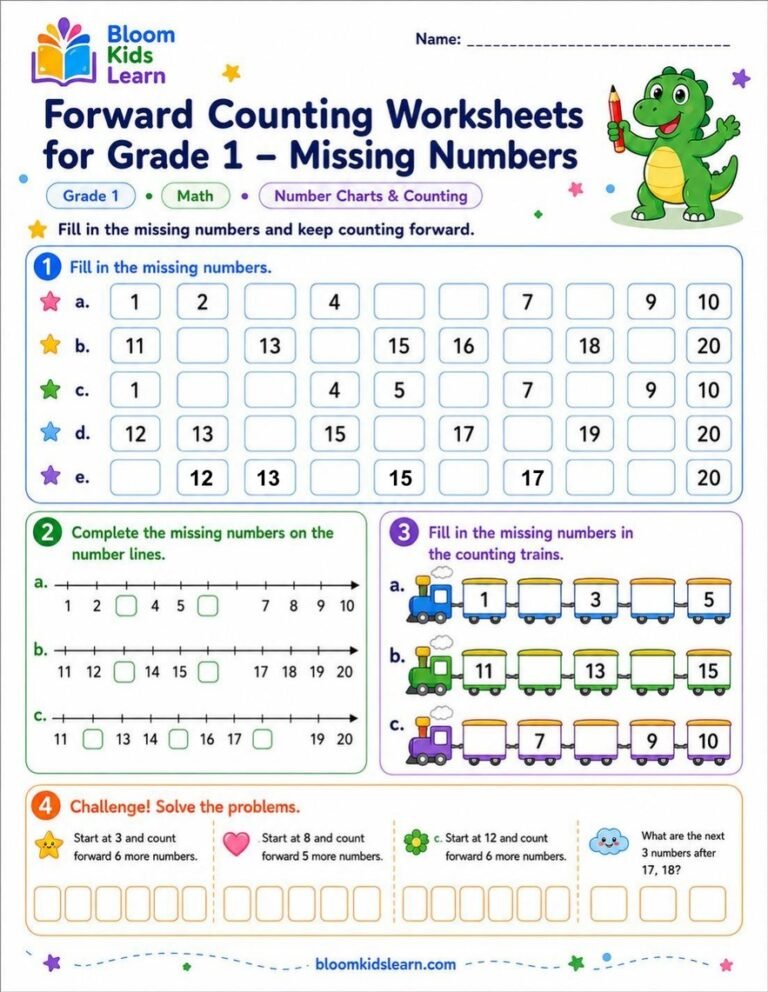

Forward Counting Challenge Worksheet for Grade 1
A less-scaffolded worksheet for children ready to explain number order and solve longer counting prompts within 20.
- Skill: Forward counting reasoning
- Learning goal: Explain and solve less-scaffolded forward counting problems within 20.
- Format: Printable PDF worksheet
 Download Worksheet PDF
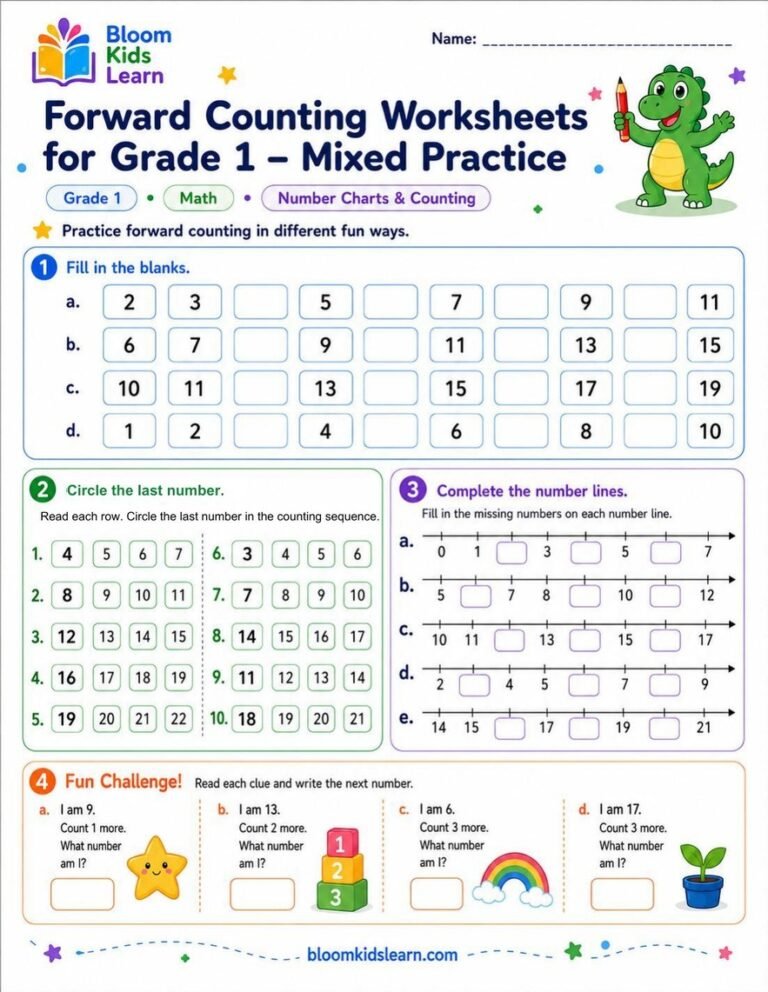
This free Forward Counting Challenge worksheet for Grade 1 removes some of the clues provided on earlier pages. Children complete longer sequences, count on from different starting numbers, study picture patterns, and solve short questions about what comes next. The number range remains familiar, but the tasks require closer reading and more independent reasoning.
Use the page after basic sequences, missing numbers, visual paths, and mixed practice are comfortable. A number line or counters can remain available, but encourage the learner to choose a strategy before reaching for a tool.
Skills included on the challenge page
- counting forward by 1 from varied starting values;
- completing longer number sequences;
- finding the final value in a count-on sequence;
- writing the next one or two numbers;
- studying picture patterns for number order; and
- explaining how an answer was determined.
The challenge is not about racing. It asks children to identify the relevant information, apply one more repeatedly, and check that the complete sequence makes sense.
When is a learner ready?
A child is ready when short forward sequences within 20 can be completed with reasonable accuracy and the learner can begin a count from a number other than 1. The student should also understand that each forward step produces one more.
If every answer still requires recounting from 1, return to focused count-on practice before using the full challenge. Moving to an easier page is a useful teaching decision, not a setback.
Read each direction carefully
One question may ask for the last number after counting on a stated amount, while another may ask for the next two values. Underline the starting number and circle how many numbers are required. Then restate the task aloud.
This brief reading routine prevents a child from solving the previous kind of question again. The mathematics may be understood even when an avoidable direction error appears.
A step-by-step challenge strategy
- Identify the starting number.
- Decide whether the task requires a missing value, the next numbers, or a final landing number.
- Say the count aloud or picture a number line.
- Move forward one step for each new number.
- Write only the values requested.
- Reread the completed response and explain the strategy.
For longer rows, point to each position while counting. One box, picture, or step should match one spoken number.
Worked count-on examples
If a prompt starts at 12 and asks for the next two numbers, say 12, 13, 14. Write 13 and 14 because those are the two values after the starting number.
If a problem asks where a count lands after three forward steps from 8, move separately: 9 is the first step, 10 is the second, and 11 is the third. The final answer is 11. Do not count the starting number as the first move.
For a sequence such as 16, 17, __, __, 20, fill one blank at a time. One more than 17 is 18, and one more than 18 is 19. Both answers fit before the printed 20.
How to approach picture patterns
Follow the pictures in the order indicated and identify what changes from one position to the next. If the pattern represents forward counting, each new position should correspond to one more.
Ask the child to describe the pattern before filling a blank. A spoken rule such as “the number increases by one each time” is more reliable than choosing an answer from appearance alone.
Let children explain their thinking
After an answer is written, ask, “How did you know?” A learner might count aloud, imagine a number line, use neighboring clues, or add one repeatedly. More than one strategy can be valid.
Listen for an explanation that connects the answer to number order. “I wrote 15 because it comes one more after 14” shows stronger understanding than “I guessed.”
Common mistakes and helpful corrections
A student may include the starting number when counting the requested moves. Mark the start with a finger, then count only new positions. Another common error is writing too many or too few answers; circle the quantity requested in the direction.
When a longer sequence contains several blanks, children may skip a value or reverse two answers. Complete one space at a time and reread the whole row. If the count crosses from 9 to 10, remind the learner that the one-more rule does not change.
Digit reversals can alter two-digit values. Ask the child to say the intended number, identify the tens digit first, and write slowly.
Support without removing the challenge
Keep a blank number line, twenty chart, or counters nearby, but allow thinking time first. If the child remains unsure, model only the first forward step and ask the learner to continue.
Cover the unused sections and complete one format at a time. Reading the direction aloud is appropriate when decoding prevents the child from showing the counting skill.
Extensions for confident students
Ask the learner to create a longer sequence with three missing values for an adult to solve. Another option is to choose a starting number and write the next seven values without a visual guide.
For a reasoning extension, the child can write a short count-on clue that ends at a chosen number. The adult must determine the start or the number of forward moves.
Use the page as an informal assessment
Let the student attempt the worksheet independently before providing corrections. Note whether errors involve number order, counting the moves, reading directions, picture patterns, or numeral formation.
Ask for an explanation from each section. The pattern of answers and explanations can guide the next lesson more effectively than an overall score.
How to check the completed worksheet
Read every completed number sequence from its starting value. Each new value should be exactly one more. For a landing-number question, recount the stated number of moves and confirm that the start was not included as a move.
When an error appears, correct the strategy first. Let the child make the forward moves again, write the corrected answer, and explain why it fits.
Where this worksheet fits
The challenge works best after the Forward Counting Mixed Practice worksheet. If a section feels frustrating, return to the Forward Counting Basic Practice worksheet. The complete Forward Counting collection explains how all six levels work together.
The activities support the official Grade 1 Common Core counting expectation to count on from numbers other than 1.
Frequently asked questions
Should a challenge worksheet be completed without tools?
No. Tools are appropriate when they support reasoning. Encourage the child to explain how the number line or counters helped.
Should this page be timed?
No. Careful reading, accurate counting, and clear explanations matter more than speed.
What should come next?
Extend forward counting beyond 20, practice backward counting, or begin counting by 2s when the one-more pattern is secure.
 Preview