

Worksheet Topic
Counting by 2s Worksheets
Counting by 2s is one of the first skip-counting patterns children learn in Grade 1. It helps students move from saying every number in order to noticing that numbers can be organized in equal jumps. This collection includes six free printable worksheets that begin with simple even-number sequences and gradually add missing numbers, visual pairs, number paths, mixed review, and reasoning challenges. Each page is designed for short, focused practice at home or in the classroom.
What does counting by 2s mean?To count by 2s, start with a number and add 2 each time. Starting at zero gives 0, 2, 4, 6, 8, and 10. Starting at one gives 1, 3, 5, 7, 9, and 11. Both patterns are correct. The first pattern contains even numbers, while the second contains odd numbers. First graders usually begin with the even-number sequence because pairs of objects make the pattern easy to see and touch.
Why this skill matters in Grade 1Skip counting builds number sense, mental addition, and pattern recognition. A child who understands that 18 is 2 more than 16 is practicing the same thinking later used for addition facts, equal groups, arrays, and early multiplication. Counting pairs also connects written numerals to real quantities. Shoes, socks, eyes, wheels on bicycles, and partners in a line are familiar examples that make groups of two meaningful.
How to introduce the patternBegin with real objects rather than a memorized chant. Place ten counters on a table and slide them into five pairs. Touch one pair and say “two,” touch the next pair and say “four,” and continue to ten. Repeat the activity with crayons, blocks, buttons, or toy animals. After the child can count the pairs accurately, write the matching numerals underneath. This concrete-to-picture-to-number sequence helps children understand why the numbers change by two.
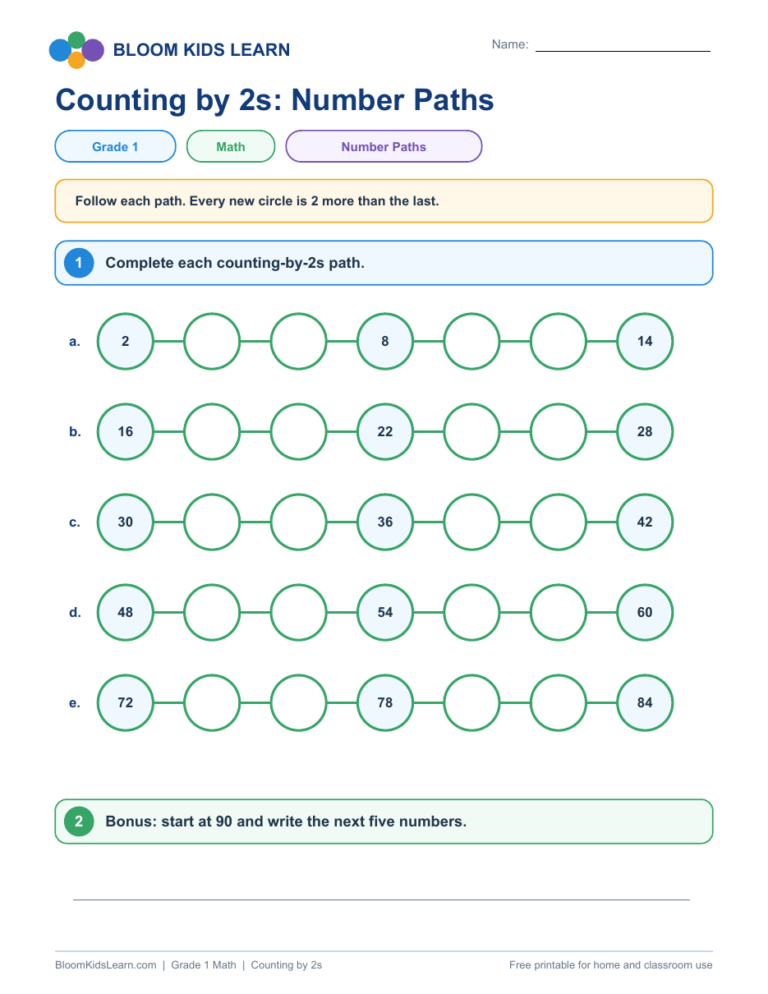
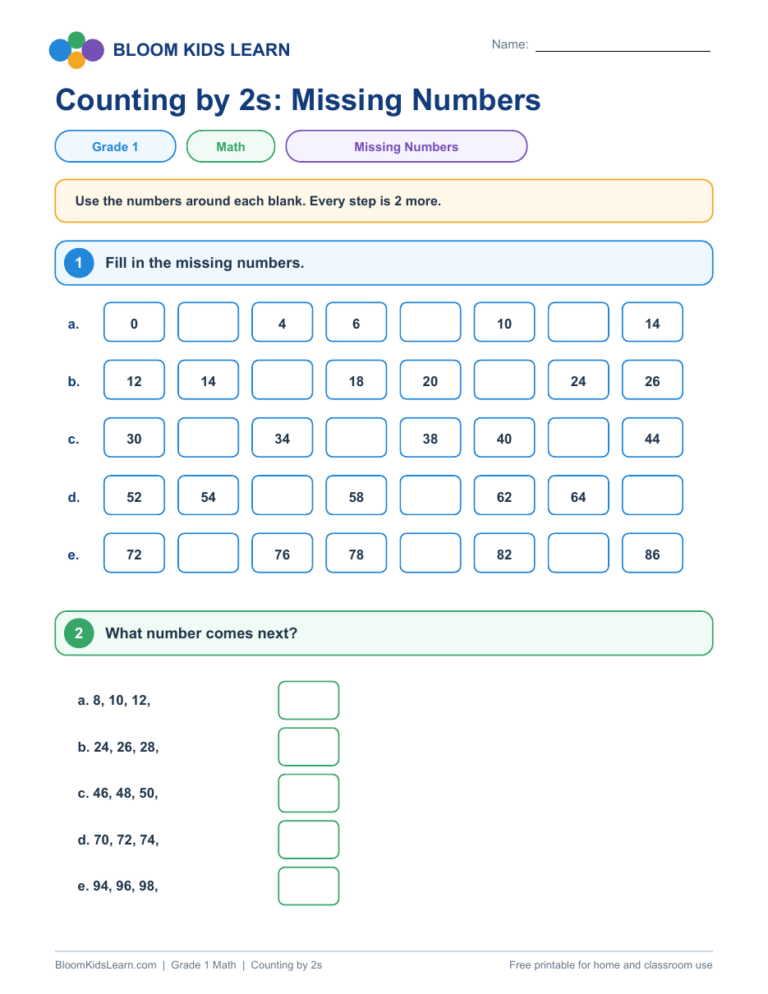
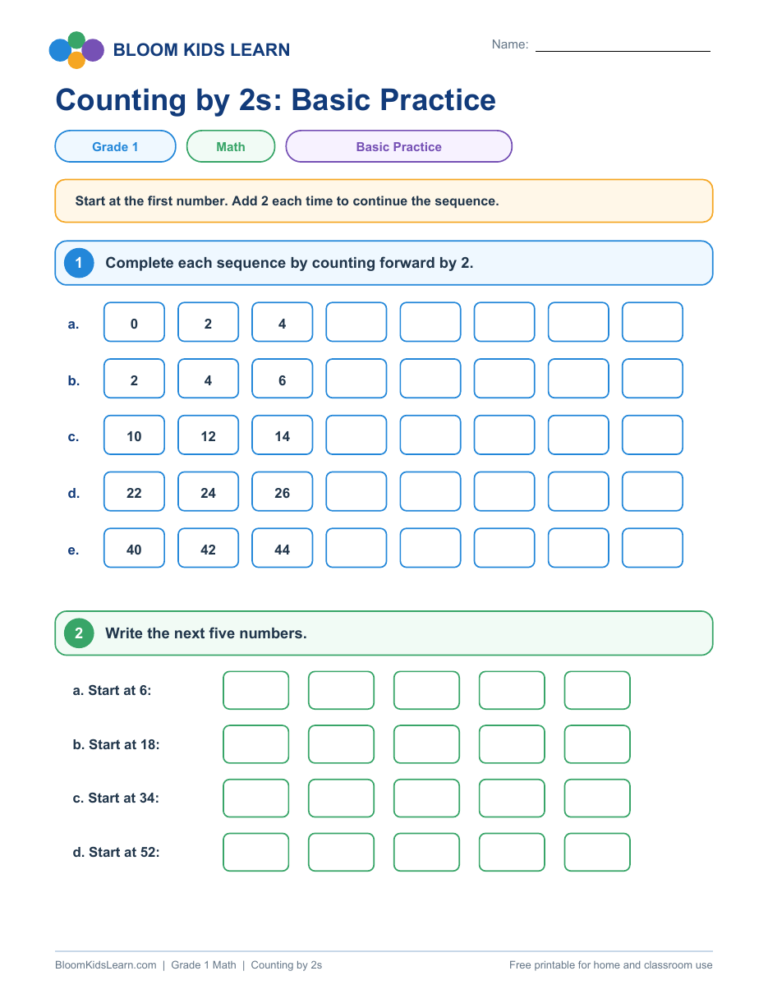
What is included in this worksheet set?The Basic Practice page introduces clear sequences with three starting clues. Missing Numbers removes selected values so learners must use numbers on both sides of a blank. Number Paths presents the same rule in connected circles. Pair and Count groups colorful dots in twos before asking for a total. Mixed Practice combines sequences, two-more clues, and even-number recognition. The Challenge page asks students to correct mistakes, continue patterns from odd starting numbers, and explain their reasoning.
A practical teaching orderUse the worksheets in their listed order when the skill is new. Start with Basic Practice and Pair and Count, because both make the jump of two explicit. Continue with Missing Numbers and Number Paths after the learner can say the sequence without prompting. Save Mixed Practice and Challenge for independent review. A child does not need to finish every page in one sitting. Ten attentive minutes usually provides more value than a long session completed with guessing or fatigue.
How to help a child who gets stuckReturn to pairs and a number line. Ask, “What is two more?” instead of supplying the answer. The child can hold up two fingers, move two spaces, or draw two dots beside the current number. If 38 to 40 feels difficult, write 38, 39, 40 and circle the landing number. Gradually remove the middle number once the jump becomes familiar. Encourage accurate thinking before speed; fluency grows from repeated correct experiences.
Common mistakes to watch forSome learners add one instead of two when a row becomes longer. Others memorize the pattern to 20 but lose it when the sequence begins at 26 or crosses 100. A third common mistake is assuming that counting by 2s always begins at zero. Use short sequences with different starting numbers to address these issues. Ask the child to check that exactly one number is skipped between each written answer.
Differentiate the practiceFor extra support, cover most of a row and reveal one step at a time. Provide a hundred chart and let the learner highlight every second square. For on-level practice, remove the chart and ask the child to explain one answer aloud. To extend learning, begin at an odd number, count backward by 2, or ask for numbers beyond 100. These changes keep the rule the same while increasing the thinking required.
Use the printables at home or schoolTeachers can use one page for morning work, a math center, intervention, homework, or an exit check. Families can place a worksheet in a reusable sleeve and write with a dry-erase marker. Read the instructions together, model one example, and let the child complete the remaining work independently. Review mistakes calmly by returning to the add-two rule. The goal is confidence and understanding, not simply a perfect-looking page.
Connections to standards and later mathThese activities support Grade 1 work with counting, number sequences, and adding within a growing range. They also prepare children to understand equal groups in later grades. The official Common Core Grade 1 counting expectation includes counting to 120 from any number less than 120. Counting by 2s is an extension that strengthens the same ideas about order and numerical relationships.
Related worksheet practiceIf adding two feels difficult, review the Counting by 1s worksheets first. After completing this collection, students can move to counting by 5s and 10s. Those larger jumps are easier when children already understand that skip counting follows a consistent rule. Keep the completed pages together so learners can see their progress from supported sequences to independent reasoning.
Frequently asked questionsShould a first grader memorize counting by 2s?Memorization can develop through practice, but understanding should come first. A child should be able to show the pattern with pairs or explain that each number is two more than the previous one.How far should Grade 1 students count by 2s?Begin within 20, then extend toward 100 or 120 as accuracy improves. Starting at different numbers is more valuable than racing far beyond the child’s understanding.Are odd-number sequences also counting by 2s?Yes. Starting at 1 creates 1, 3, 5, 7, and so on. The Challenge worksheet includes odd starts after students are secure with even numbers.How often should we practice?Short practice two or three times per week is usually enough. Mix oral counting, objects, movement, and written work so the skill does not become a meaningless chant.Simple games for counting by 2sTurn practice into movement by asking the child to take two steps for every number spoken. Make a hopscotch path labeled 2, 4, 6, 8, and 10, or toss a soft ball back and forth while saying the next value. During cleanup, place toys into pairs and count the total by twos. A quick “What comes next?” game can begin at any even number. These playful routines give the pattern a purpose and reduce the pressure that some children feel when looking at a full worksheet.Checking answers without an answer keyEvery completed sequence can be checked with the same question: is each new number exactly two more than the number before it? For an even-number row, the last digit should repeat a predictable cycle of 0, 2, 4, 6, and 8. A hundred chart offers another check because counting by 2s moves across alternating squares. Encourage learners to find and repair their own errors. Self-correction is an important mathematical habit and provides better evidence of understanding than simply copying a corrected answer.
Learning Objectives
✓Skip count forward by 2 from different starting numbers
✓Use pairs and visual groups to find totals
✓Identify missing values in counting-by-2 sequences
✓Explain that each new number is 2 more
✓Recognize even and odd counting-by-2 patterns
6 Worksheets
 Preview
 PDF