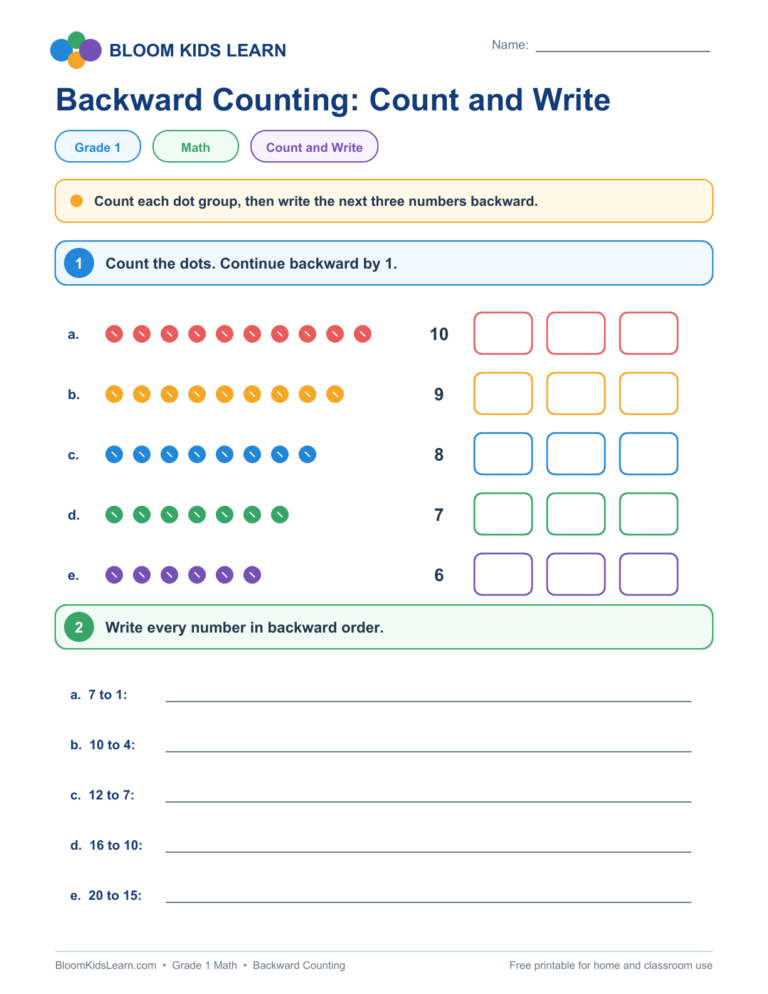
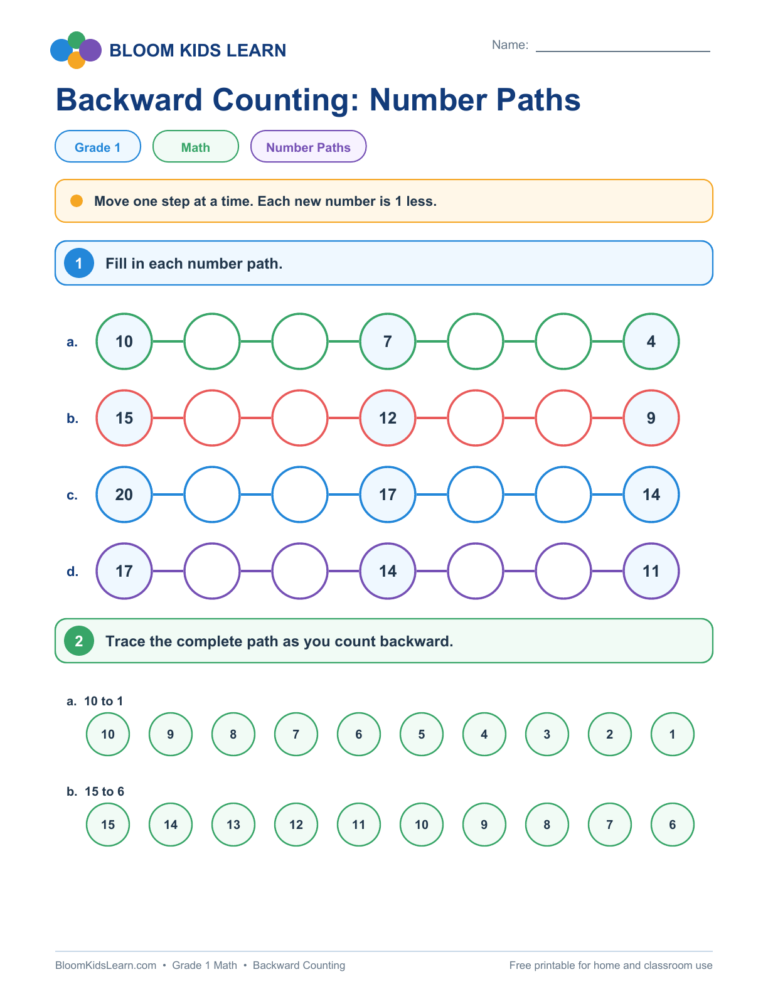
Backward Counting Challenge Worksheet for Grade 1
A Grade 1 challenge page that applies backward counting to one-less facts, simple take-away stories, and number patterns.
- Skill: Using backward counting for subtraction and patterns
- Learning goal: Use backward counting to find one less, solve take-away stories, and extend patterns.
- Format: Printable PDF worksheet
 Download Worksheet PDF
Once children can count backward by 1, the next step is using that knowledge to solve new kinds of problems. This free Grade 1 backward counting challenge worksheet asks students to find one less, solve short take-away stories, and extend decreasing patterns. The final pattern does not change by the same amount every time, so careful observation matters more than speed.
The page combines number order with early subtraction reasoning. Students still use backward counting, but they must decide how many steps to move and explain why an answer fits.
Skills included on the challenge page
- finding one less than numbers up to 20;
- using a countdown to subtract 1 or 2;
- representing take-away stories with counters or a number line;
- continuing patterns that decrease by 2;
- recognizing an alternating minus-1, minus-2 pattern; and
- checking an answer by explaining each backward move.
The word problems use familiar objects and small values so the reading demand stays manageable. The mathematical challenge comes from selecting and applying the correct backward-counting strategy.
When is a learner ready?
Use this worksheet after a child can count backward by 1 within 20 and complete ordinary missing-number sequences with little support. The student should understand that moving back one gives a number that is one less.
It is fine to use counters or a hand-drawn number line. A challenge activity can include tools; the goal is thoughtful application, not unsupported mental calculation on every question.
Start with a short strategy warm-up
Ask three oral questions: “What is one less than 14?” “If we start at 10 and move back two steps, where do we land?” and “What changes from 20 to 18?” Listen for the child to say 13, 8, and two less.
Then demonstrate two backward moves with a finger on a number line. Begin at a number, move one space left for subtracting 1, and move two separate spaces left for subtracting 2. Count the moves, not the starting position.
How to solve the one-less section
- Read the given number.
- Think of the number immediately before it.
- Move back one step mentally or on a number line.
- Write the answer and say the complete statement.
For example, one less than 16 is 15. The explanation can be, “15 comes immediately before 16, so it is one less.” Encourage a complete thought instead of an unsupported answer.
How to solve the take-away stories
Circle the starting number in the problem and underline how many objects go away. Build the starting amount with counters if needed. Remove the stated number of counters one at a time while counting backward.
For a story that begins with 9 objects and takes away 2, start at 9 and count back two moves: 8 is the first move and 7 is the second. The answer is 7. A frequent mistake is counting 9 as the first move, which produces an answer that is one too large.
After solving, reread the story with the answer. Ask whether the result should be smaller than the starting amount. This reasonableness check can catch accidental addition.
Understand patterns that decrease by 2
A pattern such as 20, 18, 16 changes by two less each time. A child may find the next value by counting back two separate numbers: from 16 to 15, then 14. Write only the landing number, 14.
Students can also notice that a decrease-by-2 pattern uses every other number. However, keep the backward moves clear before expecting a memorized skip-counting pattern.
Solve the alternating pattern
The final pattern changes by 1 and then by 2 before repeating. First, write the change under each pair of printed values: minus 1, minus 2, minus 1, minus 2. Then apply the next change to find each blank.
This problem rewards careful comparison. Students should not assume that all sequences on a backward-counting page follow one rule. Ask, “What happened between these two numbers?” before choosing the next value.
Common mistakes and helpful corrections
A learner may subtract 2 by jumping directly to the number immediately before the start. Model two distinct moves and count them aloud. If a child counts forward, ask whether taking objects away should make the quantity larger or smaller.
In the pattern section, some students continue decreasing by 1 because that rule appeared earlier on the page. Cover the unfinished portion and compare only the printed pairs. Identifying the existing change should come before filling any blank.
For a word problem error, return to the starting amount and physically remove the objects again. Correcting the model helps the learner understand the reason, rather than simply replacing the numeral.
Support for developing problem solvers
Reveal one section at a time. Allow counters for the stories, a number line for one-less questions, and small arrows under pattern changes. Read a story aloud if decoding interferes with the mathematics, but let the child decide the operation.
Complete the first example in each format together. On the next problem, ask the learner to name the strategy before beginning. Reduce the prompts as independence improves.
Extensions for confident students
Ask the learner to write a new take-away story for subtracting 2 and solve it with a countdown. Another option is to create a six-number pattern that decreases by 2.
For deeper reasoning, have the student design an alternating minus-1, minus-2 pattern beginning at a number within 20. The child should label each change and ask an adult to find a deliberately hidden value.
Use the page as an assessment
Let the student attempt each section independently before giving help. Record whether errors occur in one-less facts, counting the number of backward moves, reading stories, or identifying pattern rules. That pattern of errors suggests the best review activity.
Ask for at least one explanation from each section. A child who can describe the moves and pattern changes demonstrates more secure understanding than one who only supplies answers.
How to check the finished worksheet
For one-less questions, verify that each answer comes immediately before the given number. For take-away stories, rebuild the starting amount and count the removed objects. For patterns, write the change between every adjacent pair and make sure the rule continues through the blanks.
If an answer is wrong, correct the strategy first. Then let the learner write the new answer and explain what changed.
Review and continue learning
This page is best after the Backward Counting Mixed Practice worksheet. If one-less questions are difficult, return to the Basic Backward Counting worksheet. Browse the complete progression on the Backward Counting topic page.
The take-away practice connects with the official Grade 1 Common Core operations standard, which includes using counting strategies to add and subtract within 20.
Frequently asked questions
Are counters allowed on a challenge worksheet?
Yes. Counters help children model why backward counting solves a take-away problem. Encourage an explanation alongside the objects.
Should students memorize minus-1 and minus-2 facts?
Fluency grows through understanding and repeated use. The child should first be able to model or explain the backward moves.
Does the page need to be timed?
No. Pattern analysis and story reasoning benefit from a careful pace.

 Preview