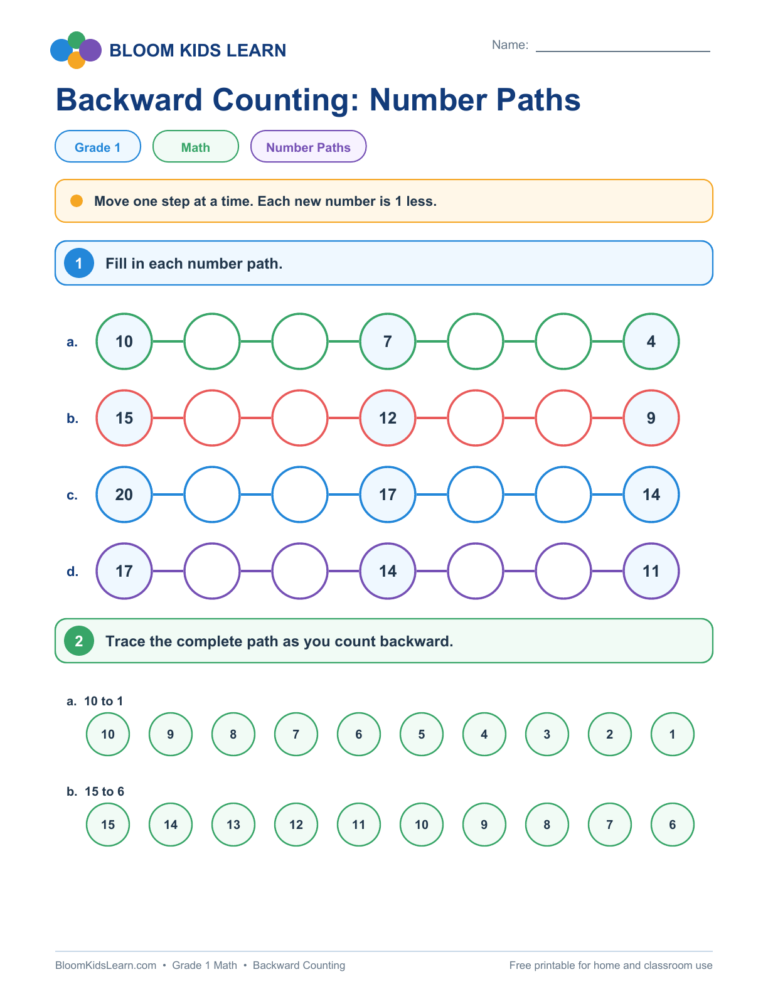
Backward Counting Count and Write Worksheet for Grade 1
Children count dot groups from 10 to 6, continue backward by 1, and write five complete countdowns.
- Skill: Counting visual groups and continuing backward
- Learning goal: Count groups from 10 to 6 and continue each sequence backward by 1.
- Format: Printable PDF worksheet
 Download Worksheet PDF
This free Grade 1 count and write backward worksheet connects quantity, numeral recognition, and number order. In the first section, students count colorful dot groups, confirm the printed starting number, and write the next three numbers in a backward sequence. The dot rows begin with quantities from 10 down to 6, giving children a concrete starting point before the pictures are removed in the second section.
The page is useful for learners who can recite a countdown but still need help connecting spoken numbers with actual amounts. Counting the dots answers “How many are there?” Continuing backward then answers “What number is one less?”
What students practice
- counting objects with one-to-one correspondence;
- matching a quantity to its written numeral;
- counting backward by 1 from a known starting number;
- writing the next three values in a countdown;
- completing picture-free sequences such as 7 to 1 and 20 to 15; and
- checking that every new number is exactly one less.
Because the worksheet shifts from visual groups to numerals alone, adults can see whether a child is ready to count backward without concrete support.
Begin by counting the dots carefully
Ask the learner to touch each dot once while saying one number. Moving from left to right can prevent dots from being counted twice or missed. After reaching the total, compare it with the printed starting numeral.
Use a complete sentence: “There are 9 dots, so we start at 9.” Then point to the first empty box and ask, “What is one less than 9?” The answer is 8. Continue with 7 and 6, checking that the numbers become smaller at every step.
Step-by-step directions for the first section
- Count every dot in the group once.
- Say the total and check the printed starting number.
- Read the starting number aloud.
- Count backward one number for each empty box.
- Write one numeral in each box.
- Read the complete countdown, including the starting number.
Have the student say the sequence before writing if pencil work interrupts the count. Oral rehearsal reduces skipped numbers and lets the child focus on numeral formation afterward.
Worked examples with quantities
If a group contains 10 dots, the sequence begins at 10. One less than 10 is 9, one less than 9 is 8, and one less than 8 is 7. The three boxes should contain 9, 8, and 7 in that order.
For a group of 6 dots, begin at 6 and continue 5, 4, 3. Students should not recount the dots after every box. The objects establish the starting quantity; the one-less rule completes the number sequence.
To make the decrease visible, cover one dot after each spoken number. Start with 8 dots, remove one, and notice that 7 remain. Repeat briefly, then return to the printed worksheet.
Move from pictures to written countdowns
The second section removes the dot groups. Students use only a starting number and the instruction to count backward. Ask the child to point to the first value, say it, and continue one less at a time.
For a countdown from 7 to 1, write 7, 6, 5, 4, 3, 2, 1. For 20 to 15, read 20, 19, 18, 17, 16, 15 before writing. Crossing from 20 to 19 can be difficult because both digits change, so emphasize that 19 is still simply one less than 20.
Why the two sections belong together
The dot groups show that backward counting represents a decreasing amount. The numeral-only section asks students to keep the same relationship in mind without seeing objects. This progression moves from concrete quantities toward mental number order.
If the first section is accurate but the second is difficult, the child may understand counting objects but need more practice starting a backward count from a written numeral. If both sections are difficult, review one-to-one counting and short countdowns within 5 before returning to the page.
Common mistakes and helpful responses
A child may count a dot twice. Encourage a consistent touching path or place a small mark beside each dot after it is counted. If the counted total does not match the printed number, recount slowly before beginning the countdown.
Some learners write the starting number again in the first box. Explain that the printed numeral already begins the sequence, so the first empty box needs one less. Others switch to forward counting; ask whether the group would have more or fewer objects after one was removed.
Numbers such as 12 and 15 may be reversed in writing. Ask the child to say the number, identify the tens digit first, and leave enough space for both digits.
Support for developing learners
Cover all but one dot row and complete it from start to finish. Allow the child to use fingers or counters to model each one-less step. A short number line can also show that backward movement goes left.
For the picture-free section, write the starting number on a separate card and move one counter backward along a number line for every answer. Reduce the tool gradually as the student becomes more independent.
Extensions for confident students
Cover the printed starting numeral and ask the learner to count the dot group, write the total, and then continue backward. This checks whether the quantity-to-numeral connection is secure.
Students can draw a new group containing between 6 and 10 dots, write its total, and add three boxes for an adult to complete. Another challenge is to choose a starting number within 20 and write a six-number countdown without pictures.
Classroom and home uses
This printable works in a Grade 1 math center, home practice folder, intervention group, or one-to-one lesson. In a partner activity, one student counts the dots while the other checks the written sequence. Partners should explain any correction using “one less” language.
How to check the answers
First recount each dot group and confirm its starting numeral. Then read the full row from the printed number through all three boxes. Every answer must be one less than the number before it.
For the second section, check that the first and last values match the requested countdown and that no number is skipped or repeated. When correcting an error, restart from the nearest correct value rather than rewriting the entire sequence.
Continue the lesson
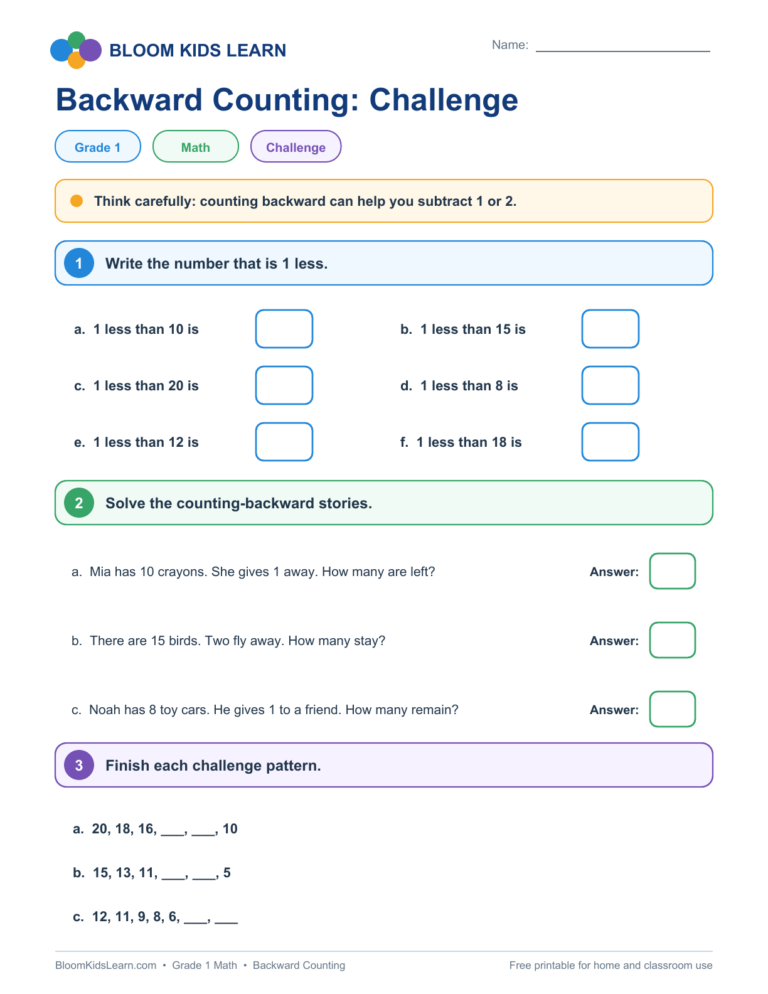
If a child benefits from visible steps, use the Backward Counting Number Path worksheet. Learners ready to switch between several formats can continue with the Backward Counting Mixed Practice worksheet. Visit the complete Backward Counting collection to choose another level of support or challenge.
Frequently asked questions
Should children recount the dots for every blank?
No. Count once to establish the starting amount. Then use one less to complete each following box.
What if the counted total does not match the printed number?
Recount slowly while touching each dot once. The printed numeral provides a useful self-check, but the child should still practice accurate object counting.
Can the number-only section be completed later?
Yes. Separating the two sections can help a child concentrate on one type of thinking at a time.
 Preview