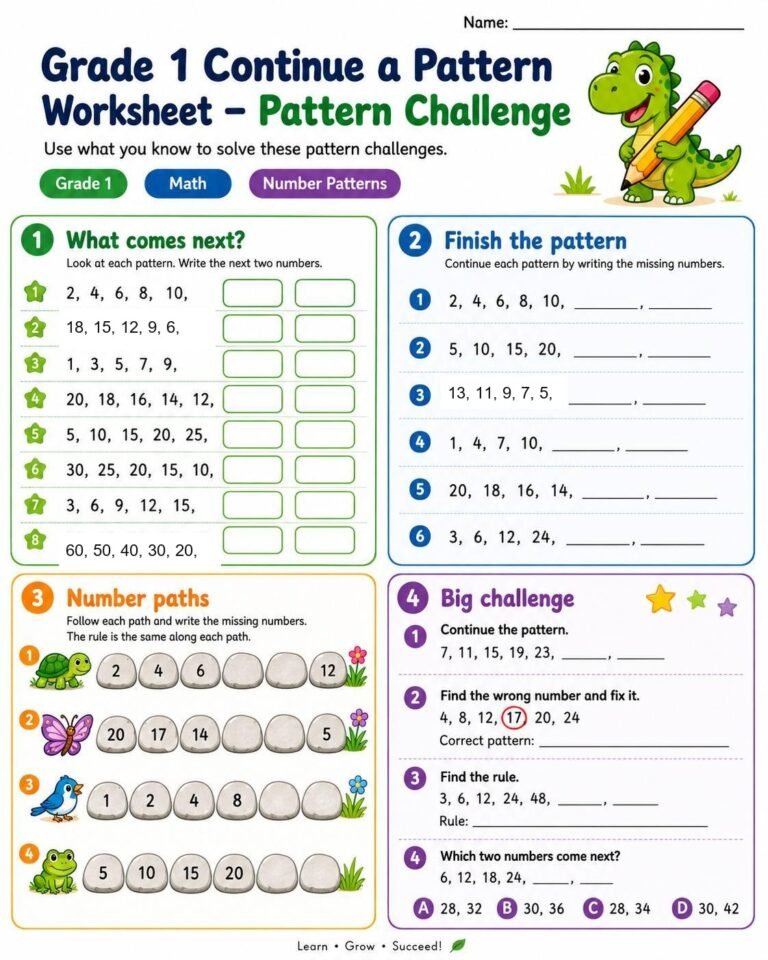

Number Pattern Worksheets for Grade 1
A collection of six free Grade 1 number pattern worksheets with direct PDF downloads and a clear learning progression.
- Skill: Identify, extend, compare, and explain increasing and decreasing number patterns.
- Learning goal: Use six printable worksheets to progress from recognizing simple patterns to explaining and applying number rules.
- Format: Printable PDF worksheet
 Download Worksheet PDF
These six free number patterns worksheets for Grade 1 help children move from noticing a simple sequence to explaining the rule that controls it. The collection covers increasing and decreasing patterns, missing terms, “what comes next?” questions, error spotting, and add-or-subtract rules.
Each worksheet is a separate US Letter PDF, so teachers and families can print only the page that matches the learner’s current need. The activities use clear number rows and short directions rather than long written problems.
Download the six Grade 1 number pattern worksheets
Want the complete set? Download all six number pattern worksheets in one PDF. The combined pack keeps the same order used in this guide, from checking whether a rule is consistent to selecting and explaining pattern rules.
1. Pattern or Not a Pattern
This page asks children to decide whether a sequence follows one consistent rule. They also find terms that disrupt a pattern and work out the next correct number. It is especially useful for a learner who can continue a familiar sequence but does not yet check whether the rule works at every step.
Read the teaching guide or download the Pattern or Not a Pattern PDF.
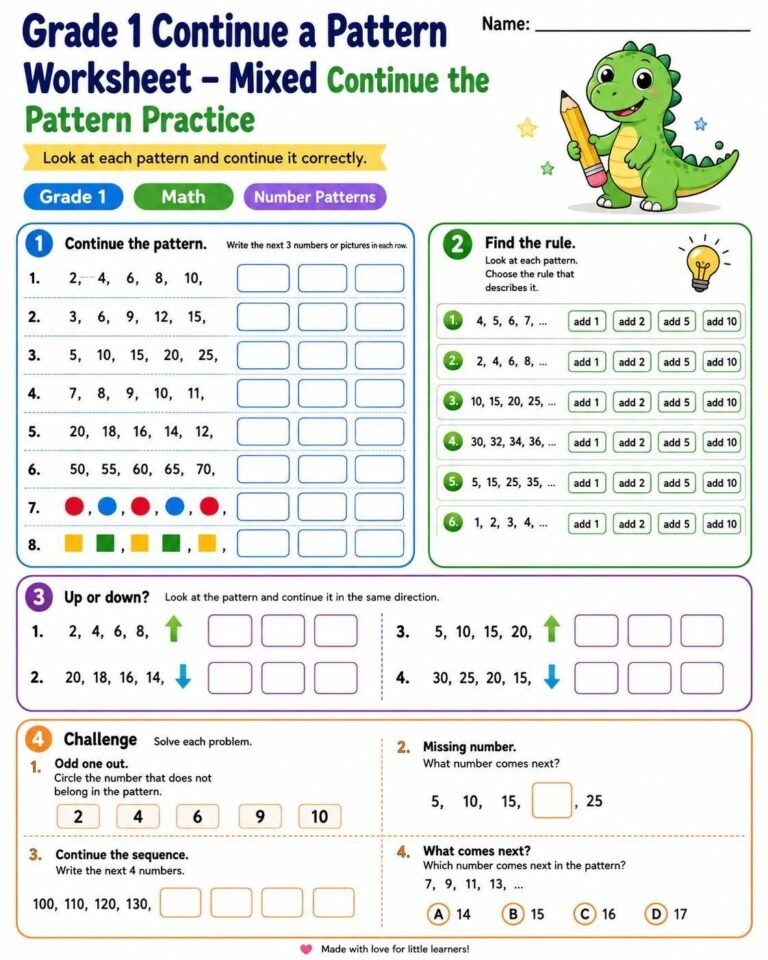
2. Continue the Number Pattern
Children identify how a row changes and write the next three terms. The page includes +1, +2, +3, +5, +10 and matching decreasing patterns. Because learners must produce three answers, the worksheet shows whether they can keep a rule consistent instead of making one lucky guess.
Open the Continue the Pattern page or download the printable PDF.
3. Missing Number Patterns
Here the blanks appear inside sequences as well as at the end. Children use the printed numbers on both sides to restore each pattern. The before-after section also makes an important distinction: in a +10 pattern, the term before 30 is 20, not 29.
See the Missing Number Patterns guide or download the missing patterns PDF.
4. What Comes Next?
This worksheet begins with one-answer predictions, then asks for two terms and uses number trains with an internal blank. The final growing-rule puzzle can be treated as an optional extension rather than a basic expectation.
Use the What Comes Next teaching notes or download the worksheet PDF.
5. Find the Pattern Rule
Children write rules in their own words, select rules from choices, and match sequences to rule cards. This makes the page a good bridge between silently continuing a pattern and explaining the mathematical relationship.
Open the Find the Rule page or download the rule worksheet PDF.
6. Choose the Rule
The final printable presents plausible rule choices beside each sequence. Learners test each option, circle the one that works throughout the row, and use it to predict the next term. A doubling question is clearly treated as a challenge.
Read the Choose the Rule guide or download the number pattern rules PDF.
A sensible order for teaching number patterns
Start with spoken counting and concrete jumps. Ask a child to count by ones, twos, fives, or tens while moving counters. Once the repeated change is familiar, show a written row and connect the spoken count to a rule such as “add 2.”
The six printables can then be used in this progression:
- Recognize whether a rule stays consistent.
- Continue a visible increasing or decreasing pattern.
- Fill terms that are missing from different positions.
- Predict one or two next numbers.
- Write or match the rule.
- Choose between several possible rules and justify the answer.
A child does not need to finish the whole set in one sitting. One focused page followed by a short conversation is more useful than rushing through six worksheets.
Language that helps children explain a pattern
Encourage complete but simple explanations: “The numbers go up by 5 each time,” “I subtract 2 to get the next number,” or “This is not a pattern because 14 breaks the add-3 rule.” Words such as increase, decrease, term, and rule can be introduced gradually.
Ask two dependable questions whenever a child is unsure:
- Are the numbers getting larger, getting smaller, or staying the same?
- How much changes from one number to the next?
What common mistakes may mean
If a learner changes the rule halfway through a row, have them write the step above each gap. If they find the step size but choose the wrong operation, ask whether the sequence is moving up or down. When a child answers from the last printed number without noticing where the blank sits, point to the neighbors on both sides.
Some errors are not pattern errors. Writing 21 instead of 12 may indicate digit-order or numeral-writing difficulty. Losing place while counting backward may call for a number line. Separating these issues prevents unnecessary repetition of a skill the child already understands.
Ways to use the collection in class or at home
For a short lesson, model one sequence, complete one row together, and let the child finish the rest independently. In a math center, place a number line, counters, and scrap paper beside the selected worksheet. The goal is not to make every learner use the same support; it is to make an appropriate support available.
The set can also work as a small progression across a week. Use Pattern or Not on the first day, Continue the Pattern next, and Missing Number Patterns after that. Save the rule pages for the end, when children are ready to describe the change rather than only apply it.
For differentiation, reduce the number of rows instead of changing the learning goal. A child who tires easily can solve three carefully chosen patterns and explain each one. A confident learner can create a new row with one deliberate error for an adult or classmate to find. Creating the example requires the learner to hold the rule steady and then decide exactly where to break it.
Grade 1 standards context
Common Core does not name “generate a number pattern” as a standalone Grade 1 standard. These printables support the counting sequence in CCSS 1.NBT.A.1 and the connection between counting and addition or subtraction in 1.OA.C.5. The multiplication-style items on two challenge pages are optional extensions, not Grade 1 mastery requirements.
Printing and answer-checking tips
Every PDF has been corrected to a true US Letter page so it should fill standard letter paper rather than printing as a small worksheet in one corner. Choose “Actual size” or “Fit to printable area” according to the printer’s margin settings; do not select multiple pages per sheet.
When checking answers, ask the child to state the rule before changing a response. A correct explanation is more informative than a page of unexplained answers. The individual worksheet pages include concise answer guidance for adults.
Keep one completed page as a reference when the child creates an original number pattern on blank paper. Ask them to write the rule underneath so another person can test it.
Frequently asked questions
What number patterns are suitable for Grade 1?
Begin with repeated +1 and -1 changes, then use +2, +5, and +10 patterns that connect to skip counting. Steps of 3 or other small values can be used after the idea of a consistent rule is secure.
Should a Grade 1 child explain the rule?
Yes, in simple language. “Add 2 each time” is enough. Explaining helps reveal whether the child understood the relationship or only guessed the next value.
What should I use before this set?
A learner who cannot yet read the numerals or count forward reliably may benefit from the Number Recognition worksheets and the Counting by 1s worksheets first.
 Preview