Counting by 5s Count and Write Worksheet for Grade 1
Count groups of five and continue skip-counting sequences with this free Grade 1 count and write worksheet for class, homework, or homeschool practice.
- Skill: Count groups of five and write the totals
- Learning goal: Count equal groups of five, continue counting-by-5s sequences, and write each total accurately.
- Format: Printable PDF worksheet
 Download Worksheet PDF
This counting by 5s count and write worksheet gives first graders a chance to connect real groups with written number patterns. Instead of starting with a long list to memorize, the page begins with colored objects arranged in groups of five. Children then continue sequences, fill gaps, and write five more numbers from two starting points. That gradual change—from seeing quantities to writing numbers independently—makes the practice easier to follow at home or in a classroom.
Use this free Grade 1 printable when a child is ready to explore equal groups and work with sequences reaching 85. It works for a ten-minute math center, a short tutoring lesson, homework, or a second look at skip counting by 5s. Counters, fingers, nickels, or a 1–100 chart can stay nearby for children who need a concrete reminder.
Counting by 5s Count and Write worksheet overview
The first section shows five rows of colored dots. Row a has two groups of five, row b has three groups, and the rows continue through six groups. The child counts each group and writes the total beside the matching sentence. This is a useful bridge between repeated addition and skip counting: 5 + 5 is 10, three groups of 5 make 15, and so on.
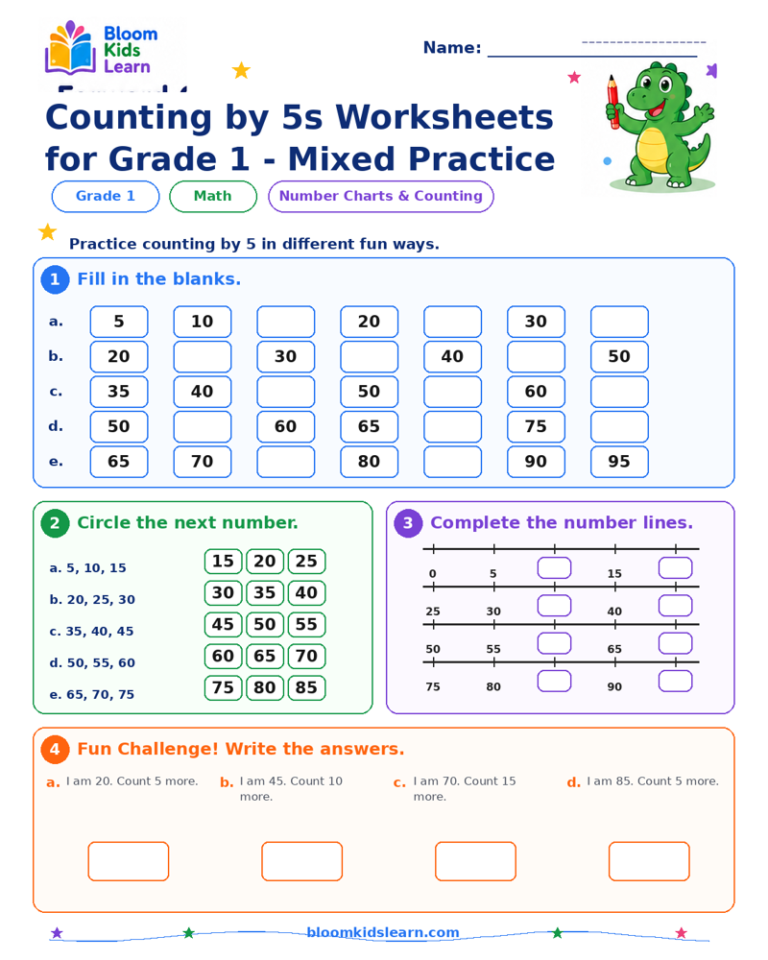
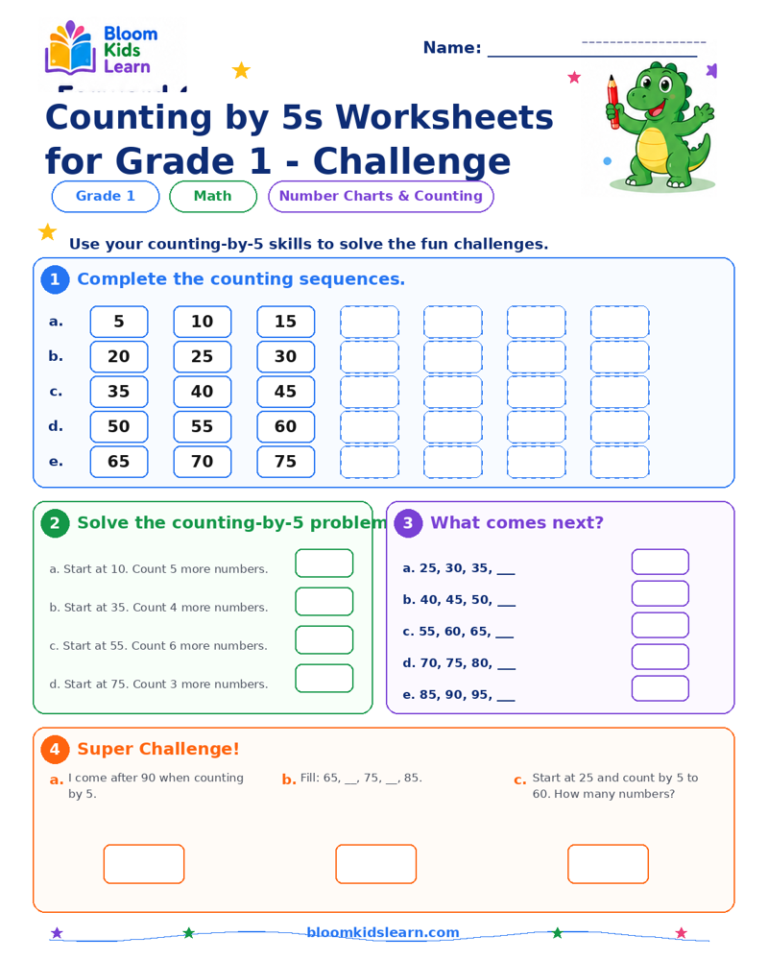
Next, children write the three numbers that follow 5, 20, 35, 50, and 70. The third section mixes printed numbers and blanks, so the learner must use the values on both sides of a gap. The final challenge begins at 15 and 60 and asks for five more numbers. There are enough clues to support a developing learner, but the last section still gives a quick fluency check.
Skills children practise
- Count equal groups of five and record the total accurately.
- Continue a skip-counting sequence from different starting numbers.
- Use “five more” to solve a missing number rather than guessing from the last digit.
- Write multi-digit numbers clearly and read a completed sequence back for checking.
How to use this Grade 1 counting worksheet
Before handing over the page, make two groups of five counters. Ask the child to count the first group as 5 and the second group as 10. Add a third group and pause: “What total do we have now?” Say 15 together. The point is not speed. Children need to notice that each new group changes the total by five.
Model one example from the second section. Starting at 20, write 25, then 30, then 35. Say “five more” each time you move to the next box. For the missing-number rows, solve one blank from both directions when possible. In 50, __, 60, the answer is 55 because it is five after 50 and five before 60.
Let the learner read the finished row aloud. This small step often catches a skipped value or a number written in the wrong order. If the page feels long, finish the picture section in one sitting and return to the sequences later.
Worked examples
Groups of five
Four groups of five make 20. Count by groups: 5, 10, 15, 20. The same idea can be written as 5 + 5 + 5 + 5 = 20.
Three numbers after a starting value
After 35 come 40, 45, and 50. Each new number is exactly five larger than the one before it.
Fill the gaps
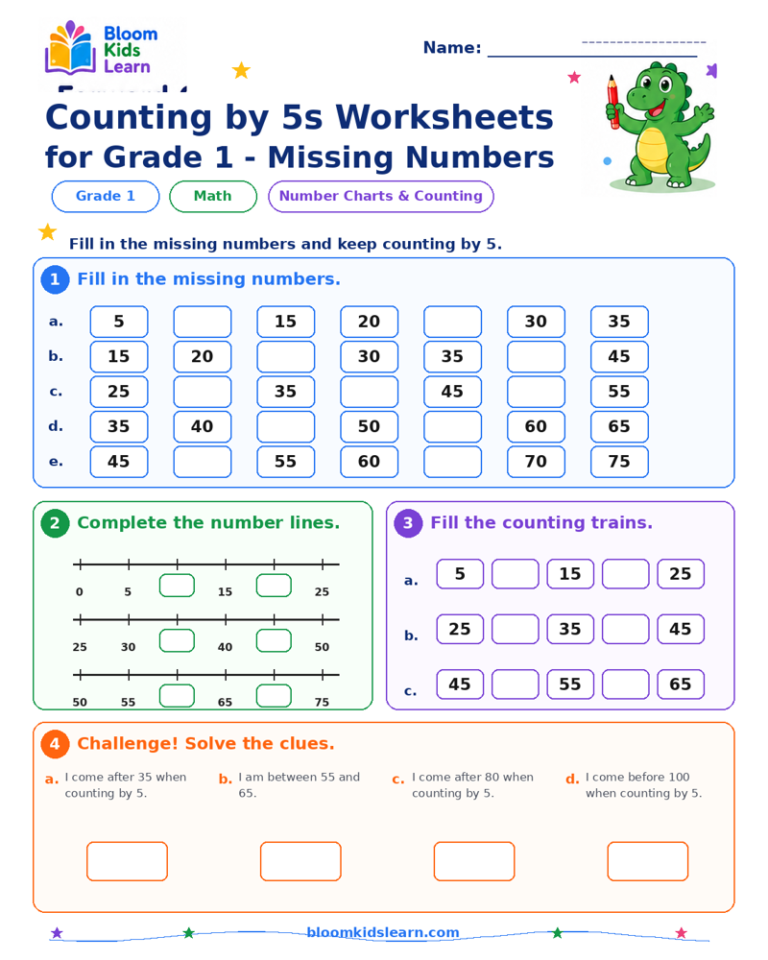
In 35, __, 45, __, 55, __, write 40, 50, and 60. Check every jump; a number that ends in 0 or 5 is not enough unless it is also five away from its neighbor.
Common errors to watch for
Counting individual dots one by one can lead to a lost count. Have the learner circle each group or touch a row of five once, then say the group total. Another frequent mistake is jumping from 15 to 25. Return to the number line and ask what number sits between them when moving by fives: 20.
Some children remember that multiples of five end in 0 or 5 and use that clue without checking the size of the jump. Encourage a two-part check: “Does it end correctly, and is it exactly five more?” For reversed digits, ask the child to read the number aloud and compare it with a 1–100 chart.
Answer guide for the printable
Section 1 totals are 10, 15, 20, 25, and 30 from rows a through e. Section 2 answers are: after 5, 10, 15, 20; after 20, 25, 30, 35; after 35, 40, 45, 50; after 50, 55, 60, 65; and after 70, 75, 80, 85.
Section 3 answers are row a: 10, 20, 30; row b: 25, 35, 45; row c: 40, 50, 60; and row d: 55, 65, 75. For the challenge, the five numbers after 15 are 20, 25, 30, 35, 40. The five after 60 are 65, 70, 75, 80, 85.
When reviewing the page, ask the child to explain one picture answer and one sequence answer. “Four groups of five make 20” or “65 is five more than 60” is more informative than a silent correction.
Support and extension ideas
For extra support, use a strip showing 5, 10, 15, 20, 25, 30 and cover one value at a time. Counters, tally marks, and nickels give the same pattern a physical meaning. Children who tire during writing can complete Sections 1 and 2 today and finish the missing numbers tomorrow.
For an extension, invite the learner to draw seven groups of five and find the total, continue one challenge to 100, or make a new missing-number row for a partner. Counting five-minute intervals around an analog clock is another natural way to practise the pattern.
Where this skill fits in math
Skip counting by 5s supports equal-group reasoning, repeated addition, and later multiplication. It is useful preparation in Grade 1, although counting by 5s is named explicitly in the Grade 2 Common Core place-value standard. Use the worksheet as practice at the child’s current level, not as a claim that every first grader must already be fluent.
Related counting practice
If the learner needs more work with consecutive numbers, try the Counting by 1s worksheet collection first. The Counting by 2s worksheets offer another equal-jump pattern when the child is ready. Switching between objects, spoken counting, and written numbers helps the idea hold together.
Questions parents often ask
Should a child complete the whole page without help?
Not necessarily. Model one example, keep a number chart available, and step back as the child becomes more confident. Short, accurate practice is more useful than rushing through every box.
What if the child can recite the list but cannot find a missing value?
Return to groups of five or a number line. Ask the child to show one jump from the number before the blank. Seeing the movement usually makes the written answer easier to explain.
 Preview