
Counting by 5s Missing Numbers Worksheet for Grade 1
Find missing values in counting-by-5s sequences with this free Grade 1 printable worksheet for classroom, homework, or homeschool practice.
- Skill: Find missing numbers in counting-by-5s sequences
- Learning goal: Complete counting-by-5s sequences within the worksheet range and explain that each next number is five more.
- Format: Printable PDF worksheet
 Download Worksheet PDF
This free counting by 5s missing numbers worksheet gives Grade 1 learners focused practice with an important number pattern. Children complete short sequences, fill gaps on number lines, finish counting trains, and solve four verbal clues. The variety helps them apply the same “five more” rule in several formats instead of relying on one memorized row.
The printable is designed for children who have already heard and practiced the sequence 5, 10, 15, 20. Most questions stay within 75, while the final clues extend thinking to 100. It can be used for a short math lesson, independent practice, homework, a math center, or homeschool review.
Download the Counting by 5s Missing Numbers PDF
What is included in this worksheet?
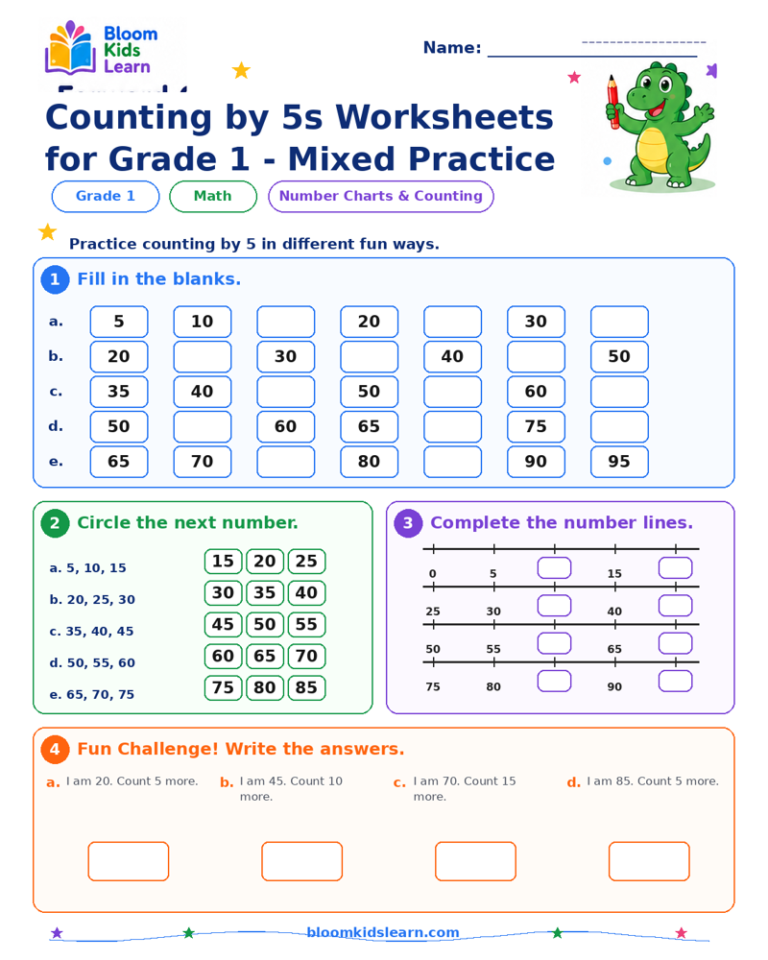
Section 1 has five counting rows beginning at 5, 15, 25, 35, and 45. Some values are supplied and others are missing. Because the blanks appear in different positions, a child must examine both the number before and the number after each gap. This is more meaningful than simply copying a complete skip-counting list.
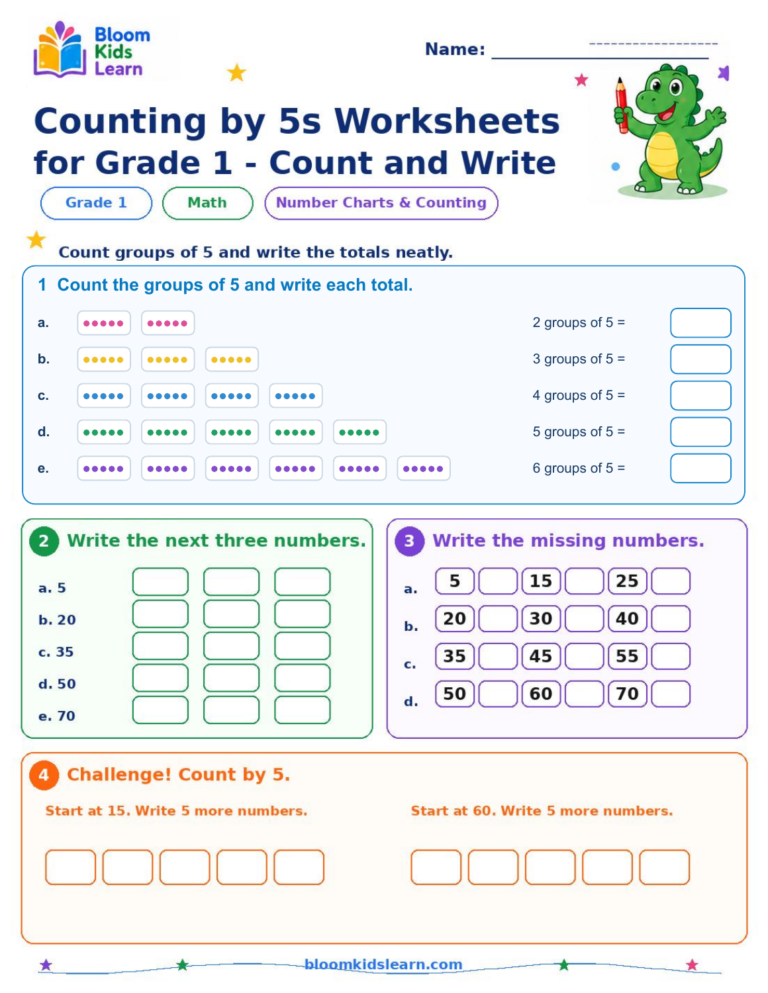
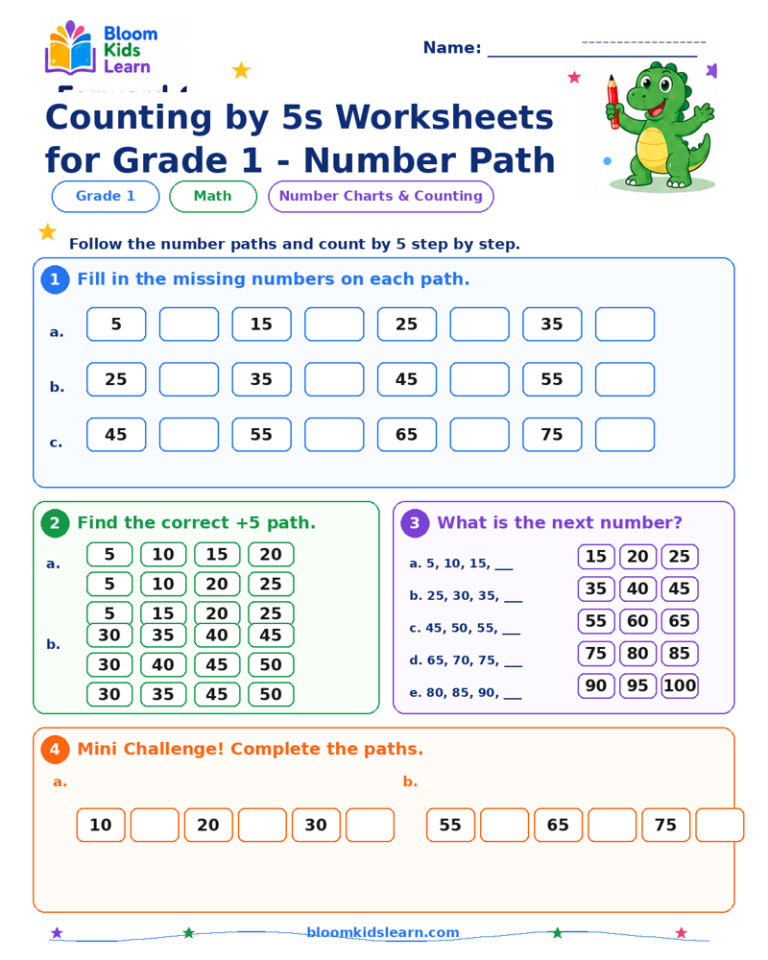
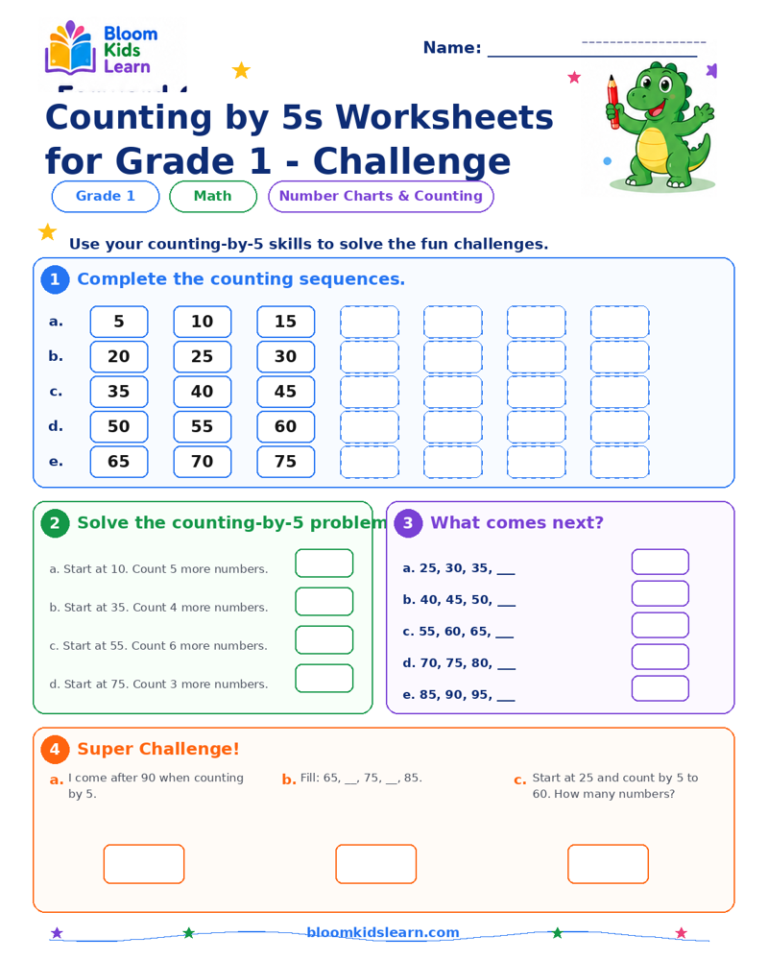
Section 2 presents three number lines from 0 to 25, 25 to 50, and 50 to 75. Learners write the missing labels at equal intervals. Section 3 uses three counting trains with alternating blanks. The final section asks children to find a number after 35, between 55 and 65, after 80, and before 100 when counting by 5s.
Learning objectives
- Complete counting-by-5s sequences from different starting values.
- Recognize that each adjacent value is exactly five more or five less.
- Use number-line spacing and neighboring clues to find a missing number.
- Explain an answer using sequence language such as “five more,” “five less,” “before,” and “after.”
How to teach the missing-number pattern
Begin by counting aloud together: 5, 10, 15, 20, 25, 30. Write the numbers and ask the learner what happens to the ones digit. It alternates between 5 and 0. Explain that this pattern is a useful check, but the number must also increase by exactly five each time.
Model one gap before the child works alone. In 5, __, 15, think aloud: “The missing number is five more than 5 and five less than 15, so it is 10.” For a blank after 20, show 20 + 5 = 25. For a blank before 55, reverse the relationship and use 55 − 5 = 50.
On the number lines, have the learner touch each tick mark while saying the values. Equal spaces represent equal jumps of five. On the counting trains, read the entire completed train aloud to check that no value was repeated or skipped.
Worked examples
Find a number between two clues
In the sequence 25, __, 35, the missing value is 30. Adding five to 25 gives 30, and adding another five gives 35. Checking from both directions confirms the answer.
Label an equal interval
On a line labeled 0, 5, __, 15, the unlabeled tick is 10. Each move to the right adds five: 0, 5, 10, 15. The visual spacing supports the same rule used in the written rows.
Solve a verbal clue
For “I come after 80 when counting by 5,” start at 80 and make one jump of five. The answer is 85. The word after means the number becomes larger. For “I come before 100,” subtract five to get 95.
Common mistakes and helpful corrections
Some children switch back to counting by 1 and write 6 after 5. Use five counters as one group and add the whole group at once. A learner may also choose any number ending in 0 or 5. Ask two questions: “Does it have the expected ending?” and “Is it exactly five away from its neighbor?”
Another common error is moving in the wrong direction for before and after. Draw a small arrow pointing right for “after” and left for “before.” If several blanks feel overwhelming, cover the later part of a row and solve one gap at a time.
Answer guidance
Section 1 answers are: row a, 10 and 25; row b, 25 and 40; row c, 30, 40, and 50; row d, 45 and 55; row e, 50 and 65. For Section 2, the missing number-line labels are 10 and 20; 35 and 45; 60 and 70.
The counting trains in Section 3 need 10 and 20; 30 and 40; 50 and 60. The challenge answers are a. 40, b. 60, c. 85, and d. 95. When checking, ask the child to explain at least one answer using “five more” or “five less.” That explanation shows whether the pattern is understood.
Differentiation and extension ideas
For extra support, provide a 1–100 chart with multiples of five highlighted. Let the child use fingers, nickels, tally groups, or bundles of five craft sticks. Complete one section at a time and say each sequence aloud before writing.
For an extension, ask the learner to continue the last number line to 100, create a new counting train, or write a clue for an adult to solve. A confident child can also work backward by 5 from 75. Connecting the pattern to five-minute intervals on an analog clock gives it a practical purpose.
Standards context
Counting by 5s is useful Grade 1 pattern and repeated-addition preparation, but it is not listed as a separate Grade 1 Common Core requirement. Skip-counting by 5s appears explicitly in the Grade 2 Common Core place-value standard. This worksheet therefore provides an age-appropriate foundation without claiming that all first graders must already demonstrate mastery.
Related number practice
If a learner needs stronger number-order practice first, use the Counting by 1s worksheet collection. Children who are ready to compare equal jumps can also explore the Counting by 2s worksheets. Short oral counting sessions alongside written work will build fluency without turning the activity into memorization alone.
Frequently asked questions
Is this worksheet suitable for independent work?
Yes, after an adult models one missing-number problem. Children who are new to skip counting may benefit from a highlighted number chart nearby.
Does the printable include an answer key?
The answers are provided above for quick checking. Encourage the learner to correct an error by recounting the sequence rather than simply copying the answer.
 Preview