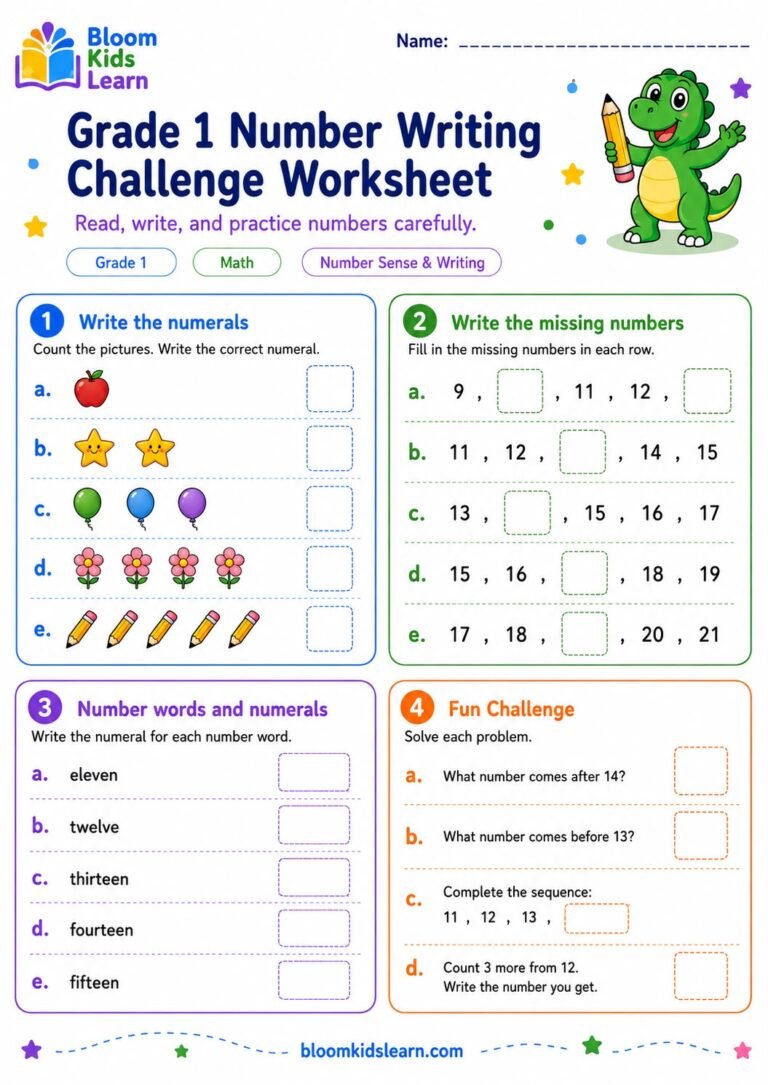

Number Writing Practice Worksheet for Grade 1
Free Grade 1 number writing practice worksheet for writing numerals 1-10, counting pictures, completing sequences, and before-and-after practice.
- Skill: Write and trace numerals 1-10
- Learning goal: Form numerals 1-10, connect counted objects to numerals, and complete simple number sequences.
- Format: Printable PDF worksheet
 Download Worksheet PDF
Writing a numeral from memory, counting a group, and completing a number sequence are related skills, but they are not the same task. This Grade 1 number writing worksheet brings those skills together so children can show whether they recognize a quantity, recall the matching numeral, and keep numbers in the correct order.
What children practise on this worksheet
The top half gives children repeated opportunities to write numbers 1 through 10. A printed model provides a quick reminder, while the empty boxes ask for independent writing. The lower activities shift from formation to number sense: learners count pictures and record each quantity, then complete short sequences and answer before-and-after questions.
This makes the printable useful for practice and for a quick teacher check. A child may write a clear 6 when it is named aloud but record 8 after counting six objects. Another child may count accurately yet hesitate when a numeral has to be written without a model. Those errors point to different next steps.
Count and write: connecting quantity to a numeral
Ask the learner to touch each picture once while counting. After saying the total, have the child write the numeral in the answer box. For example, if there are four flowers, the full response is not complete until the child both identifies the quantity as four and records 4.
If the written answer does not match the spoken total, ask, “How many did you count?” A correct spoken answer with an incorrect numeral suggests that quantity understanding may be secure while numeral recall needs practice. If the count itself changes when the child repeats it, use a slower one-to-one counting strategy.
Complete the number sequences
Before writing in a blank, read the entire row aloud. In 1, 2, __, 4, 5, the missing number is 3 because the blank sits between 2 and 4. The same idea applies when the gap appears near the end or in a sequence beginning with a different number. The mini challenge also checks what comes after 9 and what comes before 6.
Encourage children to use both neighbors as evidence. Looking only at the final printed number can lead to an answer that belongs after the row rather than inside it.
Mistakes worth noticing
- Counting eight objects but writing 6: ask the child to say the total before picking up the pencil.
- Reversing 3: compare the written numeral with the model, then try it once more from memory.
- Writing 21 instead of 12: say “one ten and two ones” and point to the digits in order.
- Skipping a number: read the sequence slowly and touch every printed number and blank.
How to use the page
Begin with one row of numeral writing, one picture-counting item, and one sequence together. Then let the learner finish independently. Avoid correcting every stroke while the child is still solving the number task; first decide whether the answer represents the right number. Neatness can be discussed afterward.
Use the answer key or recount the pictures to check the lower section. Learners who still need dotted models can use the Number Tracing 1–10 Worksheet. Children who can write 1–10 independently can move to the Writing Numbers 1–50 Worksheet or try the Number Writing Challenge.

 Preview