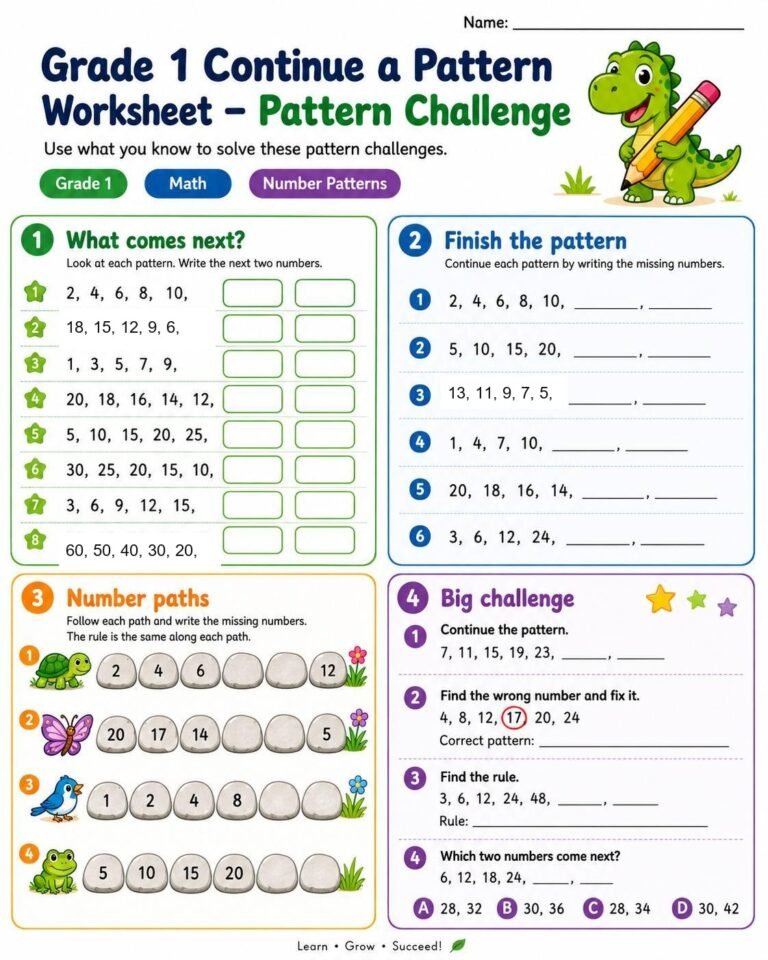
Pattern or Not a Pattern Worksheet for Grade 1
A free Grade 1 worksheet for deciding whether number sequences follow a rule, finding errors, and identifying the next correct number.
- Skill: Identify consistent number patterns and locate numbers that break a rule.
- Learning goal: Decide whether a sequence follows a consistent rule and use that rule to identify or correct an error.
- Format: Printable PDF worksheet
 Download Worksheet PDF
A number sequence is only a pattern when the same rule continues from one term to the next. This printable pattern or not a pattern worksheet asks Grade 1 learners to look past the first two numbers, test the whole row, and decide whether the rule stays consistent.
The page combines four related tasks: deciding whether a sequence is a pattern, finding a broken pattern, circling an odd number, and choosing the rule in a short challenge. It works well after children can count forward and backward but need practice explaining why a sequence works.
How to decide whether a number sequence is a pattern
Ask the child to compare each pair of neighboring numbers. In 2, 4, 6, 8, 10, every number is 2 more than the one before it, so the rule is “add 2.” The row 3, 6, 9, 12, 14 begins by adding 3, but 14 does not follow that rule. It is not a consistent pattern.
One useful check is to say the rule aloud while pointing: “add 2, add 2, add 2.” If the rule stops working anywhere in the row, the child has found the break.
What children do on this worksheet
- Circle Yes or No after checking whether eight sequences follow one rule.
- Study imperfect sequences and write the next number that the intended rule would produce.
- Circle the odd number in four otherwise regular patterns.
- Solve a short add, subtract, and doubling challenge.
The constant row 1, 1, 1, 1, 1 is worth discussing. It is a pattern because the number stays the same each time. Children sometimes think a pattern must always grow; this example shows that consistency, not size, is what matters.
A simple teaching routine
Begin with the blue section and let the child mark the rows independently. For every No answer, ask, “Where did the rule stop working?” Move to the green section next. The instruction has been clarified so children find the intended rule and write the next correct number, even when more than one printed term disrupts a row.
Keep counters or a number line nearby only if needed. A learner who loses track when subtracting can move a finger backward on the number line. Remove that support once the rule is understood.
Mistakes that reveal what to practise
If a child judges a row from its first two numbers only, ask them to test every step. If they circle the largest or smallest value as the “odd one out,” redirect attention to the change between numbers. A child who identifies “add” but not the amount may understand the direction while still needing skip-counting practice.
Ask for evidence, not just Yes or No
After two or three rows, invite the child to explain one decision: “I chose No because the pattern adds 10, but 60 should be 50.” This short explanation checks far more than the circle alone. A learner who changes an answer after explaining has used mathematical reasoning, not failed the task. You can also ask them to repair one No row on scrap paper and continue it for two more terms.
Answer guidance
In Section 1, rows 1, 2, 4, 5, 6, and 8 are patterns; rows 3 and 7 are not. The next correct numbers in Section 2 are 14, 30, 18, 18, and 30. The odd numbers in Section 3 are 7, 18, 11, and 8. The challenge answers are 17 and 30; the final rule is multiply by 2.
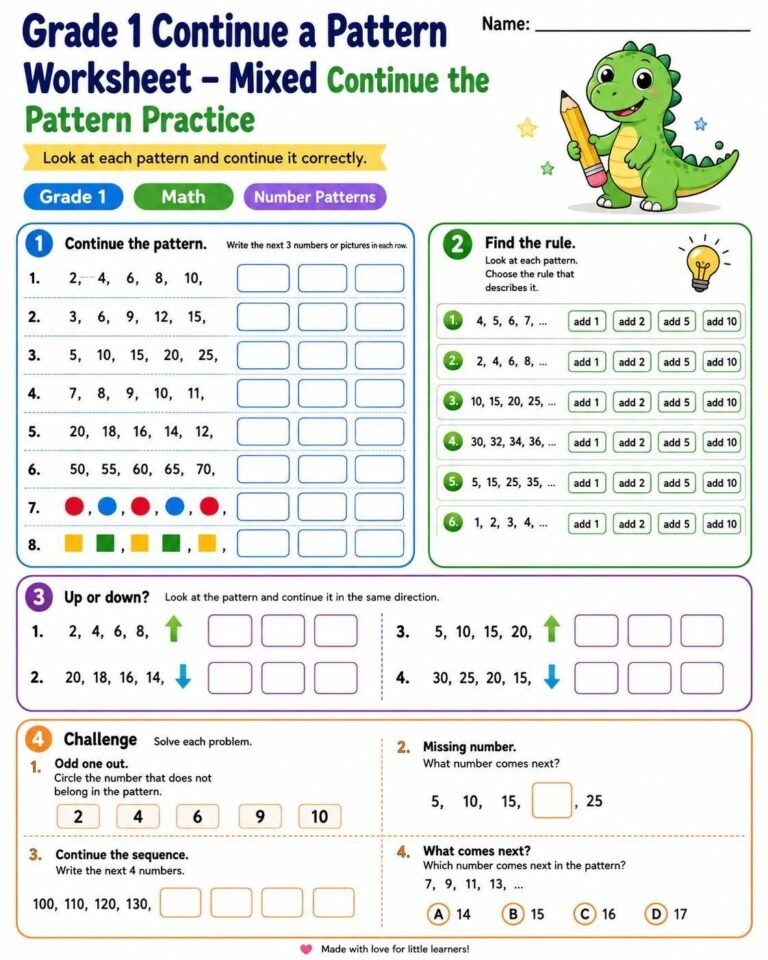
For more direct sequence practice, continue with the Continue the Number Pattern Worksheet. The complete Grade 1 number pattern worksheet collection puts all six printables in a useful order.
 Preview