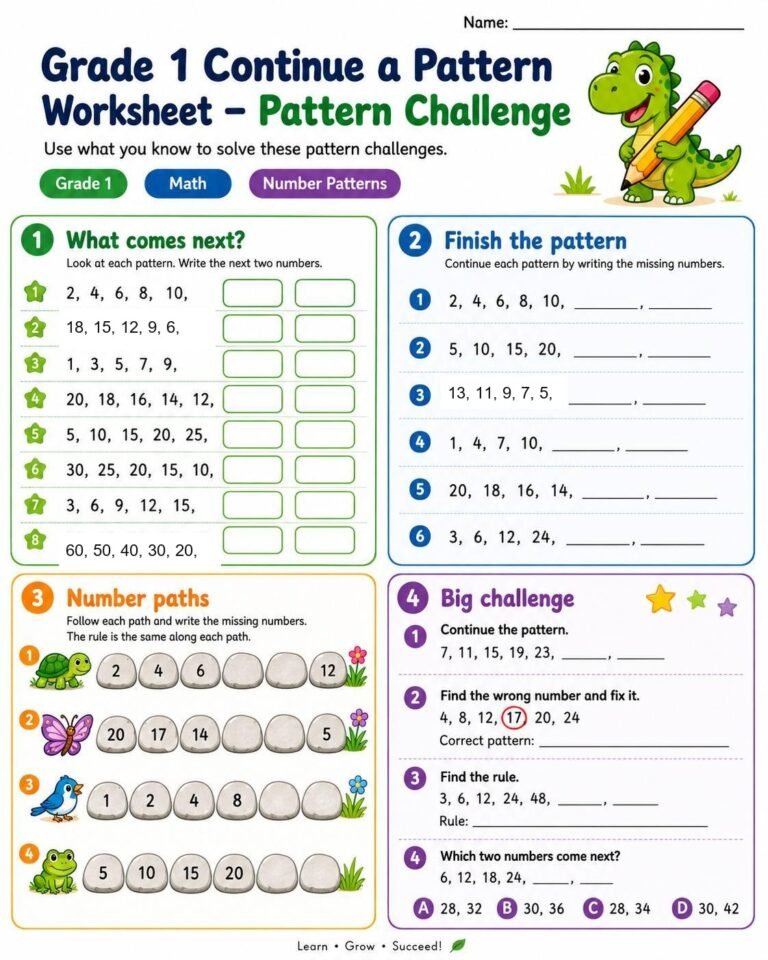

What Comes Next Number Pattern Worksheet for Grade 1
A free Grade 1 what-comes-next worksheet with short sequences, two-answer patterns, number trains, and challenge questions.
- Skill: Predict the next term in a number sequence by identifying its rule.
- Learning goal: Explain how a pattern changes and use the rule to find the next one or two numbers.
- Format: Printable PDF worksheet
 Download Worksheet PDF
“What comes next?” is a prediction question, but a good answer should come from a rule rather than a guess. This what comes next number pattern worksheet helps Grade 1 learners study a short sequence, describe the change, and write the next term.
The page begins with straightforward +1 and +2 patterns, then includes steps of 3, 5, and 9, decreasing sequences, number trains, and one optional challenge based on a growing rule.
A three-step way to predict the next number
- Compare the first two numbers.
- Check that the same change works for the next pair.
- Apply that change to the final printed number.
For 30, 35, 40, 45, 50, each term is 5 more than the previous term. Adding 5 to 50 gives 55. In 50, 45, 40, 35, 30, the direction is reversed; subtracting 5 gives 25.
From one answer to two answers
Section 1 asks for one next number. Section 2 asks for two. This small change is useful because a child who has truly found the rule should be able to apply it more than once. If the first answer is correct and the second is not, ask the learner to repeat the rule before filling the second box.
Why the number trains help
The train cars place a blank inside each pattern. Children must look left and right: 1, 2, 3, 4, __, 6 has 5 in the empty car, while 20, 18, 16, __, 12, 10 has 14. The pictures make the position of each term clear without changing the mathematics.
The optional final challenge
The last sequence, 2, 3, 5, 8, 13, 21, is different from the constant-step rows. Each term is made by adding the two numbers before it, so the next number is 34. This is an extension question, not a basic Grade 1 expectation. Model it or leave it for a child who enjoys puzzles.
Mistakes to listen for
A learner may see 9, 18, 27 and answer 29 because they focus only on the final digit. Ask what happened from 9 to 18 and from 18 to 27; both jumps are +9, so the next term is 54 after 45. If the child answers 35 after 50, 45, 40, 35, 30, they may have repeated a printed number instead of making one more -5 step.
One next number can still show strong reasoning
A short response does not have to be a shallow task. Before accepting an answer, ask the child to name the rule and point to two places where it works. If they can say “add 3” and demonstrate 3 to 6 and 6 to 9, the next answer is supported. For a quick extension, ask for one more term after the written answer without adding another printed worksheet.
Answer guidance and related practice
Section 1 answers are 6, 12, 10, 20, 18, 15, 20, and 18. Section 2 continues with 6 and 7; 12 and 14; 30 and 35; 18 and 21; 10 and 8; and 17 and 19. The train blanks are 5, 8, 25, and 14. The challenge answers are 55, 54, 25, and 34.
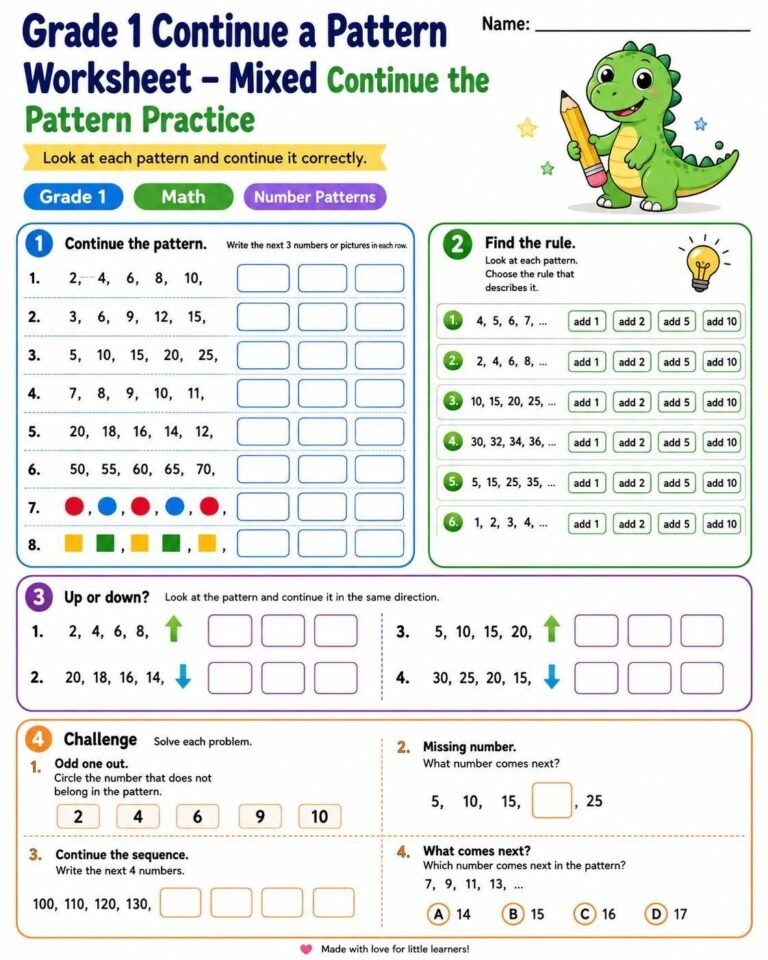
For three-answer extensions, use the Continue the Number Pattern Worksheet. The full number pattern collection includes six printable PDFs.
 Preview