
Counting by 5s Worksheet: Basic Practice for Grade 1
Build skip-counting confidence with this free Grade 1 counting by 5s worksheet featuring sequences, +5 chains, choices, and short challenges.
- Skill: Count forward by 5 from different multiples of five
- Learning goal: Continue counting-by-5s sequences within 75 and explain that each next number is five more.
- Format: Printable PDF worksheet
 Download Worksheet PDF
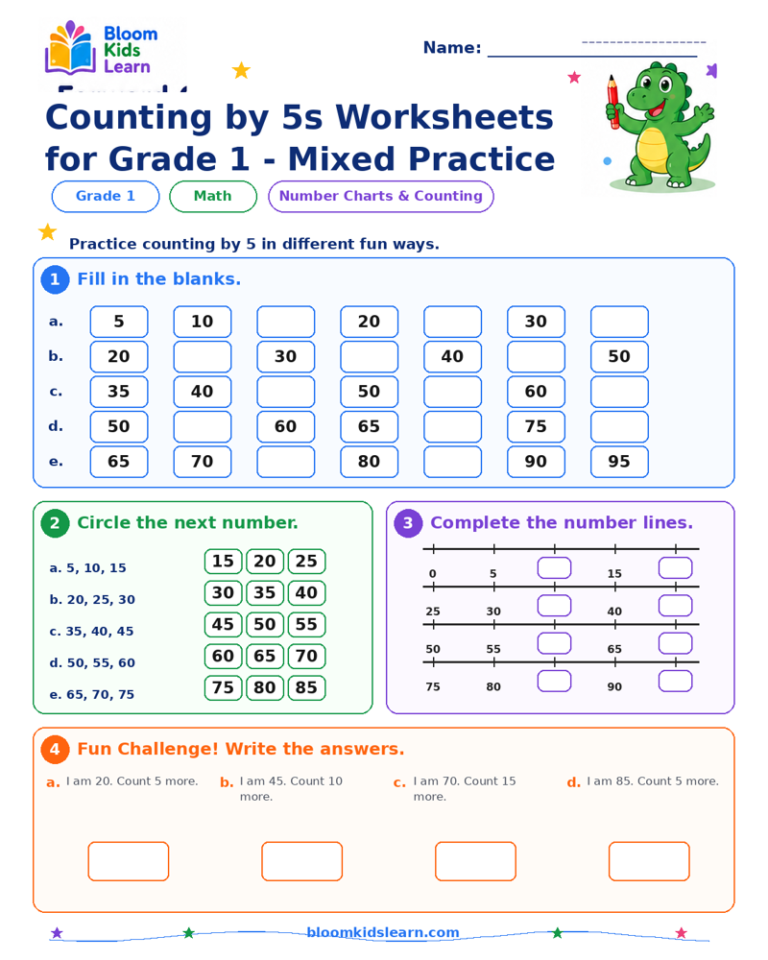
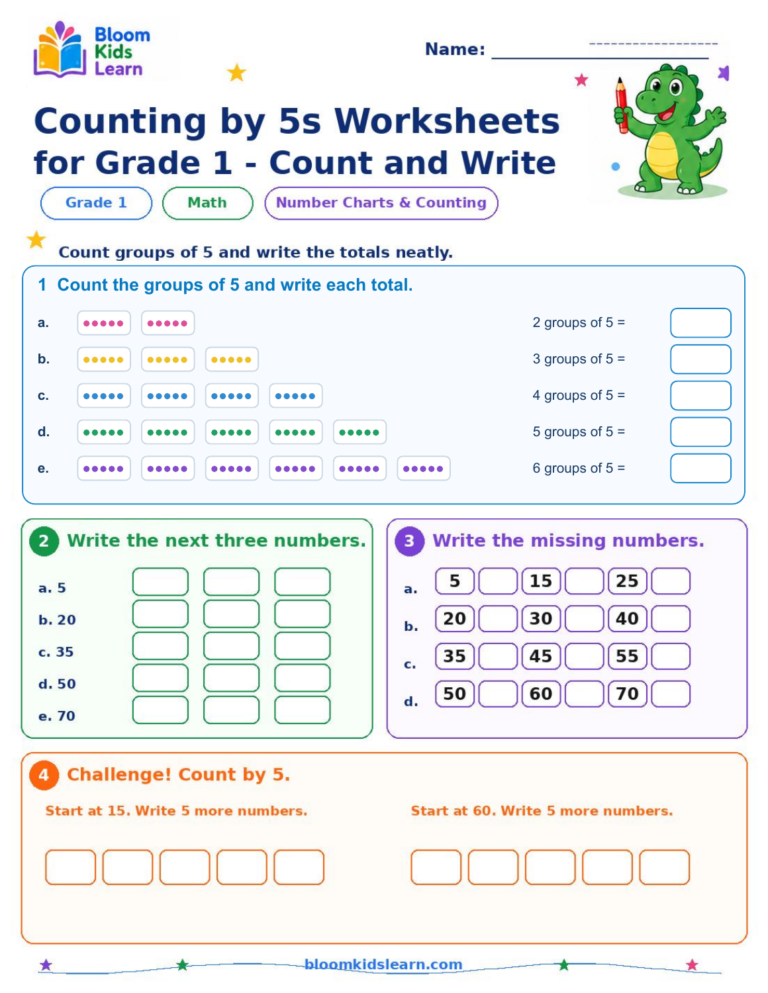
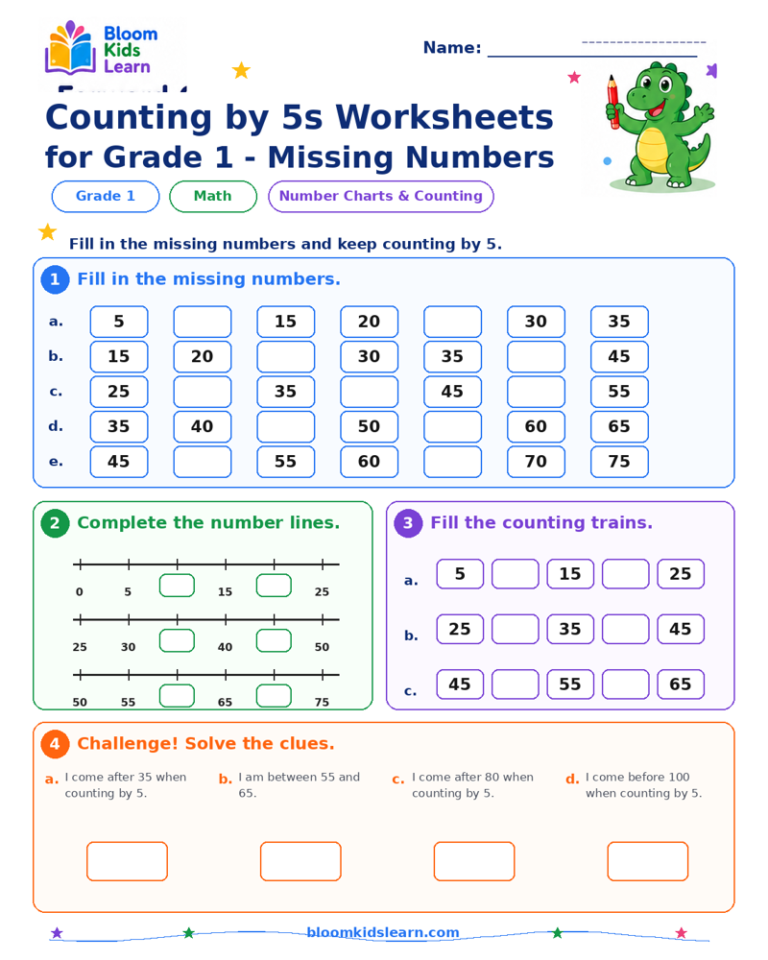
This free Grade 1 counting by 5s basic practice worksheet helps children recognize and continue a predictable number pattern. The printable begins with clear examples, then asks learners to complete sequences, follow +5 number chains, choose the next number, and extend two short challenges. It works well as an introduction after a child can count forward confidently by 1s.
Counting by 5s is useful because the sequence has an easy-to-notice ones-digit pattern: 5, 0, 5, 0. Children can connect it to the numbers on an analog clock, groups of five fingers, nickels, tally marks, and later multiplication facts. This worksheet keeps the numbers within 75 so first graders can focus on the rule rather than large-number reading.
Download the Counting by 5s Basic Practice PDF
What children practice
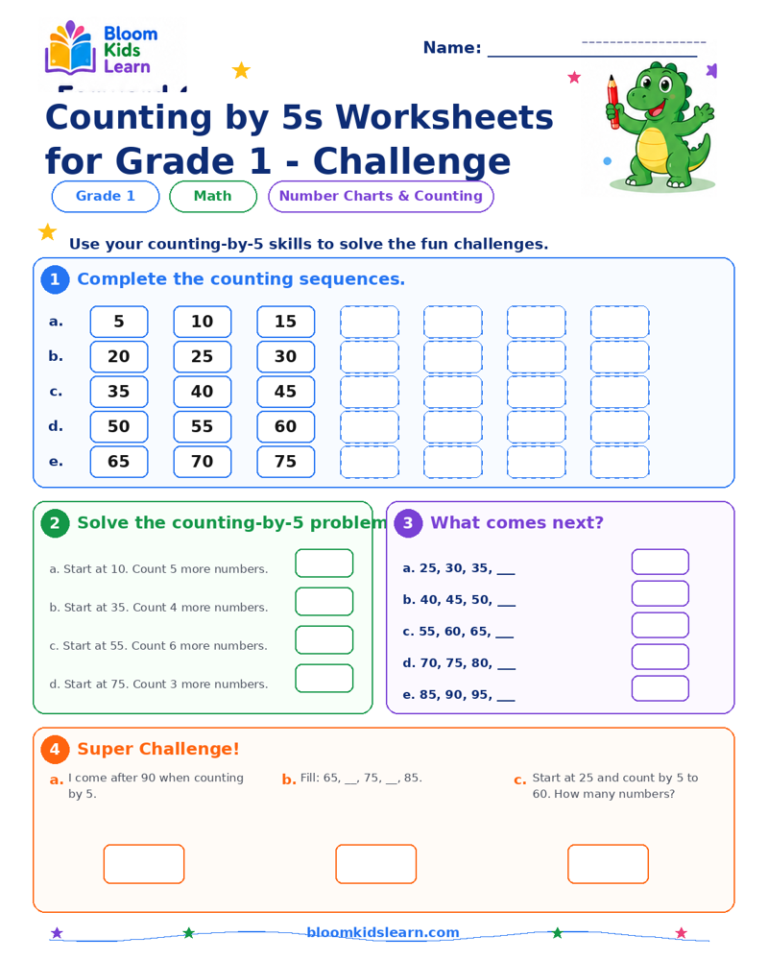
The first section contains five rows. Each row gives three starting numbers and four empty boxes. The rows begin at 5, 15, 25, 35, and 45, so children practice continuing from different points instead of memorizing only 5, 10, 15. Every correct next number is five more than the number before it.
Section 2 shows four +5 number chains beginning at 10, 20, 30, and 40. The arrows make the operation visible and help children connect spoken skip counting with repeated addition. Section 3 asks learners to circle the next number from three choices. The nearby distractors encourage children to check the rule instead of selecting a number by appearance.
The mini challenge finishes the page with two starting values. Children write the next five numbers after 5 and after 40. This provides a simple independent check before moving to worksheets with fewer clues.
Learning objectives
- Count forward by 5 from several starting multiples of five.
- Continue increasing sequences within 75.
- Use the repeated-addition rule “add 5.”
- Choose the correct next value from plausible options.
- Notice that multiples of five end in 0 or 5.
How to introduce counting by 5s
Start with a familiar visual. Ask the child to hold up one hand and count five fingers. Add a second hand and count ten fingers. Continue with groups of five counters or five tally marks. Say the totals together: 5, 10, 15, 20. Then write the sequence and circle the last digit of each number. Point out the repeating 5, 0 pattern.
Model one worksheet row before independent work. For 15, 20, 25, __, think aloud: “Five more than 25 is 30.” Check the result by looking at the ones digit: after a number ending in 5, the next multiple of five ends in 0. This check supports accuracy, but remind the child that the number must also become five larger.
For the number chains, have the learner touch each arrow and say “plus five.” On the multiple-choice questions, ask the child to say the entire sequence before circling an answer. These small routines slow down guessing and make the mathematical rule explicit.
Worked examples
Continue a sequence
The row 25, 30, 35 continues with 40. Add five to 35, or count on five numbers: 36, 37, 38, 39, 40. After 40, the next values are 45, 50, and 55.
Complete a +5 chain
A chain starting at 20 uses three equal steps: 20 + 5 = 25, 25 + 5 = 30, and 30 + 5 = 35. Writing the totals above counters grouped in fives can make the repeated increase easier to see.
Choose the next number
For 35, 40, 45, the correct next number is 50. The choices 45 and 55 are nearby, but only 50 is exactly five more than 45.
Common mistakes and helpful corrections
A child may switch to counting by 1 and write 16 after 15. Return to a group of five objects and add the whole group at once. Another common mistake is repeating the last printed number. Ask, “What is five more?” and trace the next arrow or box.
Some learners use the 0-and-5 ending rule without checking the size of the number. For example, both 40 and 50 end correctly, but only one can follow 35. Encourage the child to use both checks: the answer must end in 0 or 5 and must be exactly five more.
If the child loses place in a long row, cover all but one blank at a time. Reading the completed row aloud after writing is a quick way to catch skipped or repeated values.
Answer guidance
Section 1 answers are: row a, 20, 25, 30, 35; row b, 30, 35, 40, 45; row c, 40, 45, 50, 55; row d, 50, 55, 60, 65; row e, 60, 65, 70, 75. Section 2 chains are 15, 20, 25; 25, 30, 35; 35, 40, 45; and 45, 50, 55.
Section 3 answers are 20, 35, 50, and 65. In the mini challenge, the five numbers after 5 are 10, 15, 20, 25, 30. The five numbers after 40 are 45, 50, 55, 60, 65.
When checking, ask the learner to explain one row using “five more” language. A correct explanation shows stronger understanding than a page completed from memory alone.
Differentiation and extension ideas
For extra support, provide a 1-100 chart and highlight multiples of five. Use bundles of five craft sticks, tally marks, or fingers to connect each written number to a quantity. A learner who tires easily can complete Sections 1 and 2 in one session and return to the choices and challenge later.
For an extension, ask the child to continue one row to 100 or count backward by 5 from 75. Children can also write a new +5 chain for an adult to solve. Another practical activity is to label a paper clock by counting 5, 10, 15, and so on around the face.
Standards context
Counting by 5s is valuable Grade 1 pattern practice and preparation for later place-value work. It is not named as a separate Grade 1 Common Core requirement. The skill appears explicitly in the Grade 2 Common Core expectation to skip-count by 5s, so this page is best used as a developmentally appropriate foundation rather than as a claim that every first grader must master it immediately.
Related worksheets
If forward number order is still developing, begin with the Counting by 1s worksheets. Learners ready for another equal-jump pattern can use the Counting by 2s worksheet collection. Mixing oral counting, objects, and written practice helps children understand that skip counting represents equal groups.
Frequently asked questions
Does a child need to memorize the sequence first?
No. Begin with groups of five and a number chart so the pattern has meaning. Fluency usually improves naturally with short, repeated practice.
How long should this worksheet take?
Most learners need about 10 to 15 focused minutes. It is fine to divide the page into two shorter sessions.
Can children use a hundred chart?
Yes. A chart is a useful learning tool. Encourage the child to explain the +5 rule while using it, then gradually remove the support as confidence grows.
 Preview