Counting by 5s Mixed Practice Worksheet for Grade 1
Practise counting by 5s with sequences, number lines, choices, and clues in this free Grade 1 mixed practice worksheet for school or home.
- Skill: Use counting-by-5s sequences, number lines, and clues
- Learning goal: Apply the +5 pattern in sequences, number lines, choices, and short counting clues.
- Format: Printable PDF worksheet
 Download Worksheet PDF
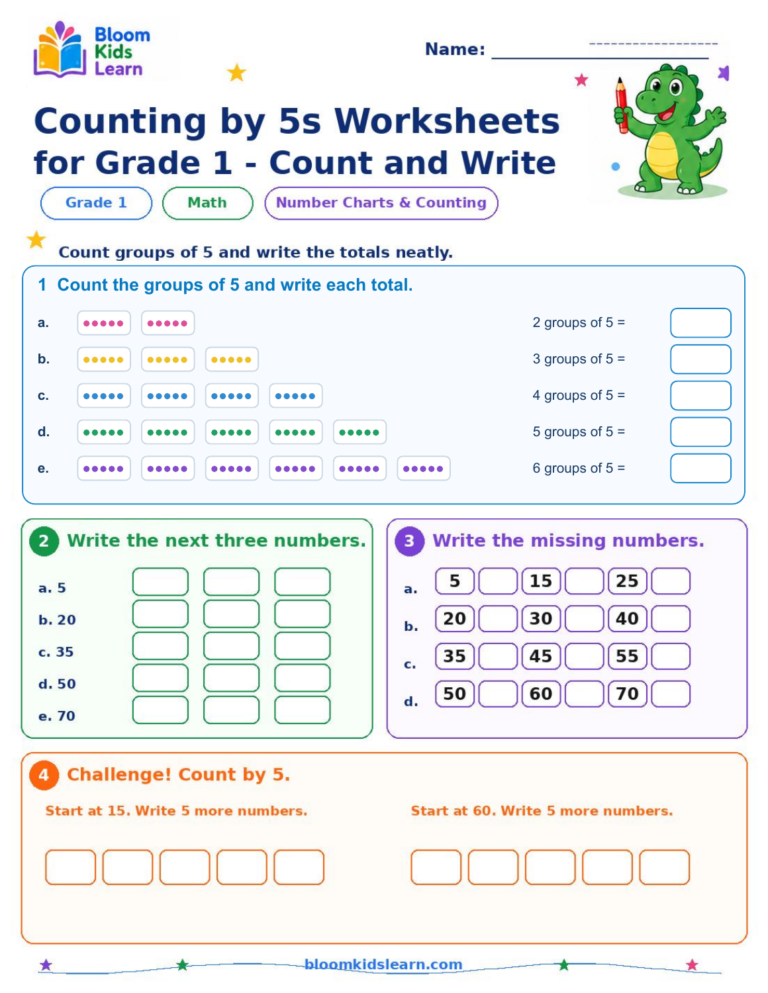
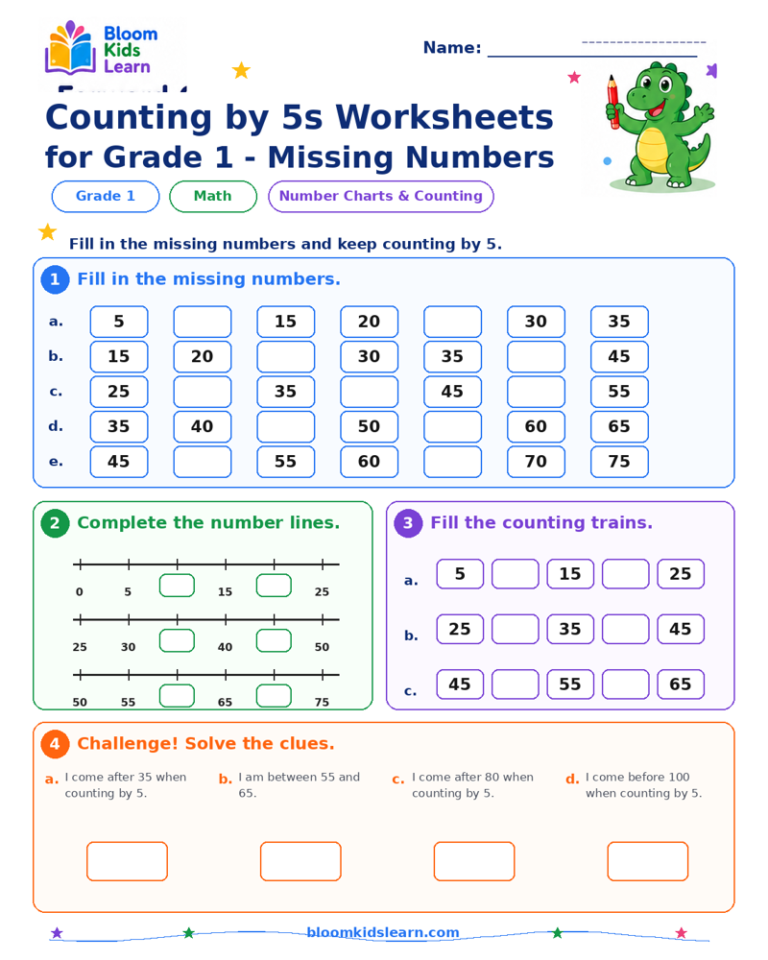
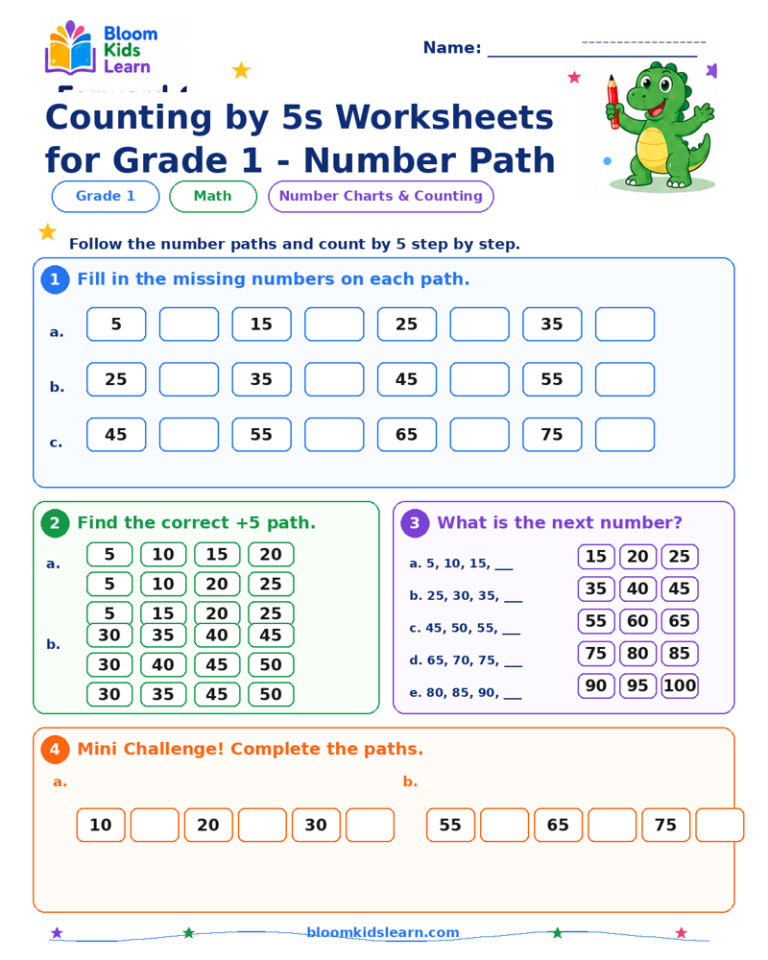
This counting by 5s mixed practice worksheet gives Grade 1 learners several ways to use the same number pattern. The page starts with familiar sequences, then asks children to choose the next number, complete number lines, and solve short clues. A child who can recite 5, 10, 15 may still need practice starting at 20, 35, or 65, so the varied starting points are intentional.
Use this free printable for a math center, a quick review after a lesson, homework, tutoring, or homeschool practice. The numbers stay within 95, and the tasks provide enough clues for developing learners without turning every answer into a guess. A 1–100 chart, counters, or a few nickels can be kept nearby when a visual reminder helps.
Download the counting by 5s mixed practice worksheet PDF
Counting by 5s mixed practice worksheet overview
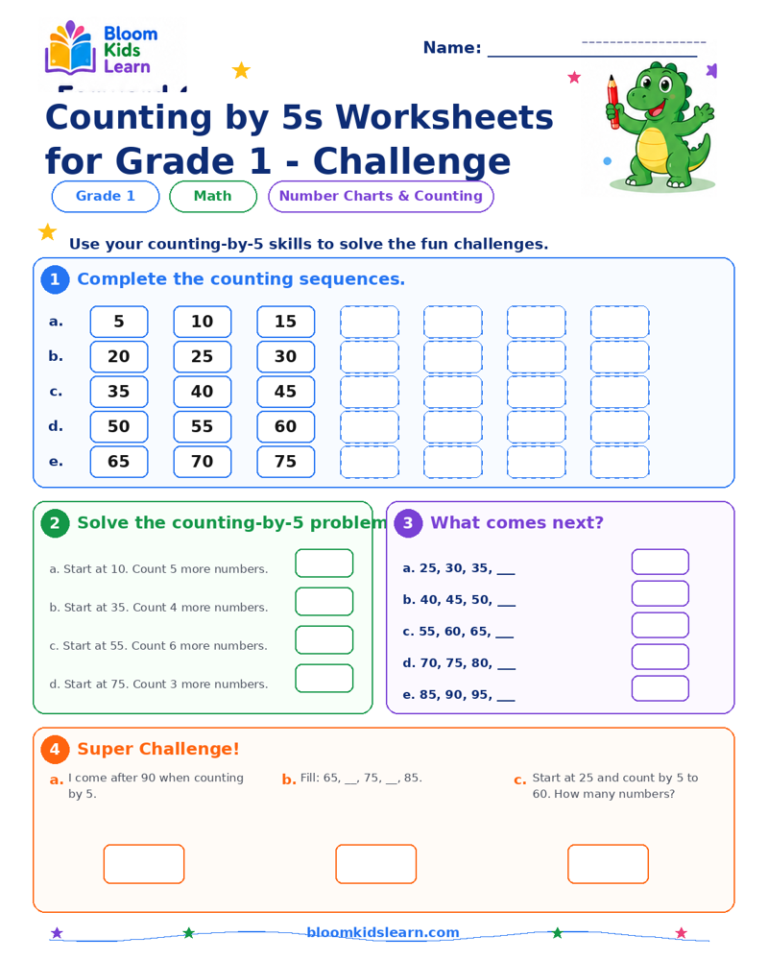
Section 1 contains five seven-box rows. The first begins at 5, followed by rows beginning at 20, 35, 50, and 65. The blanks move around from row to row, so children have to use the numbers on either side instead of filling every answer from memory.
Section 2 presents five short sequences and three choices for the next number. Section 3 turns the pattern into four number lines, with missing labels at equal intervals. In Section 4, children solve four clues: count 5 more than 20, count 10 more than 45, count 15 more than 70, and count 5 more than 85.
Skills this Grade 1 math worksheet supports
- Continue a counting-by-5s sequence from several starting values.
- Recognize equal jumps of five on a written row and a number line.
- Choose a next number by checking the full pattern, not just the ending digit.
- Translate simple “count more” clues into accurate number answers.
How to use the page with a learner
Warm up orally, but do not always begin at 5. Try 20, 25, 30, 35, then ask the child what comes next. Starting in the middle helps reveal whether the learner understands the +5 rule. If needed, place five counters beside the starting number and make one physical jump.
Model one blank from Section 1. In 35, 40, __, 50, the missing value is 45 because it is five after 40 and five before 50. For the choices, have the child say the sequence aloud before circling. On a number line, point out that each tick is one equal step; the labels change by five even when the written numbers are not all shown.
Finish with the clue section. Underline the words more and the amount to add. For “I am 45. Count 10 more,” make two +5 jumps: 50, then 55. Encourage the learner to explain one answer after the page is complete.
Worked examples
Complete a sequence
In 65, 70, __, 80, the blank is 75. Add five to 70, then check that 75 is five less than 80.
Choose the next number
For 35, 40, 45, the next number is 50. The nearby choices 45 and 55 are not correct: one repeats the last value and the other jumps by ten.
Read a number line
On the line labeled 50, 55, __, 65, __, the missing labels are 60 and 70. Each tick represents another five.
Common errors and useful prompts
Some children switch to counting by 1 and write 21 after 20. Ask, “How many are in one jump?” and let the child move five counters. A learner may also choose any value ending in 0 or 5. Remind them that the answer must have the right ending and be exactly five away.
On the number lines, a child might read the printed labels but ignore the equal spaces. Trace each tick from left to right and say the values together. In the challenge, “count 15 more” can be misread as “add 5.” Break it into three +5 jumps: 70 to 75, 80, then 85.
Answer key and checking guidance
Section 1 answers are: row a, 15, 25, 35; row b, 25, 35, 45; row c, 45, 55, 65; row d, 55, 70, 80; row e, 75, 85, 95. Section 2 answers are 20, 35, 50, 65, and 80.
Section 3 answers are 10 and 20; 35 and 45; 60 and 70; and 85 and 95. Section 4 answers are a. 25, b. 55, c. 85, and d. 90. Ask the child to justify one answer with “five more” language instead of marking the page right or wrong silently.
Support and extension ideas
For extra support, highlight multiples of five on a 1–100 chart. Complete one row at a time and cover the unused sections until the child is ready. Groups of five buttons, tally marks, or nickels can make the equal jump visible.
For an extension, ask the learner to continue row e to 100, write a new three-choice question, or count backward by 5 from 95. A clock connection also works well: count 5, 10, 15, and 20 minutes around the face.
Standards context
Counting by 5s supports equal groups, repeated addition, and early place-value thinking. It is a useful Grade 1 foundation, although skip-counting by 5s appears explicitly in the Grade 2 Common Core place-value standard. Adjust the level of support to the learner rather than treating one worksheet as a mastery test.
Related practice
For more consecutive-number practice, use the Counting by 1s worksheet collection. The Counting by 2s worksheets provide another equal-jump pattern when the learner is ready. Mixing concrete objects, oral counting, and written sequences keeps the focus on the relationship between numbers.
Frequently asked questions
Is mixed practice harder than a basic sequence page?
It can feel more challenging because the starting numbers and question types change. That variety is useful once a child understands the basic +5 pattern.
Should a child use a number chart?
Yes. A chart is a support tool, not a shortcut. Encourage the child to use it to check a jump, then explain the answer without looking.
 Preview