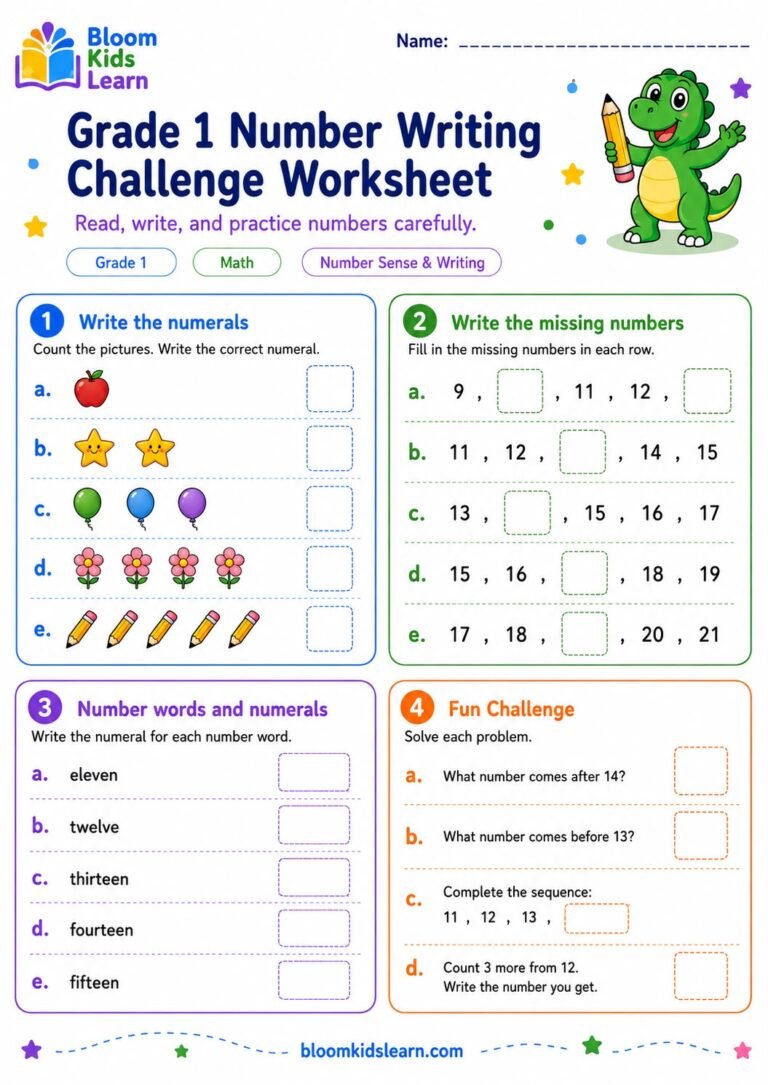
Number Tracing 1–10 Worksheet for Grade 1
Free Grade 1 number tracing 1-10 worksheet with guided handwriting and counting practice.
- Skill: Trace and write numerals 1-10
- Learning goal: Form numerals 1-10 and connect counted objects to numerals.
- Format: Printable PDF worksheet
 Download Worksheet PDF
Children who are just beginning to write numerals often need to see the shape before they can produce it alone. This Number Tracing 1–10 Worksheet for Grade 1 keeps the practice tightly focused on the first ten numerals. Each row gives a clear model, a dotted numeral to trace, and blank boxes for another attempt.
What children practise
The worksheet is about forming 1, 2, 3, 4, 5, 6, 7, 8, 9, and 10 with controlled pencil movement. Children work on straight strokes, curves, joins, and the spacing needed to keep a numeral recognizable. Because the page stays within 1–10, the learner can give attention to shape and size instead of trying to remember a long number sequence.
From tracing to writing alone
Use a three-step progression. First, trace the dotted model slowly while saying the numeral. Second, copy the same numeral in the next box while the model remains visible. Third, cover the model with a small card and ask the child to write the numeral from memory. If a child can trace 8 neatly but cannot write it when the dots disappear, tracing alone is no longer the skill they need. Show one model, cover it, and invite a fresh 8. That quick check tells you whether the shape has been learned.
Shapes that need different movements
Straight-stroke numerals such as 1 and 7 benefit from a steady top-to-bottom motion. Curved numerals such as 2, 3, 5, 6, 8, and 9 need a smooth turn rather than several tiny stops. For 4, demonstrate the diagonal and crossbar separately. Ten introduces a second digit, so leave a small, even space between the 1 and the 0. Keep the writing large enough to be seen but inside the guide boxes.
Mistakes to watch for
- A 3 that is reversed or looks like an E.
- A 5 whose top line is missing or whose curve closes like a 6.
- An 8 made from two uneven loops.
- A 9 that is written as a 6.
- A 10 with the digits touching or in the wrong order.
Ask the child to compare the attempt with the model and name one change to make. Avoid asking for perfect handwriting; aim for a recognizable shape, consistent size, and a controlled start-and-stop.
How to use the page
Print on US Letter paper. Begin with two or three rows, give a short hand stretch, and return to the remaining numerals. A pencil with a comfortable grip is enough. For a child who tires quickly, complete 1–5 in one session and 6–10 later. A sheet protector and washable marker make it possible to repeat the trace–copy–write sequence without using another page.
Where to go next
When the first ten shapes are recognizable, move to the Number Tracing 1–20 Worksheet for teen numerals. Learners who no longer need dotted guidance can try the Number Handwriting Practice Worksheet and then the Number Writing Practice Worksheet for independent counting and sequence work.
This focused tracing activity supports early Grade 1 numeral writing and number-representation skills.
A closer look at numeral formation
Use the first ten rows to notice how the pencil moves. The 1 is made from a clean downward stroke, while 2 and 5 need a turn rather than a series of tiny marks. Curved numerals such as 3, 6, 8, and 9 are easier to read when the curve closes neatly instead of becoming a sharp corner. Encourage a light, steady grip so the child can stop at the baseline and keep each numeral inside the writing space.
After a child traces a row, cover one model with a finger and ask for one numeral from memory. Compare that attempt with the model only after it is finished. This quick check shows whether the child is following dotted lines or remembering the shape. If 8 is neat while tracing but open or oversized when copied, practise one slow 8 at a time before asking for a full row. If 1, 4, or 7 drifts above the line, add a simple top and bottom boundary and reduce the number of repetitions.
How to record progress
Circle one numeral that is easy and one that needs another try. A useful note is specific: “3 has a smooth curve but 5 starts too low,” rather than “write neatly.” Revisit only the difficult forms in a short session, then let the learner finish with a numeral that feels successful.
One-minute formation check
Choose two numerals from the page and ask the learner to write each once without a dotted model. Watch the starting point, direction, and stopping point rather than judging speed. If the shape is recognizable but floats above the baseline, add a light guide line. If the child presses hard or erases repeatedly, shorten the row and use one calm, deliberate attempt. These small observations help decide whether the next practice should focus on movement, spacing, or confidence.
This focused tracing activity supports early Grade 1 numeral-writing and number-representation skills.

 Preview