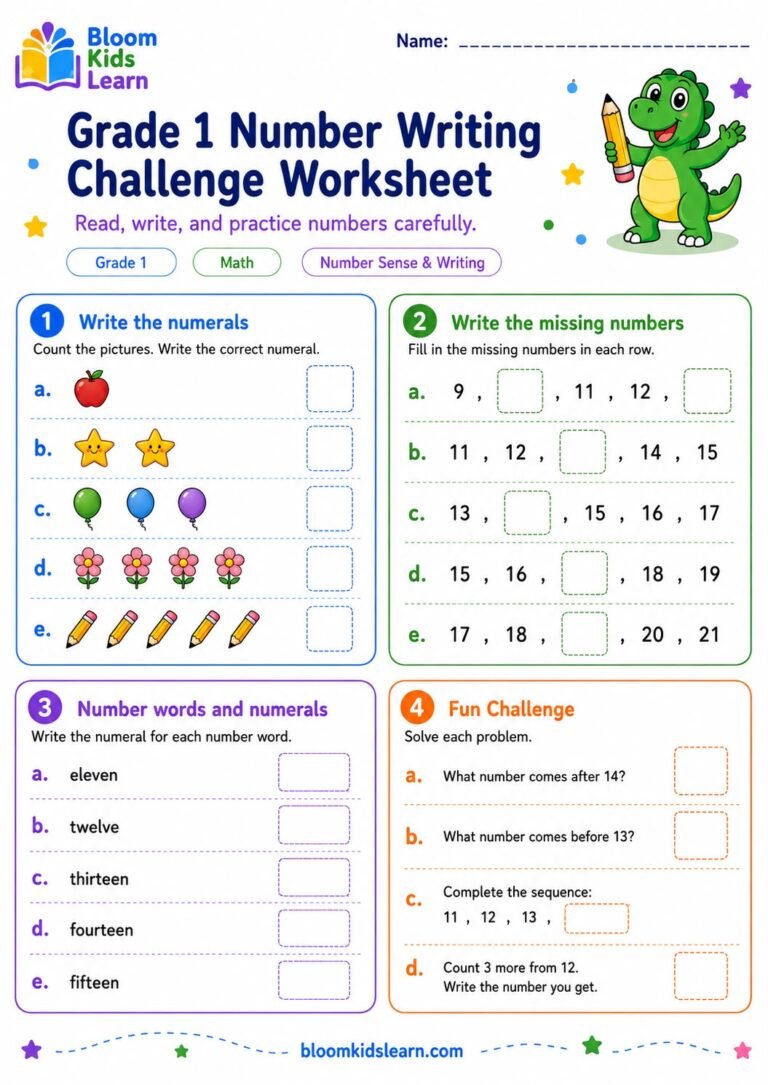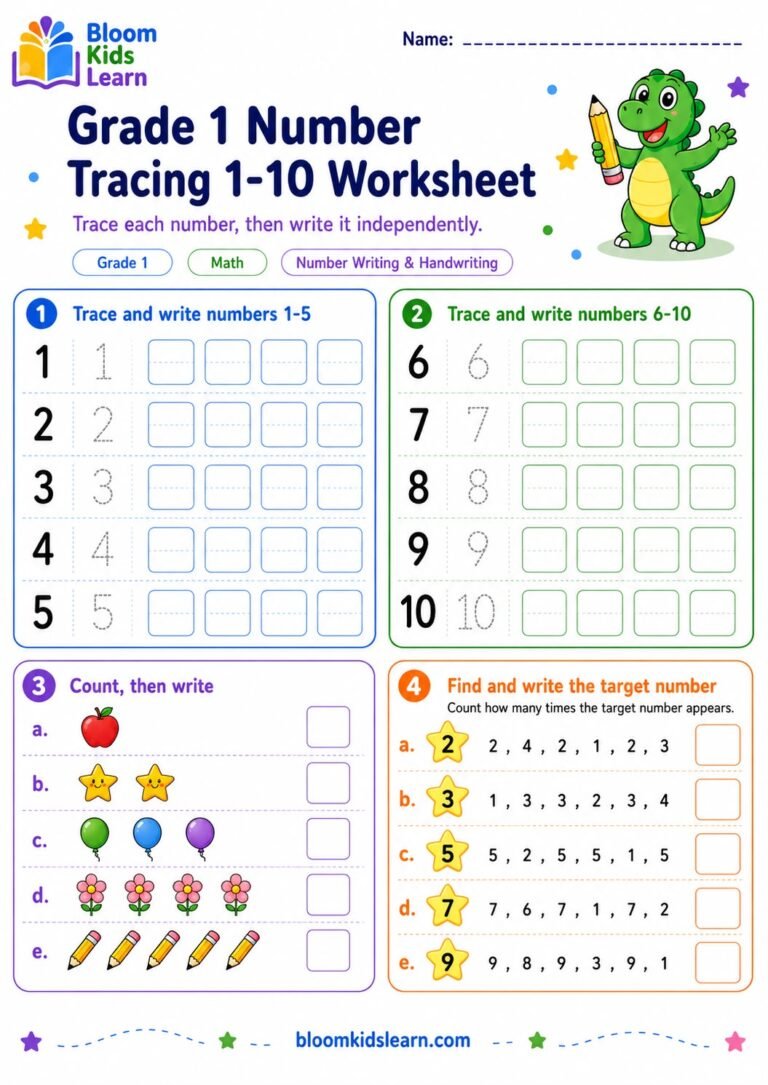

Number Tracing 1–20 Worksheet for Grade 1
Free Grade 1 number tracing 1-20 worksheet for tracing, counting, and missing-number practice.
- Skill: Trace and write numerals 1-20
- Learning goal: Form numerals 1-20 and complete before-and-after sequences.
- Format: Printable PDF worksheet
 Download Worksheet PDF
Numbers 11–20 ask children to do something new: keep two digits in the correct order while they write. This Number Tracing 1–20 Worksheet for Grade 1 is different from a first-ten tracing page because it gives focused practice with teen numerals, repeated digits, spacing, and the move from a single-digit shape to a two-digit number.
Why 11–20 can be harder
In 1–10, one symbol fills the writing box. From 11 onward, the learner must form two symbols and keep them in the right order. The worksheet includes 11, 12, 13, 14, 15, 16, 17, 18, 19, and 20, so children meet repeated digits in 11, a rounded zero in 20, and several pairs that are easily reversed. A child may know the counting sequence but still write 21 for 12 or squeeze the digits together.
What children practise
Each row moves from a clear model to dotted tracing and then to a blank box. Learners trace the first digit, trace the complete teen number, and copy it with less guidance. Encourage them to say the number while their pencil moves. The spoken word, the two-digit symbol, and the written action should stay connected.
Spacing and digit order
Show that 1 and 2 in 12 are separate digits with a small, even gap. The 1 comes first because it names the ten; the 2 names the ones. Compare 12 and 21 with number cards and read both aloud. For 11, make two clear 1s rather than one long mark. For 20, leave room for the 0 and close its oval neatly. A lightly drawn center line can help a child keep both digits on the same baseline.
From tracing to independent writing
Use three passes. First, trace slowly and follow the model’s direction. Second, copy beside the dotted example while looking back only when needed. Third, cover the model and write the number from memory. If a learner can trace 16 but writes 61 independently, the next lesson should emphasize digit order and place language, not more tracing. Ask, “Which digit tells the tens?” and let the child rebuild 16 with a ten and six ones.
Mistakes to notice
- Writing 21 when the prompt is twelve.
- Reversing the order of 15 or 19.
- Making 11 uneven so one digit is much taller.
- Leaving no space between the digits in 18.
- Writing 20 as 02 or forgetting the zero.
Circle the exact part that needs attention and offer one fresh attempt. A short explanation is more helpful than a page full of erasing.
Using the printable
Print on US Letter paper and work in two small sessions if needed. Begin with 11–15, take a brief break, and return to 16–20. A number line and ten-frame are useful supports, but let the child try the dotted rows first. A sheet protector allows repeated trace–copy–write practice with a washable marker.
Next step
After teen numerals are recognizable, move to the Number Handwriting Practice Worksheet for independent formation. Children who can write 11–20 without dots can use the Number Writing Practice Worksheet to count objects and complete sequences, or extend to Writing Numbers 1–50.
This targeted teen-number practice supports early Grade 1 number writing and counting work described in the Common Core State Standards.
Why teen numbers deserve their own practice
Numbers 11–20 ask children to coordinate two digits while still remembering the counting sequence. The repeated digits in 11 can make spacing disappear, and 12, 15, and 19 can be reversed when a child says the number correctly but writes the tens and ones in the wrong order. The final 20 is another useful checkpoint because the ones digit returns to zero.
Work across one row at a time. Have the learner say “twelve,” point to the 1, then point to the 2 before tracing or copying. Leave a small, even gap between the digits; they should look like one number, not two unrelated marks. For 16 and 19, compare the written form with 6 and 9 so the child notices the starting point and the direction of the curve.
A simple teen-number check
Choose three numerals after the tracing is complete: 11, 12, and 20. Ask the child to copy each beside the model, cover the model, and write it again. If the second attempt changes the order of the digits, the next lesson should include counting aloud and building the number with two cards before more pencil practice. If the order is correct but the digits run together, focus on spacing and size rather than adding more sequence work.
Say the teen number as two digits
Before tracing 14 or 19, have the learner point to the first digit and say “one ten,” then point to the ones digit. This keeps the digits in order and makes the space between them intentional. A quick memory check—look, cover, write—shows whether the child can carry the two-digit form into independent writing.

 Preview