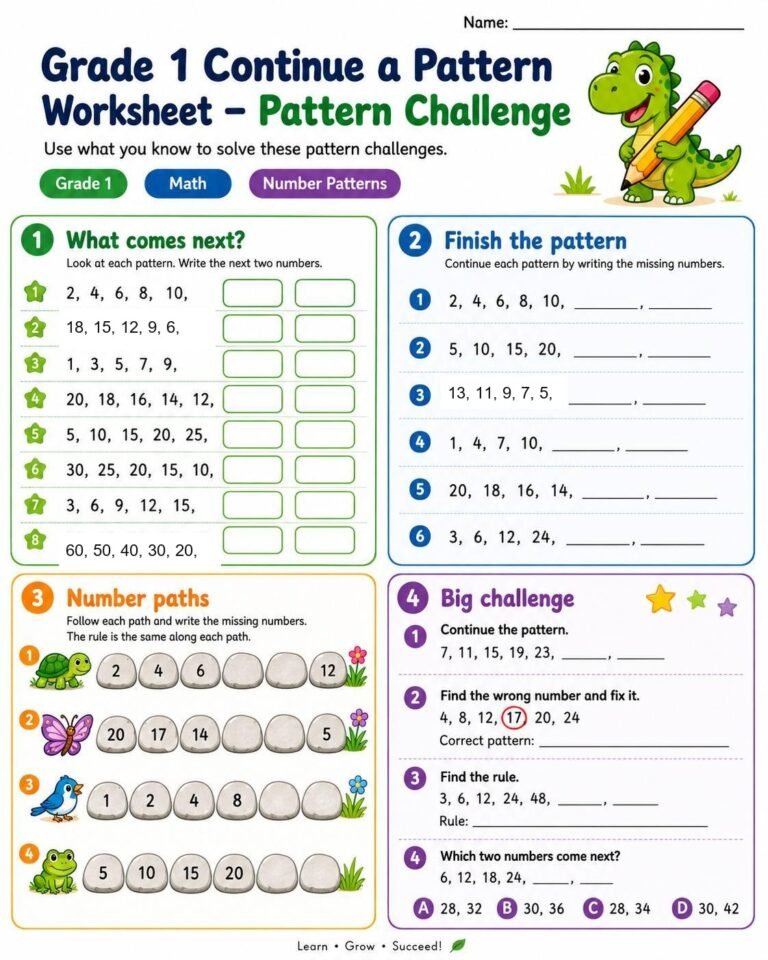

Continue the Number Pattern Worksheet for Grade 1
A printable Grade 1 worksheet for extending increasing, decreasing, and skip-counting number patterns.
- Skill: Extend increasing and decreasing number patterns using a consistent rule.
- Learning goal: Find how a sequence changes and write the next three numbers accurately.
- Format: Printable PDF worksheet
 Download Worksheet PDF
Extending a sequence requires two decisions: first find how the numbers change, then keep that change going without switching rules. This continue the number pattern worksheet gives Grade 1 learners repeated practice with both increasing and decreasing sequences.
The main rows use familiar steps of 1, 2, 3, 5, and 10. Children write three new terms instead of supplying only one answer, which makes it easier to see whether they truly understand the rule.
Find the change before writing
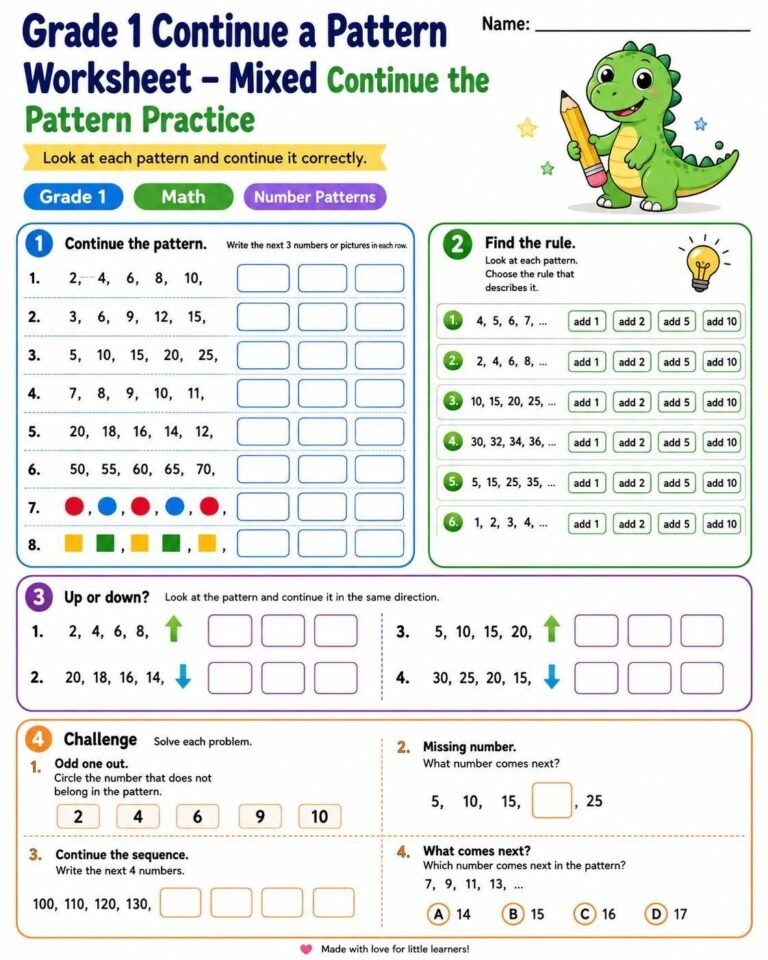
Teach the child to compare the first two terms before reaching for a pencil. In 2, 4, 6, 8, the change is +2. The next three numbers are 10, 12, and 14. In 20, 18, 16, 14, the numbers move down by 2, so the continuation is 12, 10, and 8.
Checking a second pair matters. A guessed rule must work throughout the row. For example, “add 2” explains both 2 to 4 and 4 to 6; it is not based on one convenient step.
Four kinds of practice on the printable
- Continue the pattern: infer the rule and write the next three terms.
- Skip-count patterns: apply a printed add 2, add 5, or add 10 rule.
- Up or down: notice whether the sequence increases or decreases before extending it.
- Challenge: continue less familiar +3, -5, and doubling patterns.
The labeled skip-count rows are useful for learners who need support because the rule is visible. The unlabeled rows require more reasoning and can be used as a quick check after guided practice.
How to use the worksheet without turning it into guessing
Ask the child to write a small rule beside each row, such as +5 or -2. After filling the boxes, have them start with the last printed term and say the completed sequence aloud. This catches changes such as writing 25, 30, 40 after a +5 pattern: the child may know how to begin but lose the step partway through.
If writing three answers feels overwhelming, cover the last two boxes and reveal one at a time. For extension, ask the learner to continue one selected row for three additional terms on scrap paper.
Connect the rows to familiar skip counting
The +2, +5, and +10 rows are not isolated tricks. They are the same sequences children hear when skip counting. Before writing, say one row together and tap once for each term. Then stop speaking just before the blank so the child supplies the next number. For a decreasing row, reverse the spoken count. This oral rehearsal is useful when a learner understands the step but loses their place while writing.
What different errors may mean
A child who continues an increasing row correctly but misses decreasing rows probably needs backward-counting practice. A child who writes the correct first answer and then changes the step may need to point back to the rule before every new term. Reversing digits, such as writing 21 for 12, is a numeral-writing issue rather than a pattern-rule error.
Answer guidance and next step
Examples include 2, 4, 6, 8, 10, 12, 14; 5, 10, 15, 20, 25, 30, 35; and 20, 18, 16, 14, 12, 10, 8. The challenge rows continue with 17, 20, 23; 75, 70, 65; and 96, 192, 384.
Children ready to work with gaps inside a sequence can move to the Missing Number Patterns Worksheet. Browse all six pages in the Number Pattern Worksheets for Grade 1 collection.
 Preview