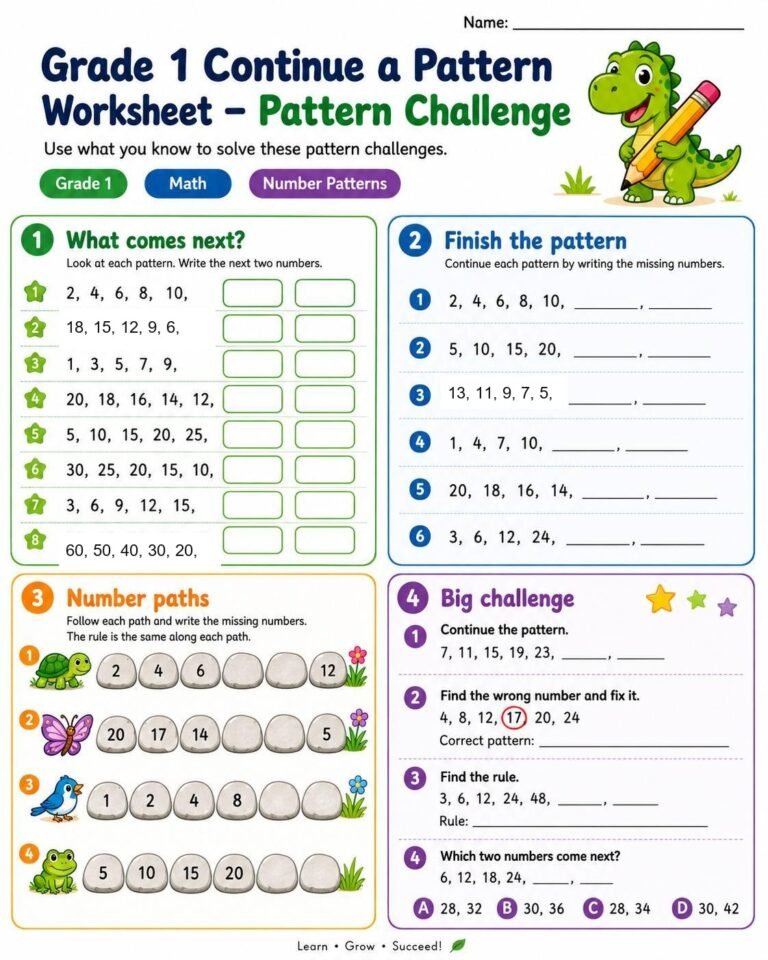

Missing Number Patterns Worksheet for Grade 1
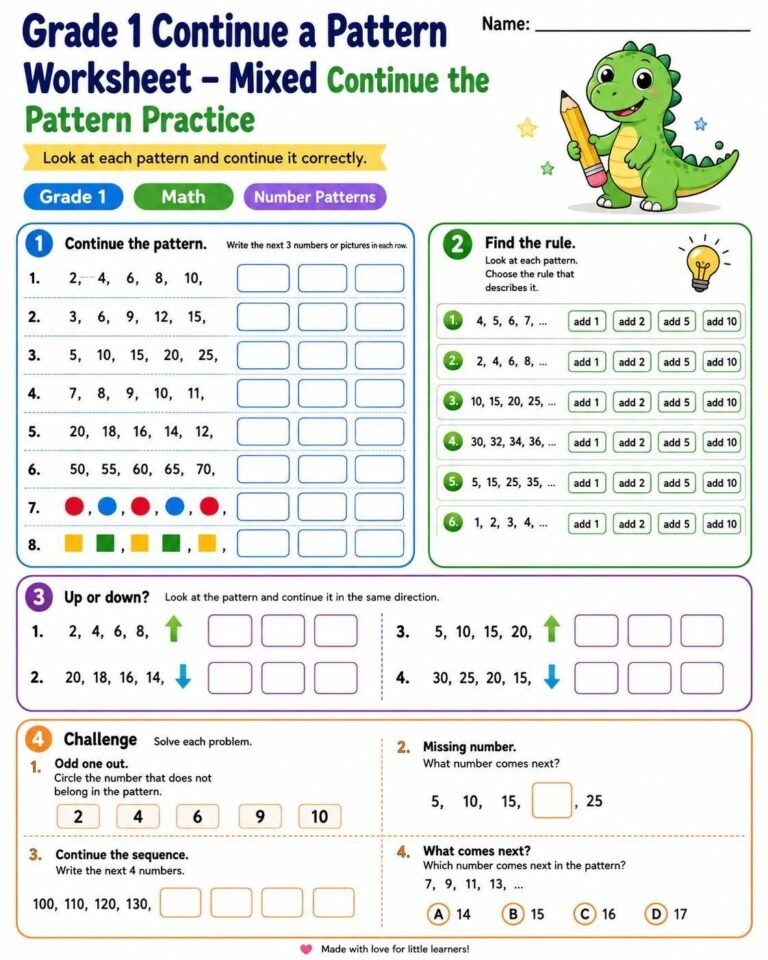
A Grade 1 missing number patterns worksheet with sequence gaps, pattern boxes, before-after questions, and challenge rows.
- Skill: Use surrounding numbers to fill gaps in increasing and decreasing patterns.
- Learning goal: Identify the step in a number pattern and complete missing terms in different positions.
- Format: Printable PDF worksheet
 Download Worksheet PDF
A blank in the middle of a sequence can be harder than a blank at the end. The child must use the numbers on both sides, not simply continue from the final printed term. This missing number patterns worksheet gives Grade 1 learners several ways to practise that reasoning.
The printable includes horizontal sequences, boxed patterns, before-after questions, and longer challenge rows. Most rules use repeated addition or subtraction with steps that children may already know from counting by 2s, 5s, and 10s.
Use both neighbors to solve a missing number
In 2, 4, __, 8, __, 12, the first pair shows a step of +2. Counting on gives 6 for the first blank, and checking from the other side confirms that 6 is 2 less than 8. The same check prevents a common mistake: writing the next number at the end of the row instead of the number that belongs in the blank’s position.
For a decreasing example such as 20, 18, __, 14, __, 10, move backward by 2. The missing values are 16 and 12.
What each section checks
- Fill in the blanks mixes +1, +2, +3, +5, +7, +10 and matching subtraction rules.
- Pattern boxes changes the visual format so children must rely on number relationships.
- Before, after, and between asks for positions inside skip-count patterns rather than ordinary counting by ones.
- Challenge extends longer patterns and includes values that cross 100.
Before, after, and between have a special meaning here
In a pattern, “before” means the previous term in that sequence. In 10, 20, 30, 40, 50, the number before 30 is 20, not 29. Likewise, the pattern number after 30 is 40. Pointing this out helps children separate skip-count language from ordinary before-and-after-by-one questions.
Useful ways to provide support
Let the child draw small jumps above the row or whisper-count between printed terms. If +7 is unfamiliar, they can start at 7 and repeatedly add another 7 with counters or a number line. For confident learners, cover one printed term as well as the original blanks and ask them to restore the whole sequence.
Do not correct every mistake immediately. Ask, “Does your number make the same jump on both sides?” That question directs attention back to the mathematical relationship.
Pattern gaps are not always counting-by-one gaps
Children may have completed many ordinary missing-number rows such as 17, 18, __, 20. On this page, the step can be larger. A blank between 20 and 40 in a +10 pattern is 30, while a blank between 20 and 30 in a +5 pattern is 25. Ask the child to identify the step before filling any box. This prevents a familiar-looking layout from triggering the wrong counting habit.
Answer guidance
The first section answers are 6 and 10; 15 and 25; 7 and 11; 16 and 12; 12 and 18; 40 and 30; 21 and 35; and 80 and 60. In the pattern boxes, the missing values are 6 and 10; 10, 20, and 35; 3 and 5; 16 and 12; and 20 and 50.
If the child solves these gaps accurately, use the Find the Pattern Rule Worksheet to shift from completing patterns to explaining them. All six downloads are organized on the Grade 1 Number Pattern Worksheets page.
 Preview