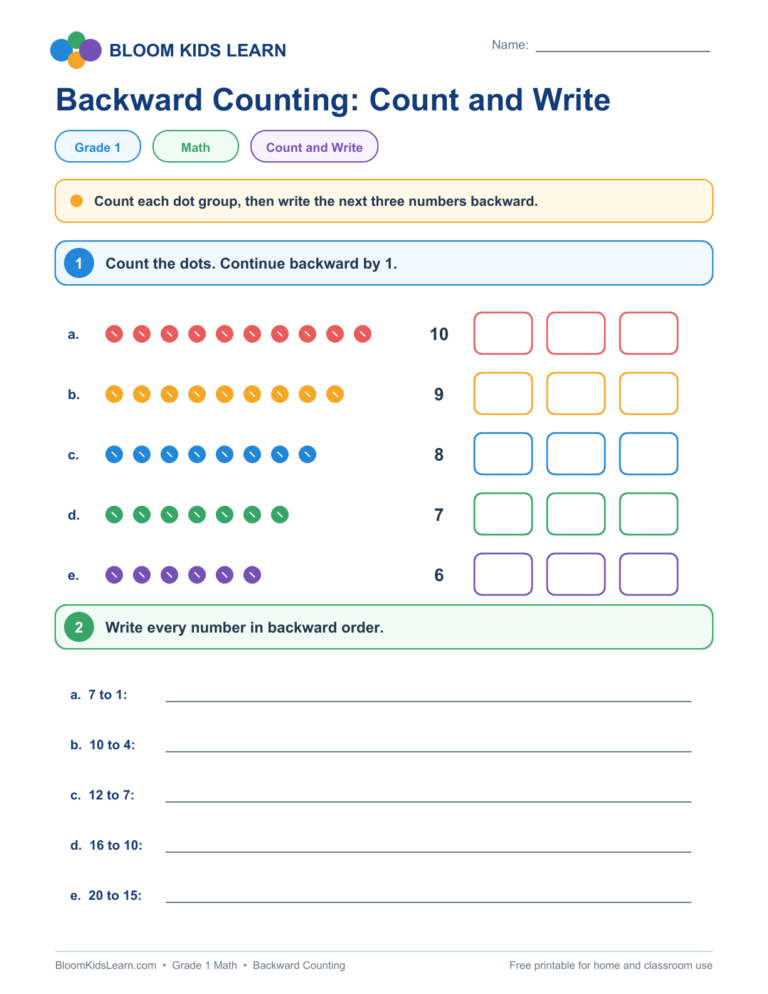
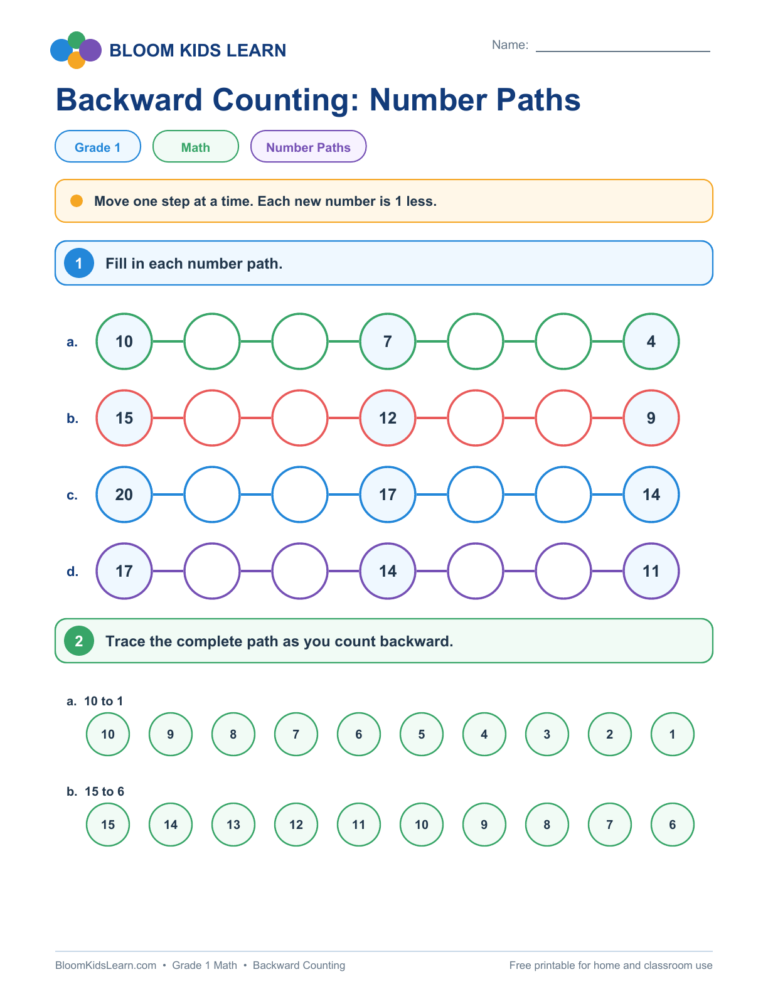
Backward Counting Mixed Practice Worksheet for Grade 1
A varied Grade 1 review with number lines, multiple-choice questions, and missing numbers in descending sequences.
- Skill: Applying backward counting in different formats
- Learning goal: Complete number lines, choose the next number, and solve descending sequences.
- Format: Printable PDF worksheet
 Download Worksheet PDF
When one skill appears in several formats, children must use number sense instead of relying on a familiar page layout. This free Grade 1 backward counting mixed practice worksheet combines number lines, one-less choices, and descending sequences on one clear page. It is designed as a review after students have practiced backward counting in more focused activities.
The variety also makes the page useful as an informal skills check. An adult can see whether a learner understands the one-less relationship across formats or succeeds only when a visual guide is available.
Three ways students show understanding
The first section contains five number lines with alternating blanks. Printed values provide clues as the counts move backward from numbers within 20. In the second section, children circle the number that comes immediately before a given number. The final section removes the number line and asks students to complete short descending sequences.
Every task follows the same mathematical rule: move back one number at a time. However, students must read each direction and decide how to show the answer—writing in a blank, circling a choice, or completing a row.
Skills reviewed on this worksheet
- counting backward by 1 within 20;
- using a number line in the decreasing direction;
- identifying the number immediately before another number;
- selecting one less from several choices;
- completing descending sequences without a visual path; and
- checking whether each answer fits the task format.
The mixed structure also builds flexible attention. Children need to pause when the section changes instead of continuing the previous response pattern.
Begin with a short oral warm-up
Choose three starting numbers, such as 18, 12, and 7. Ask the learner to count backward four numbers from each one. Then ask, “What number comes immediately before 14?” This rehearses both the countdown and the language used in the choice section.
Review that backward movement on a standard number line goes to the left and produces a smaller number. One step left means one less. Keep this visual rule available while introducing the first section.
How to complete the number lines
- Find the starting number and the direction of the line.
- Point to each printed or empty position in order.
- Say one number for every step.
- Write the missing value in the blank.
- Continue until the complete line counts backward smoothly.
- Read the entire line aloud to check it.
Alternating blanks require the child to move between printed clues and written answers. If a student skips a blank, cover the later part of the line and reveal one position at a time.
Worked number-line example
Suppose a line shows 20, __, 18, __, 16. One step back from 20 is 19, so 19 belongs in the first blank. One step back from 18 is 17, so 17 belongs in the second blank. The finished line reads 20, 19, 18, 17, 16.
Use both neighbors to verify an answer. The value 19 is one less than 20 and one more than 18. If it satisfies both relationships, it fits the missing position.
How to solve the one-less choices
Read the given number, then say the number immediately before it. Look at all choices only after deciding the answer. This prevents a child from selecting a number because it looks similar.
For example, the number before 15 is 14. A learner can confirm by counting 15, 14 or by placing a finger on 15 and moving one space left on a number line. Circle only the choice that is exactly one less.
Complete sequences without a number line
The final section asks students to transfer the same idea to ordinary number rows. Begin at the printed starting value and decrease by one in every space. Say the short sequence before writing if handwriting causes the child to lose track.
This section reveals whether the visual line has become a mental strategy. A child who is accurate on the number lines but struggles here may need more practice counting on from varied starting numbers without looking back to 20.
Common mistakes and helpful responses
Some children point right on the number line and begin counting forward. Ask whether the answers should become larger or smaller, then restart from the first printed number. Others circle the number after rather than before; repeat the phrase “one step back, one less.”
A child may treat a printed clue as another blank and overwrite it. Trace the complete line first, identifying which positions already contain answers. If a sequence includes two blanks, solve one space at a time to prevent reversed entries.
Digit reversals can alter values such as 12 and 15. Have the student say the intended number, identify the tens digit, and rewrite it carefully.
Use the page as an informal assessment
Let the learner complete the page independently before correcting it. Group errors by section: number-line movement, before-number choices, or picture-free sequences. The pattern shows what kind of practice should come next.
If errors occur only after the number line is removed, continue visual practice and gradually cover parts of the line. If mistakes occur in every section, return to short hands-on countdowns using counters and the language of one less.
Support and extension options
For support, reveal one section at a time, allow a number line, and ask the child to say each answer before writing or circling. Complete one example together, then reduce prompts.
For an extension, ask the learner to create one problem in each format: a number line with a missing value, a one-less choice question, and a short backward sequence. The student should solve and explain each new problem.
Classroom and home uses
This printable works as morning work, a station activity, homework, small-group review, or a short assessment. In pairs, children can compare answers and explain one correction without simply exchanging completed pages.
How to check the completed page
Read every number line and sequence from left to right. Each value should be one less than the value before it. For the choice section, confirm that the circled answer comes immediately before the given number.
Ask the child to explain one answer from each format. Explanations such as “I moved one space left” or “14 is one less than 15” show that the response is based on number relationships rather than guessing.
Plan the next practice step
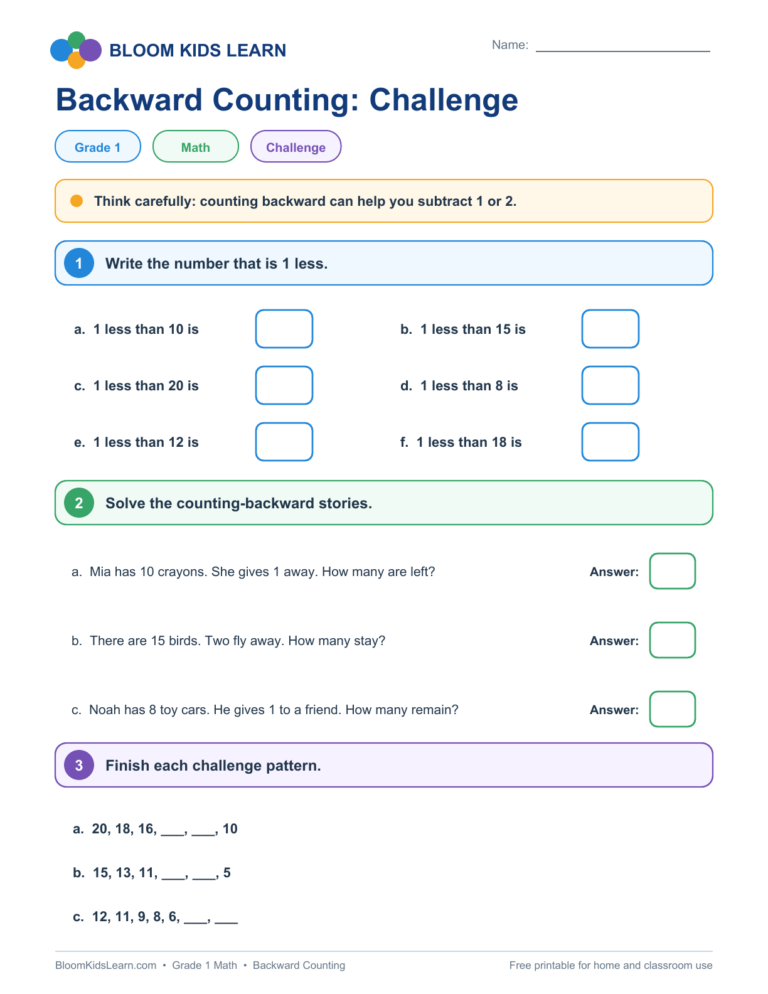
Use the Backward Counting Missing Numbers worksheet for more focused sequence work. If the mixed page is completed accurately and independently, continue with the Backward Counting Challenge worksheet. Browse every level on the Backward Counting worksheets page.
These activities reinforce the number-order work described in the official Grade 1 Common Core counting standard.
Frequently asked questions
Should the visual section be completed first?
Yes. It provides a helpful model before the worksheet removes the number line.
Can a learner use a number line for every section?
Yes at first. Gradually encourage mental counting when the child can explain the one-less rule and answer accurately.
What if only one section is difficult?
Review that specific format with a few short examples. The rest of the page does not need to be repeated immediately.
 Preview