
Counting by 2s Challenge Worksheet for Grade 1
Challenge Grade 1 learners with longer counting-by-2s sequences, count-on prompts, next-number questions, and reasoning problems in this free PDF.
- Skill: Apply counting by 2s to longer sequences and reasoning problems
- Learning goal: Continue counting-by-2s patterns, solve count-on prompts, and explain equal jumps of two.
- Format: Printable PDF worksheet
 Download Worksheet PDF
This free Grade 1 counting by 2s challenge worksheet is designed for children who can already continue a basic skip-counting pattern and are ready to reason more independently. The printable moves from longer sequences to short word prompts, next-number questions, and a final set of problems that require careful reading. It is a useful end-of-topic check for classroom practice, homework, math centers, or homeschool review.
The activity does not rely on a single memorized row. Children count on from 2, 12, 22, 32, and 42, then apply the same add-two rule to starting numbers as high as 92. This range helps show whether a learner understands the pattern or only remembers the beginning of the familiar 2, 4, 6 sequence.
Download the Counting by 2s Challenge PDF
What is included on the worksheet
Section 1 asks children to complete five number rows. Each row provides three starting values followed by four empty boxes. For example, the first row begins 2, 4, 6, and the child continues with 8, 10, 12, and 14. Later rows begin at 12, 22, 32, and 42, so the same rule must be applied from different points.
Section 2 includes four counting-on prompts. A learner starts at a given number and counts a stated number of additional values by twos. Starting at 6 and counting five more numbers leads through 8, 10, 12, 14, and 16. The child records the final value in the answer box.
Section 3 presents five “What comes next?” questions. These sequences extend from 34 through the 90s. The Super Challenge then asks for the number after 58, two missing values in a sequence from 72 to 80, and the number of values said when counting from 14 through 30 by twos.
Skills and learning objectives
- Continue a counting-by-2s pattern from different starting numbers.
- Count a specified number of equal jumps.
- Identify the next value in an increasing sequence.
- Find missing values using clues on both sides.
- Count how many terms appear in an inclusive sequence.
- Explain that each new value is two more than the one before it.
How to introduce the challenge
Begin with one oral example that starts away from 2. Say, “Start at 22 and count by twos.” Ask the child to explain why 24 comes next. A useful response is, “Twenty-four is two more than twenty-two.” This short explanation confirms that the student is using the rule rather than guessing.
For Section 1, have the learner read the three printed numbers before writing. Encourage a quick check after every row: subtract two from a written answer and see whether it returns to the previous number. In Section 2, make the meaning of “count more numbers” clear. The starting number is not one of the additional numbers. A child starting at 18 and counting four more says 20, 22, 24, 26.
Let the student attempt the final section independently. If a mistake appears, ask for a drawing, number line, or spoken sequence before providing the answer. The goal is not speed. The goal is to choose and apply a reliable strategy.
Worked examples
Continuing a longer row
The row 32, 34, 36, __ begins with equal jumps of two. Add two to 36 to get 38, then continue 40, 42, 44. Checking adjacent pairs confirms the same difference throughout the row.
Counting a set number of values
Start at 44 and count three more numbers by twos. The three counted values are 46, 48, and 50, so 50 belongs in the answer box. Writing a small tick for each new number can prevent a child from making too many or too few jumps.
Counting terms from 14 to 30
List the complete sequence: 14, 16, 18, 20, 22, 24, 26, 28, 30. Both the starting and ending values are included, giving nine numbers in all.
Common mistakes and corrections
A learner may count the starting value as the first “more number” in Section 2. Ask the child to place a finger on the starting number and move only when saying the first new value. Another common mistake is making the correct jumps but stopping one step early. Simple tally marks can keep track of how many additional numbers have been counted.
In the Super Challenge, a child may answer eight instead of nine when counting from 14 to 30. Eight is the number of jumps, while nine is the number of values in the written sequence. Drawing nine dots connected by eight arrows makes the distinction visible.
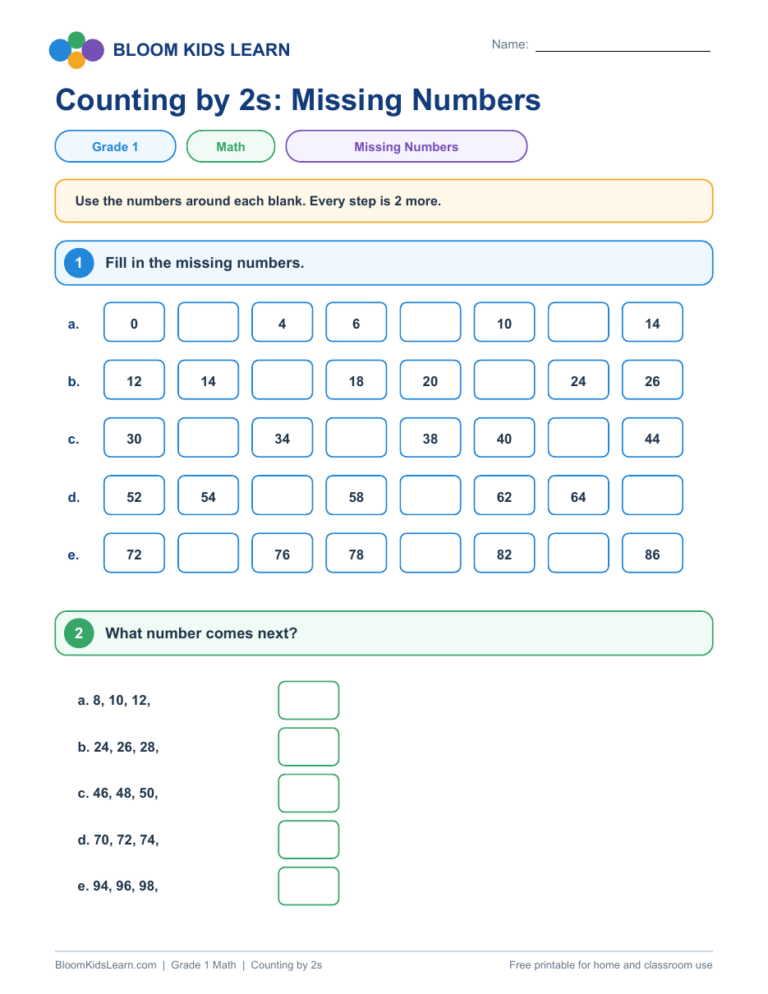
If a student switches to counting by 1 near a blank, return to the neighboring printed values. The difference between 72 and 76 is four, so one number reached by a jump of two, 74, must fit between them.
Answer guidance
Section 1 completed rows end with: 8, 10, 12, 14; 18, 20, 22, 24; 28, 30, 32, 34; 38, 40, 42, 44; and 48, 50, 52, 54. Section 2 final values are 16, 26, 42, and 50. Section 3 answers are 40, 54, 68, 82, and 94. The Super Challenge answers are 60; 74 and 78; and 9 numbers.
Accept a correctly drawn number line, tally strategy, or spoken explanation as useful evidence of understanding. If only one answer is wrong, discuss that strategy before assigning extra practice. A repaired error can reveal more learning than a page copied from an answer key.
Differentiation and extension
For support, complete one row at a time and provide a 1-100 chart. The learner may highlight every second number or use counters grouped in pairs. Cover the Super Challenge until the first three sections are accurate, then return to it in a later session.
For an extension, begin at an odd number such as 15 and ask for six more values. Children can also write their own “count more numbers” problem and solve it using both a sequence and an addition equation. Another useful challenge is to count backward by 2 from one of the final answers.
Related worksheets
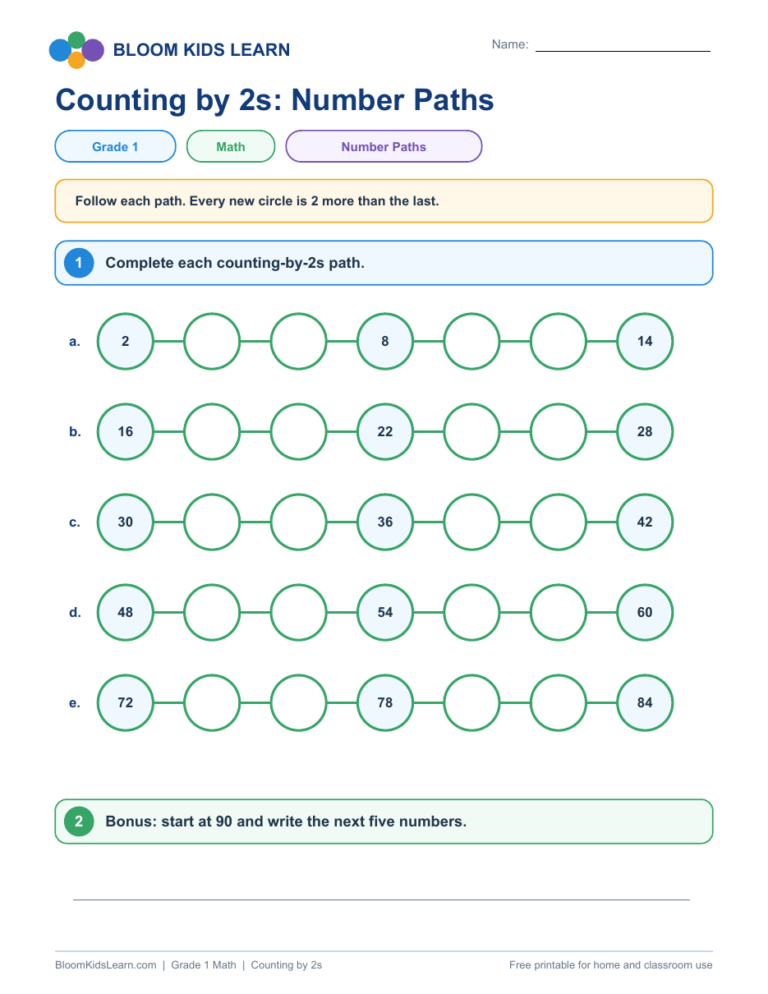
Use the Basic Practice worksheet when a learner needs clearer starting clues. The Number Paths worksheet supports children who benefit from a visual route, and the Count and Write worksheet connects written sequences with counting objects in pairs. Browse the complete Counting by 2s worksheet collection for the full progression.
Frequently asked questions
When should children use this page?
Use it after the learner can accurately continue shorter counting-by-2s sequences. It works well as an end-of-topic review rather than a first lesson.
Can a child use a number chart?
Yes. A chart is a helpful reasoning tool. Gradually remove it after the child can explain and apply the add-two rule independently.
Should the worksheet be timed?
No. Accuracy and clear reasoning matter more than speed. A relaxed 10- to 15-minute session is usually enough for focused practice.

 Preview