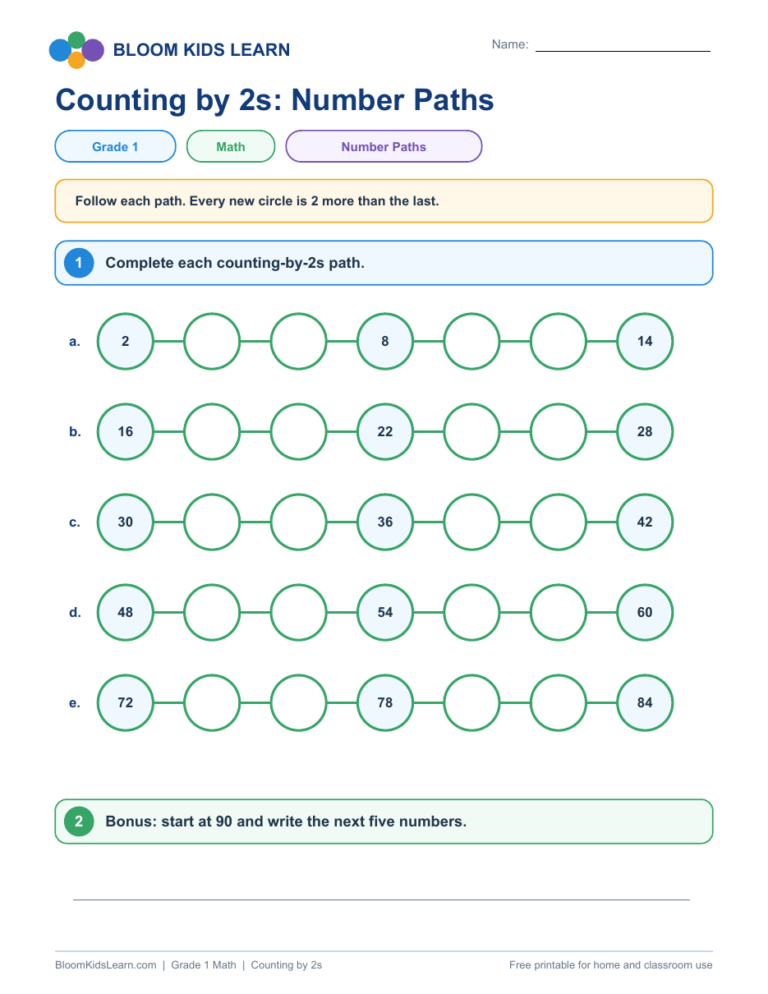

Counting by 2s Basic Practice Worksheet for Grade 1
Free Grade 1 counting by 2s practice with number sequences from varied starting points. Includes a clean printable PDF and practical teaching guidance.
- Skill: Counting forward by 2 from different starting numbers
- Learning goal: Continue skip-counting sequences by adding 2 each time.
- Format: Printable PDF worksheet
 Download Worksheet PDF
This free Counting by 2s Basic Practice worksheet gives first graders a clear introduction to skip counting. Instead of beginning every row at zero, the printable uses several starting numbers so children learn the rule behind the pattern: each new number is exactly 2 more than the number before it. The uncluttered layout provides enough clues to begin confidently and enough empty boxes for meaningful independent practice.
What children practice on this worksheet
The first section contains five number sequences. Each row shows three consecutive values in a count-by-2 pattern, followed by five empty boxes. Students read the given numbers, identify the repeated jump, and continue the sequence. The second section asks them to start at 6, 18, 34, and 52 and write the next five numbers. These varied starting points prevent the activity from becoming a memorized chant that only works from 2.
- Adding 2 mentally to find the next number
- Reading and writing even numbers in order
- Continuing a pattern from a number other than zero
- Maintaining the rule across a longer sequence
How to teach counting by 2s before using the page
Place a small collection of counters, crayons, or blocks on a table and arrange the objects in pairs. Touch one pair while saying “2,” touch the next pair while saying “4,” and continue. Then write the matching numbers underneath the pairs. Ask what changes from one number to the next. When the child can explain that two objects are added each time, connect the same idea to the worksheet boxes.
A number line can provide additional support. Begin on the first printed number, move two spaces to the right, and say the landing number. Repeat the move several times. The child should notice that exactly one number is passed over during every jump. Remove the number line when the learner can make the jumps mentally.
Directions for the printable
Read each row from left to right. Say the three printed numbers aloud, then write the next number in the first empty box. Check that it is 2 more than the previous value before continuing. In section two, the starting number is given in the direction. The first answer should be 2 more than that starting number, not the starting number itself.
Model only one example so the remaining rows still show what the child can do independently. If an answer is incorrect, avoid erasing it immediately. Ask the learner to compare the answer with the number before it and count on two. This short conversation reveals whether the difficulty comes from addition, numeral writing, or losing track of the pattern.
Worked example
Suppose a row begins 10, 12, 14. Start at 14 and add 2. One more is 15, and two more is 16, so 16 belongs in the next box. Add 2 again to get 18. The completed beginning becomes 10, 12, 14, 16, 18. The same reasoning works when a row starts at a larger number such as 40, 42, 44.
Common mistakes and helpful corrections
A child may add 1 and write 15 after 14. Point to the instruction “count by 2s” and use two fingers to count 15, 16. Another learner may repeat a number or switch to counting by 1s near the end of a row. Have the child place a small dot above every written answer while rereading the sequence. If crossing a decade causes trouble, briefly write the hidden number between the two answers: 18, 19, 20.
Differentiate the activity
For extra support, complete one row with counters and keep a hundred chart nearby. Cover later boxes so the child sees only one decision at a time. For on-level practice, ask the learner to complete the page without a chart and explain one row aloud. For an extension, continue each sequence for five more numbers on the back, start at an odd number, or count backward by 2 from the final answer.
Ways to use this worksheet
Teachers can use the printable for morning work, a small-group lesson, a math center, intervention, homework, or a short exit check. Families can place it in a reusable sleeve and practice with a dry-erase marker. A ten-minute session is usually enough. Stop before accuracy drops, and return another day rather than turning skip counting into a tiring task.
Answer guidance
Check each answer by subtracting the previous number. The difference should always be 2. Rows that begin with an even number should continue with even numbers. In section two, the five answers after 6 are 8, 10, 12, 14, and 16. Use the same add-two rule for the other starting values. Encourage the child to repair an error independently after locating the first place where the pattern changes.
Continue learning
Review the prerequisite Counting by 1s worksheets if adding two is not yet secure. Browse the complete Counting by 2s collection, then continue with the Counting by 2s Missing Numbers worksheet when it is published. The official Grade 1 counting standard provides useful context for counting from different starting numbers.
Frequently asked questions
Should students say the skipped numbers?
They may say them quietly at first, but the goal is to recognize the two-step jump without needing every number.
Can children start at an odd number?
Yes. Starting at 1 gives 1, 3, 5, 7, and 9. This worksheet begins with even numbers because pairs make that pattern easier to visualize.
Does the worksheet include an answer key?
A separate answer-key PDF is not required because every sequence can be checked by confirming that each new value is 2 more than the last.

 Preview