
Counting by 2s Worksheet: Number Paths for Grade 1
Follow connected circles and practice adding 2 with a free Grade 1 counting by 2s number paths worksheet, including a bonus that reaches 100.
- Skill: Follow number paths by adding 2 within 100
- Learning goal: Complete connected number paths by counting forward in jumps of 2.
- Format: Printable PDF worksheet
 Download Worksheet PDF
This free Grade 1 counting by 2s number paths worksheet turns skip-counting practice into a visual journey. Instead of reading a plain row of numerals, children follow connected circles and fill the empty stops along each path. The page contains five paths that increase by 2, followed by a short bonus that begins at 90. The changing starting numbers help students focus on the rule—add 2—rather than relying only on a memorized chant that begins at 2.
Download the printable PDF: Grade 1 Counting by 2s Number Paths Worksheet
What is on the worksheet?
Each path has seven connected circles. Some circles contain clues and the remaining circles are blank. Students begin with the first printed number, move along the line, and add 2 at every stop. The five paths begin at 2, 16, 30, 48, and 72, so practice extends from familiar early facts into larger two-digit numbers. The final prompt asks children to start at 90 and write the next five numbers, which provides useful practice crossing from the nineties to 100.
- Count forward by 2 within 100.
- Continue a pattern from several starting numbers.
- Use visual position to keep a sequence in order.
- Check missing values with clues on both sides.
- Move accurately across a decade boundary.
Why number paths help first graders
A connected path makes each jump visible. One circle represents one new number in the sequence, while each line shows that the next answer is related to the previous one. This layout can be especially helpful for children who lose their place in a long number row. They can point to one circle at a time, say the next number, and write it before moving forward.
The paths also show that counting by 2s does not need to begin at zero. For example, a child who starts at 16 can reason “18 is 2 more, then 20 is 2 more.” That flexible thinking is more valuable than reciting one fixed list because it supports mental addition, number relationships, and later work with equal jumps on a number line.
How to model the first path
Point to the first circle and read the number 2. Trace the connecting line with a finger and ask, “What is 2 more than 2?” Write 4 in the next circle. Continue to 6, then pause at the printed 8. Explain that 8 confirms the first two answers because each step still increases by 2. Complete one more circle together and then invite the child to finish the path independently.
If the child is unsure, draw two small dots beside the current number or let them make a two-space jump on a number line. Keep the language consistent: “Start here, add 2, and land here.” Gradually remove the number line once the learner can make the jump mentally.
A short teaching routine
- Warm up with movement. Take two steps while saying 2, two more while saying 4, and continue to 20.
- Trace before writing. Let the child follow the first path with a finger and say the full sequence aloud.
- Complete one path at a time. Cover the lower paths if a full page feels distracting.
- Check each route. Read the completed circles from left to right and confirm that every move adds exactly 2.
- Finish with the bonus. Discuss what happens when the sequence moves from 98 to 100.
The worksheet fits a brief math lesson, independent center, homework activity, intervention session, or home review. Ten focused minutes is usually enough. Accuracy and explanation matter more than speed, so allow a child to point, whisper-count, or use counters while the pattern is developing.
Common mistakes and how to respond
Some children add 1 when moving to the next circle because the circles appear beside one another. Remind them that the line means “one step on this path,” but the number rule is “2 more.” Ask the child to show the jump with two fingers or two counters before writing again.
A learner may also restart the familiar 2, 4, 6 pattern when a path begins at 16 or 48. Circle the actual starting number and say, “We keep the add-2 rule, but we begin here today.” If a child writes 49 after 48, let them count 48, 49, 50 by ones and identify the number two counts after 48. When crossing to 100, build 98 with a hundred chart or base-ten blocks and show that 2 more completes the next hundred.
Support and extension ideas
For extra support, provide a hundred chart and let the child lightly mark each landing number before transferring it to the worksheet. Another option is to fill the first blank on every path together. Children who need help with handwriting can say the answers while an adult records one path, then write the next path themselves.
For an extension, ask the student to draw a new five-circle path starting at an odd number such as 7. The completed sequence will remain odd because adding 2 preserves the odd pattern. A confident learner can reverse one finished path and count backward by 2, or cover a printed clue and reconstruct it using the surrounding numbers.
Answer guidance
The completed paths are 2, 4, 6, 8, 10, 12, 14; 16, 18, 20, 22, 24, 26, 28; 30, 32, 34, 36, 38, 40, 42; 48, 50, 52, 54, 56, 58, 60; and 72, 74, 76, 78, 80, 82, 84. For the bonus, the next five numbers after 90 are 92, 94, 96, 98, and 100.
When checking, avoid marking only the final answer. Find the first place where the pattern changes incorrectly, return to the previous correct circle, and add 2 again. This helps the child repair the reasoning that caused later answers to shift.
Learning context
Counting by 2s is useful preparation for equal groups, repeated addition, and multiplication in later grades. For Grade 1, the immediate goal is to notice a consistent numerical relationship and continue it accurately. The task also supports broader work with counting sequences and understanding that a number can be reached through predictable jumps.
Related worksheets
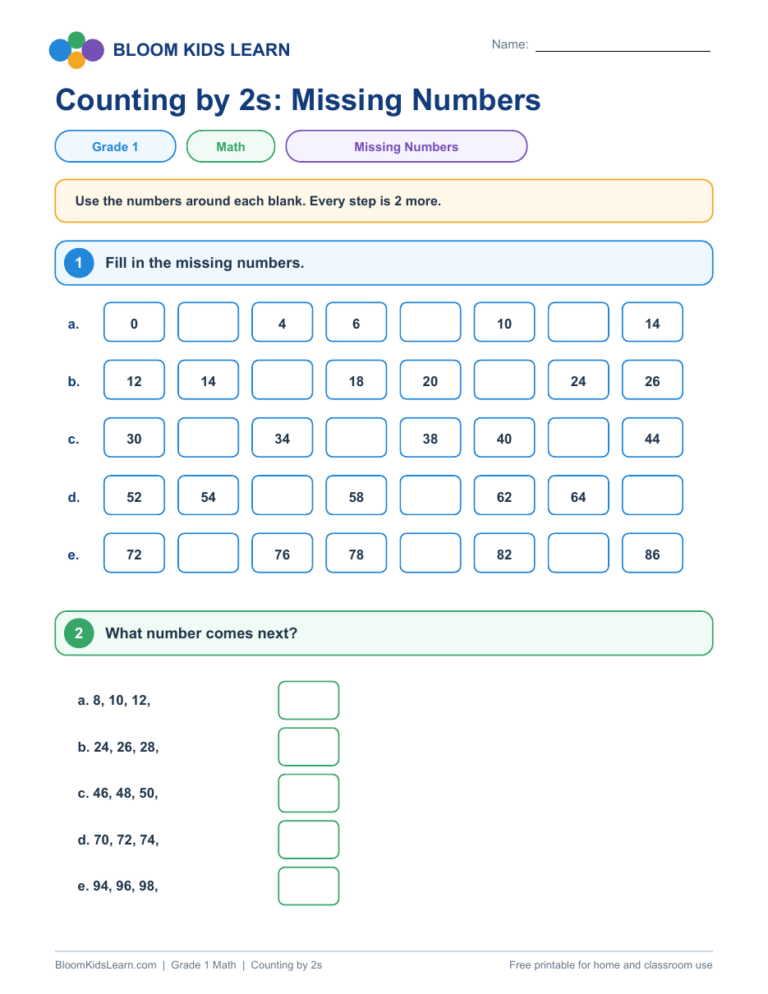
Children who are new to the skill can begin with the Counting by 2s Basic Practice Worksheet. For more work using surrounding clues, try the Counting by 2s Missing Numbers Worksheet. Browse the full Counting by 2s worksheet collection, or review the Counting by 1s worksheets when consecutive counting still needs practice.
Frequently asked questions
Should children use a number line?
Yes, when it helps them make accurate jumps. The number line is a learning tool, not a shortcut. Remove it gradually as the child begins adding 2 mentally.
Why do the paths start at different numbers?
Different starts show whether a learner understands the rule. A child who can continue from 48 or 72 is using “add 2” flexibly instead of recalling only one memorized sequence.
Is there a separate answer key?
No separate file is needed. All completed sequences and the bonus answers are provided in the answer guidance above for quick checking.

 Preview